
Essential Healthcare Workforce Planning Terms for Hospital HR Leaders
When HR, nursing, finance, and operations teams share the same workforce planning language, they make faster, better decisions together. This glossary defines essential healthcare workforce planning terms in plain English, with practical hospital examples and related concepts, so leaders can align more quickly and act with confidence.
Strategic Workforce Planning Fundamentals
Strategic workforce planning aligns workforce capacity and capabilities with long-term organizational and patient care goals. The need to plan ahead keeps growing. Cleveland Clinic's ConsultQD reports that WHO projected a global health worker gap of 14.5 million by 2030, and that U.S. News and World Report identified healthcare roles as a major share of the most in-demand jobs.
The terms below form the foundation every hospital planning team needs.
- Agile workforce planning A flexible staffing approach that allows leaders to adjust quickly when patient demand, seasonal patterns, or emergency conditions change. Related terms: Scenario planning, contingency planning, flexible staffing
- Scenario planning Testing workforce plans against multiple plausible futures, such as a demand surge, new service-line launch, or retirement wave, to spot risks before they become operational problems. Related terms: Agile workforce planning, supply/demand analysis, predictive modeling
- Strategic workforce planning The process of aligning workforce capacity, capabilities, and composition with long-term organizational goals through analysis, forecasting, and action planning. Related terms: Workforce model, supply/demand analysis, workforce segmentation
- Supply/demand analysis Comparing available internal and external talent against projected staffing requirements to identify workforce gaps, surpluses, and timing risks. Related terms: Demand-based planning, needs-based planning, talent pipeline
- Workforce model A structured framework for estimating the staffing mix, volume, and configuration needed to deliver care under anticipated demand conditions. Related terms: WISN, caregiver mix, FTE
Supply and Demand Analysis
Effective workforce planning requires examining both internal recruiting capacity and the external talent market. Clear supply-and-demand language helps leaders understand where shortages may emerge, which roles are hardest to fill, and when pipeline investments are needed.
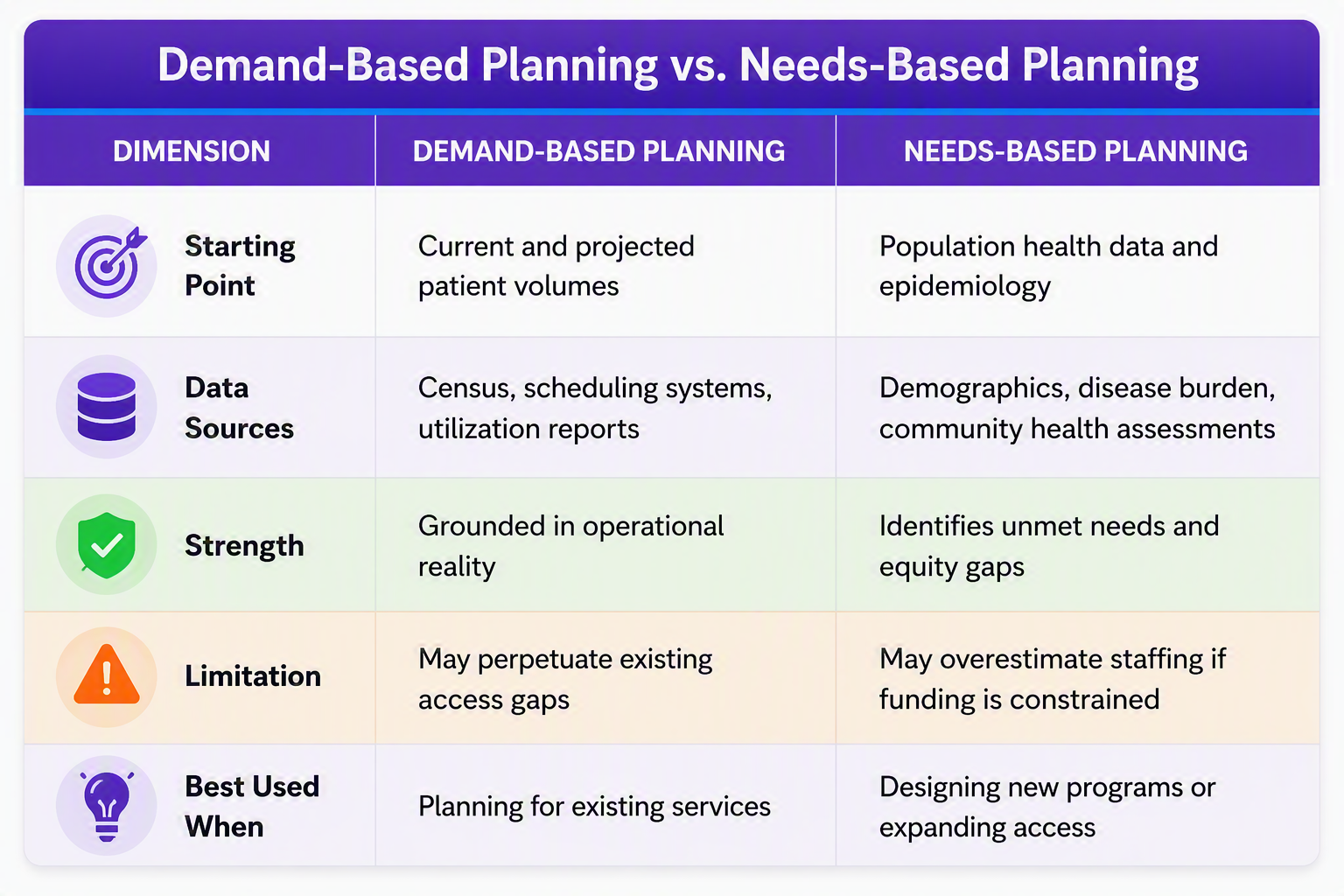
- Demand-based planning: Forecasting staffing needs from current and projected patient volumes, service utilization patterns, and scheduled procedures. Related terms: Needs-based planning, supply/demand analysis, workforce model
- Health Professional Shortage Area (HPSA): A federally designated geographic area, population group, or facility determined to lack sufficient primary care, dental, or mental health providers to serve its community. A rural critical-access hospital in an HPSA qualifies for loan repayment programs that help it recruit family medicine physicians who might otherwise choose urban practice settings. Related terms: Talent pipeline, supply/demand analysis
- Needs-based planning: Determining ideal workforce levels from population health requirements, including demographics, epidemiology, and disease burden, rather than current utilization alone. Related terms: Demand-based planning, stock-and-flow analysis, WISN
- Stock-and-flow analysis: A modeling method that tracks the current workforce and expected inflows and outflows, such as new graduates, retirements, migration, and departures. Related terms: Supply/demand analysis, talent pipeline, attrition
- Talent pipeline Upstream sourcing relationships, such as schools, training programs, residency partnerships, and recruitment channels, that support future hiring needs. Related terms: Recruitment funnel, supply/demand analysis, HPSA
The table below clarifies the distinction between the two primary planning approaches:
Workforce Models and Structures
How hospitals organize, classify, and count their people forms the structural backbone of every staffing report and budget. Strong workforce structures help leaders compare roles consistently, understand labor capacity, and match the right mix of people with changing patient needs.
- Caregiver mix (workforce mix): The composition of permanent, per-diem, traveler, agency, and other staff within a unit or facility. Related terms: Skill mix, float pool, PRN, agency/traveler labor
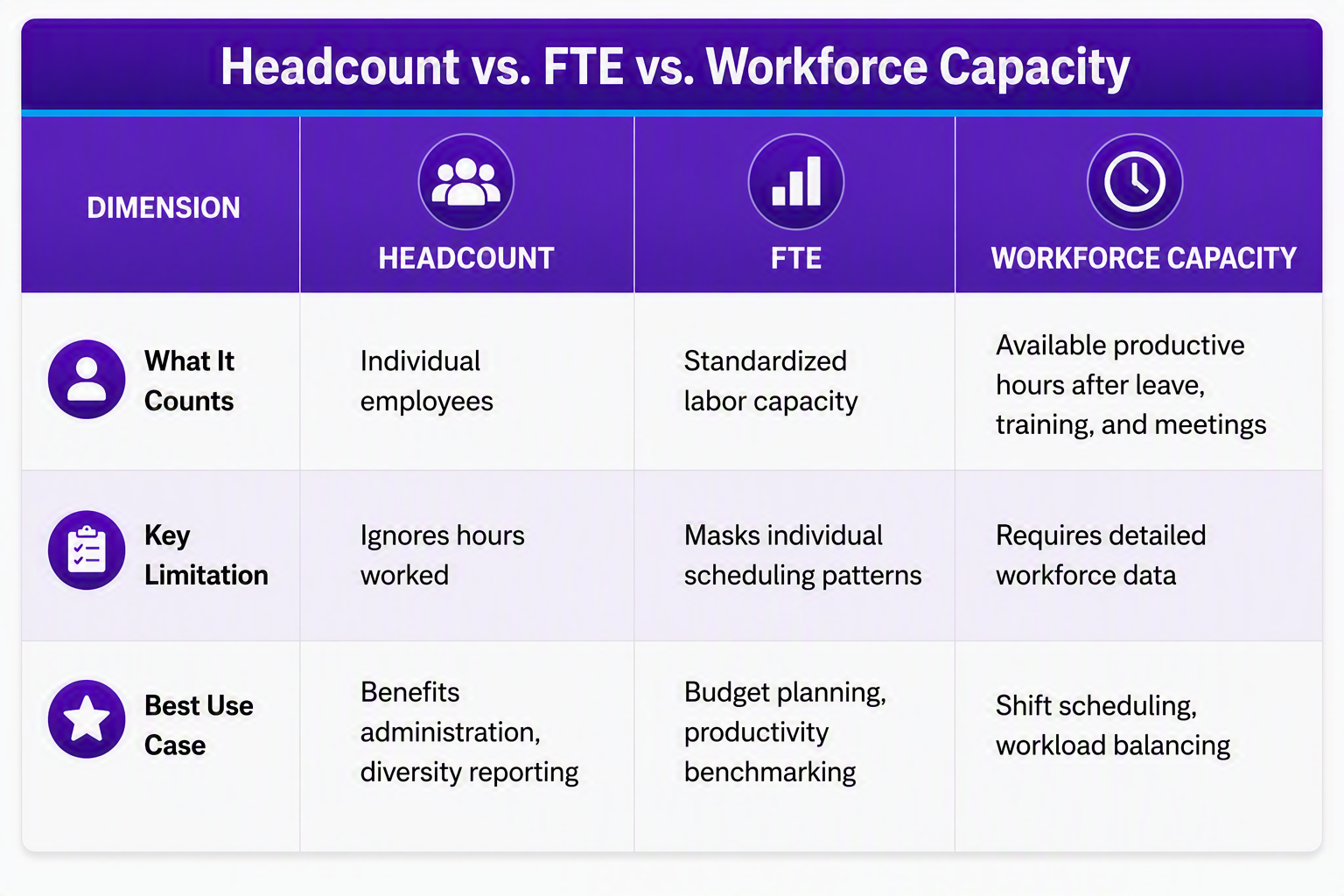
- Full-time equivalent (FTE): A standardized unit for measuring labor capacity. In many U.S. workforce calculations, 1.0 FTE is commonly based on 40 hours per week or 2,080 hours per year. Related terms: Headcount, workforce model, vacancy rate
- Headcount: The count of individual employees in a role, department, or unit, regardless of whether they work full-time or part-time hours. Related terms: FTE, workforce segmentation
- WISN (Workload Indicators of Staffing Need): A WHO methodology that estimates staffing requirements based on workload and activity time standards for each workforce category. Related terms: Workforce model, demand-based planning, skill mix
- Workforce segmentation: Grouping staff by role criticality, skill rarity, risk of departure, or strategic importance to prioritize planning and workforce investments. Related terms: Skill mix, succession planning, workforce model
The following table clarifies three commonly conflated workforce measures:
Key Staffing Metrics and Definitions
These KPIs belong on every workforce planning dashboard because they connect staffing activity to hiring speed, retention, coverage, and cost. Tracking them consistently helps leaders identify problems earlier and adjust plans before gaps widen.
- 90-day retention: The percentage of new hires still employed after their first 90 days, often used as an early signal of onboarding effectiveness and job fit. Related terms: Onboarding, retention rate, time-to-productivity
- Nurse-to-patient ratio: The number of patients assigned to each nurse during a shift, reflecting staffing intensity and, in some states, regulatory requirements. Related terms: Skill mix, scheduling adherence, demand-based planning
- Recruitment funnel: The stages from sourcing and screening through interviewing, offering, and hiring, with conversion measured at each step. Related terms: Time-to-fill, time-to-hire, talent pipeline
- Retention rate: The percentage of employees who remain with an organization over a defined period, typically calculated as the inverse of turnover. Related terms: Turnover rate, attrition, replacement cost
- Scheduling adherence: The degree to which actual worked schedules match the planned staffing template. Related terms: Flexible staffing, overtime rate, float pool
- Time-to-fill: The number of calendar days from when a position is posted to when an offer is accepted. Related terms: Time-to-hire, vacancy rate, recruitment funnel
- Time-to-hire: The number of calendar days from first applicant contact to the new hire's start date. Related terms: Time-to-fill, credentialing, onboarding
- Time-to-productivity: The time from a new hire's start date until they reach expected independent performance levels. Related terms: Onboarding, competency assessment, 90-day retention
- Turnover rate: The percentage of staff who leave, voluntarily or involuntarily, over a defined period. Related terms: Attrition, retention rate, replacement cost
- Vacancy rate: The number of unfilled budgeted positions expressed as a percentage of total budgeted positions. Related terms: Time-to-fill, supply/demand analysis, headcount
Contingent and Flexible Staffing Concepts
This section covers commonly searched terms, including float pool and PRN, and how they relate to agency labor and flexible staffing. These categories give hospitals surge capacity and workforce flexibility, and the distinctions between them are often confused in practice.
- Agency/traveler labor: External temporary staff sourced through staffing agencies, often used to fill critical vacancies, cover surges, or support hard-to-staff roles when internal resources fall short. Related terms: Float pool, PRN, premium pay, caregiver mix
- Bench staffing (back-up roster): A pre-identified group of credentialed providers or staff available for rapid deployment during unexpected volume spikes, emergency events, or staff absences. Related terms: Contingency planning, float pool, credentialing
- Contingency planning: Short-term strategies for managing sudden surges, mass absences, or emergency events through predefined staffing protocols, trigger points, and escalation paths. Related terms: Agile workforce planning, scenario planning, bench staffing
- Flexible staffing: Workforce models, such as variable-hour roles, weekend programs, cross-trained coverage, and flexible pools, designed to match staffing levels to changing patient demand. Related terms: Float pool, PRN, overtime rate
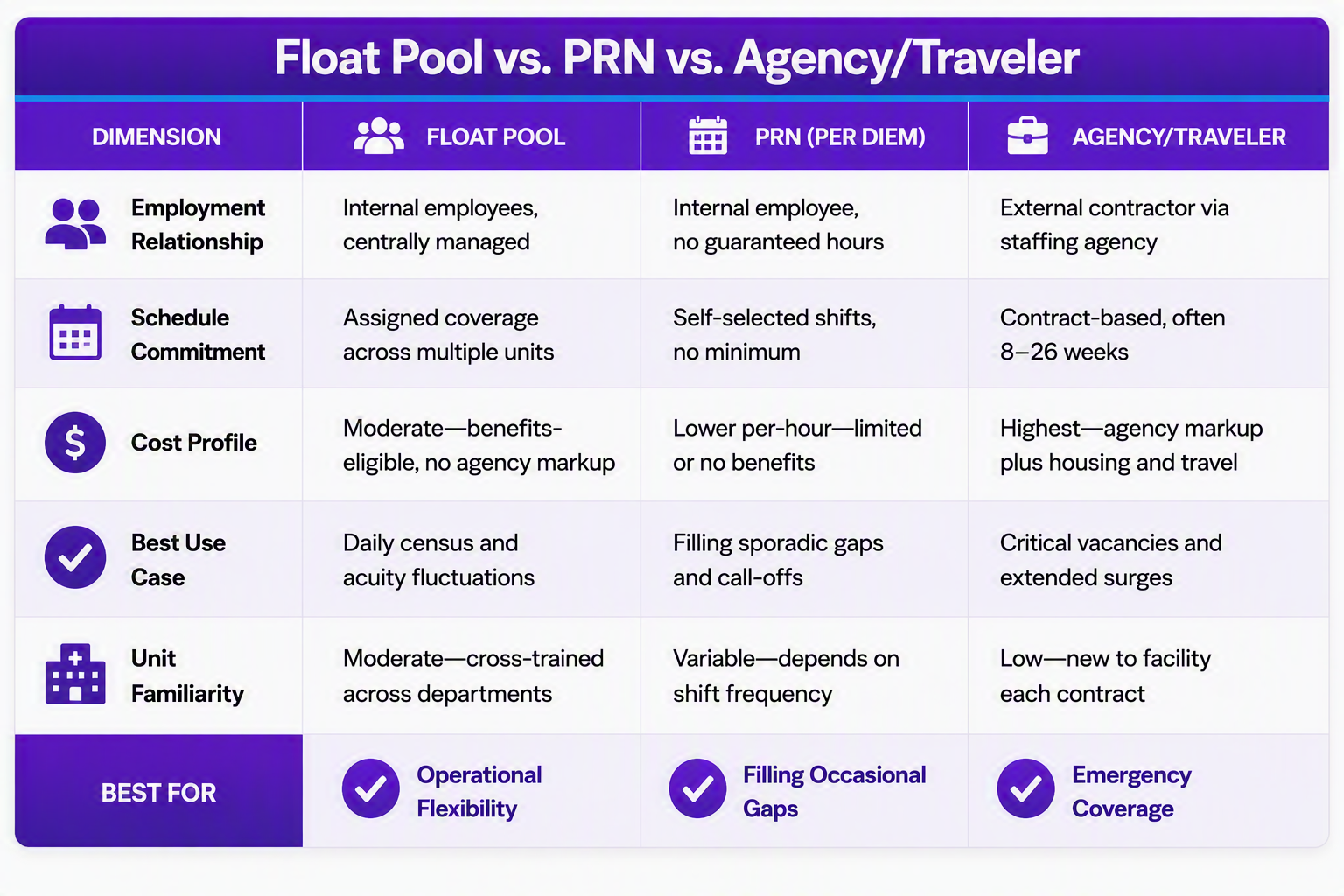
- Float pool: A centrally managed group of cross-trained clinical staff who are not assigned to a single unit and can be redeployed as census and acuity shift. Related terms: Caregiver mix, flexible staffing, skill mix, PRN
- Per-diem staff (PRN): On-call or as-needed workers who pick up shifts without a guaranteed schedule. PRN comes from the Latin pro re nata, meaning "as needed" or "as the situation demands." Related terms: Float pool, contingency planning, flexible staffing, agency/traveler labor
The following table clarifies the distinctions among the three most commonly confused contingent staffing categories:
Financial and Operational Workforce Metrics
Staffing decisions are financial decisions. Workforce planning often calls for upfront investment before returns appear, but reducing turnover, overtime, and premium labor can produce meaningful budget impact over time.
- Labor cost per case Total labor expense divided by patient cases or encounters, used to normalize staffing cost to clinical activity volume. Related terms: Premium pay, overtime rate, FTE
- Overtime rate The proportion of total hours paid at overtime rates, signaling coverage pressure, schedule gaps, or chronic understaffing. Related terms: Premium pay, flexible staffing, labor cost per case
- Premium pay Additional compensation beyond base wages for nights, weekends, holidays, overtime shifts, or hard-to-fill assignments. Related terms: Overtime rate, agency/traveler labor, labor cost per case
- Replacement cost The total cost to replace a departing worker, including recruiting, onboarding, training, and lost productivity during ramp-up. Related terms: Turnover rate, retention rate, time-to-productivity
Competency, Credentialing, and Role Definitions
These terms define what staff members are qualified and permitted to do. They are essential for safe staffing, role clarity, compliance, hiring, and development.
- Competency assessment: A structured evaluation of an individual's skills, knowledge, and behaviors against defined role standards. Related terms: Competency framework, credentialing, skill mix
- Competency framework: The documented set of skills, knowledge areas, and behaviors required for a role or job family. Related terms: Competency assessment, scope of practice, workforce segmentation
- Credentialing: The process of verifying a healthcare provider's licenses, education, training, certifications, and relevant professional history before granting clinical privileges. Related terms: Scope of practice, time-to-hire, competency assessment
- Scope of practice: The legally defined activities, procedures, and decisions a licensed professional is authorized to perform, as determined by state licensing boards and institutional policy. Related terms: Credentialing, skill mix, competency framework
- Skill mix: The proportion of different professional roles and skill levels deployed on a unit or across a facility. Related terms: Caregiver mix, WISN, competency framework, workforce segmentation
Credentialing supports workforce planning by confirming who is qualified to practice, which privileges they hold, and when re-verification is due.
Data, Analytics, and Predictive Planning
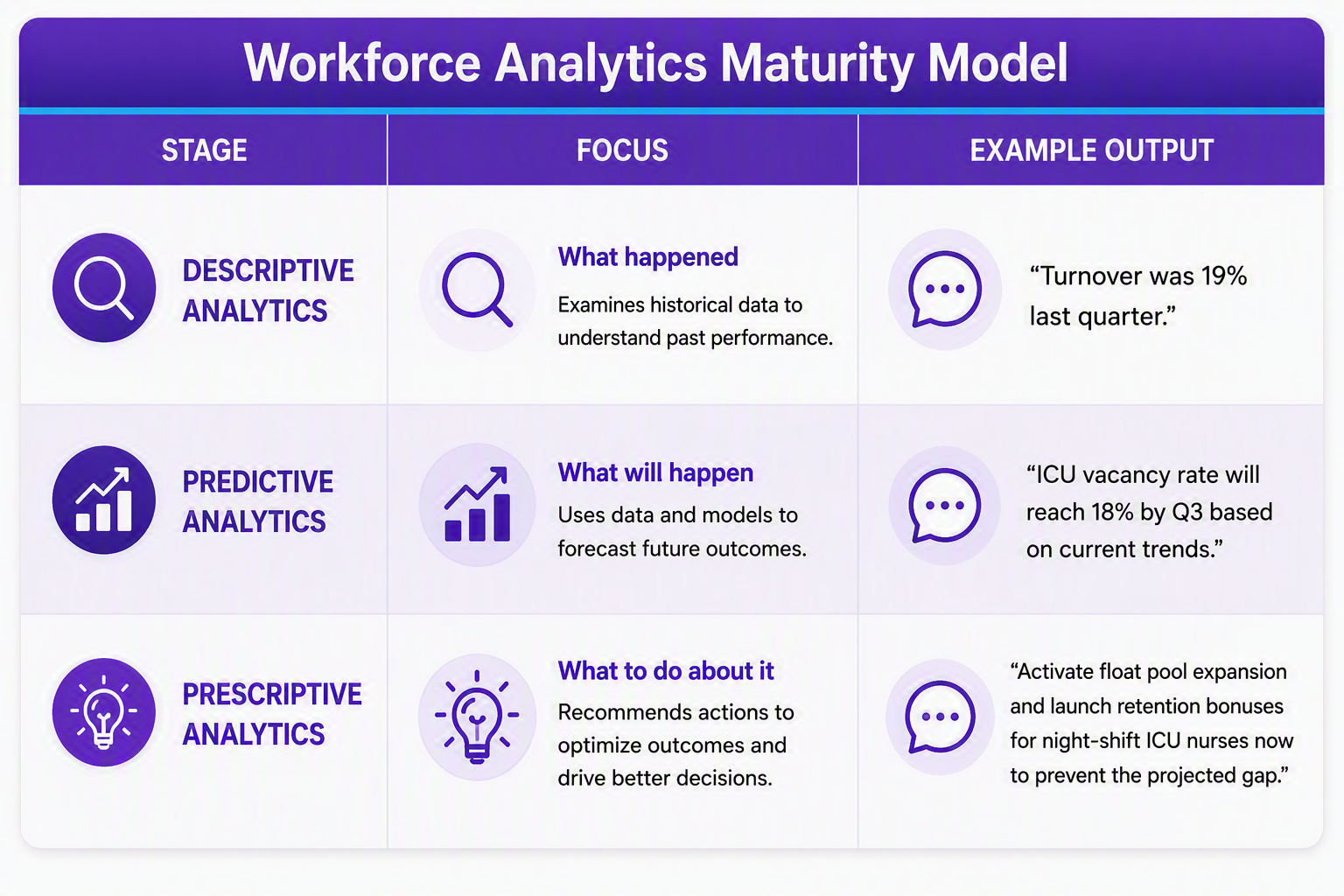
Data and analytics help move workforce planning from retrospective reporting to forward-looking decisions. The goal is to spot skill gaps, forecast staffing needs, and adjust plans as demand changes.
- Predictive modeling: Using historical data, statistical methods, and machine learning to forecast future staffing needs under different demand scenarios. Related terms: Workforce analytics, scenario planning, demand-based planning
- Workforce analytics: The systematic collection, analysis, and visualization of workforce data, such as demographics, cost, utilization, staffing, and engagement, to inform planning decisions. Related terms: Predictive modeling, supply/demand analysis, turnover rate
WorkWise helps turn workforce data and staffing forecasts into recommendations leaders can act on.
The analytics maturity journey:
Retention, Turnover, and Talent Development
Retention, turnover, and talent development sit at the center of workforce planning because they shape hiring demand, onboarding capacity, team stability, and care continuity. Strong workforce plans address how organizations recruit, develop, and retain clinical talent over time.
- Attrition: The reduction of staff through voluntary resignations, retirements, or involuntary separations without immediate replacement. Related terms: Turnover rate, stock-and-flow analysis, succession planning
- Continuing education: Employer-supported professional development, including continuing education credits, certification renewals, training programs, and tuition support, that helps keep clinical skills current. Related terms: Competency assessment, retention rate, onboarding
- Onboarding: The structured process of integrating new hires through orientation, training, mentorship, culture-building, and progressive responsibility. Related terms: 90-day retention, time-to-productivity, competency assessment
- Succession planning: Identifying and developing internal talent to fill critical leadership and clinical roles when incumbents leave, retire, or advance. Related terms: Workforce segmentation, talent pipeline, attrition
Building a Resilient Healthcare Workforce
A resilient healthcare workforce takes more than terminology. It requires shared definitions, reliable metrics, scenario planning, and regular review, so leaders can translate workforce insights into action.
- Diversity and inclusion metrics Quantitative measures of workforce representativeness used to identify gaps, set goals, and track progress toward a more equitable workforce. Related terms: Workforce analytics, workforce segmentation, retention rate
Action Roadmap: From Glossary to Operational Impact
- Adopt a shared vocabulary so HR, nursing, finance, and operations leaders use the same definitions.
- Build dashboards around core metrics, including vacancy rate, turnover rate, time-to-fill, overtime rate, and 90-day retention.
- Pilot scenario-based workforce plans in one high-impact department before scaling.
- Establish regular review cycles so workforce plans stay current as demand and labor markets change.
- Invest in competency development, onboarding, succession planning, and retention.
- Layer in predictive analytics to anticipate staffing needs before gaps emerge.
When organizations apply these concepts consistently, workforce planning becomes a practical way to anticipate staffing risk, support care quality, and build a more resilient clinical workforce.
Frequently Asked Questions
What is workforce planning in a hospital context?
Workforce planning in a hospital is the strategic process of analyzing current staffing levels, forecasting future needs based on patient demand and organizational goals, and building recruitment, training, and retention pipelines to close any gaps between supply and demand. It moves beyond simply filling today's open positions to anticipating tomorrow's workforce requirements across every department and role.
How is skill mix defined and why is it important?
Skill mix is the proportion of different professional roles and skill levels deployed on a unit or across a facility, for example the ratio of RNs to LPNs to CNAs on a medical-surgical floor. Optimizing skill mix ensures the right combination of clinical expertise is available to meet patient needs efficiently, without overstaffing high-cost roles where they are unnecessary. That directly affects both care quality and labor costs.
What roles do float pools and PRN staff play in healthcare?
A float pool is a centrally managed group of cross-trained clinicians available for redeployment across units as census and acuity shift, while PRN (pro re nata) staff are on-call workers who pick up shifts as needed without a guaranteed schedule. Both provide flexible coverage without the premium cost of agency labor. Float pool staff offer daily redeployment flexibility, while PRN staff fill sporadic gaps and call-offs.
How does predictive modeling improve staffing decisions?
Predictive modeling uses historical data, statistical algorithms, and machine learning to forecast future staffing requirements under various demand scenarios. This enables hospital HR leaders to adjust hiring, workforce coverage, and resource allocation before shortages occur, for example anticipating a seasonal surge in respiratory admissions and preparing float pool coverage weeks in advance.
Why are retention rates critical for hospital HR leaders?
Retention rates directly affect care continuity, team stability, and the bottom line. Even small improvements in retention can reduce recruiting burden, onboarding demand, and productivity loss. Beyond finances, high retention preserves institutional knowledge, strengthens team cohesion, and correlates with better patient outcomes and safety metrics.