

How to Build a Healthcare Float Pool
A healthcare float pool is an internal roster of credentialed, cross-trained clinicians, centrally scheduled and deployed across multiple units within a single health system to fill staffing gaps without relying on external agencies. When planned and managed well, float pools deliver travel-nurse-like flexibility by reducing third-party markups, limiting overtime, and keeping institutional knowledge in-house. This seven-step implementation playbook guides hospital operations leaders through every phase, from demand analysis to continuous optimization, with a focus on building a more flexible and cost-effective internal staffing model.
Why Healthcare Float Pools Are a Strategic Staffing Priority
Float pools are not a new idea. They have helped hospital staffing leaders balance efficiency, care quality, and nurse satisfaction since the 1980s. What has changed is the technology that makes them more effective. With predictive analytics, automated credentialing, and mobile self-scheduling, today's float pools operate as high-performance internal staffing systems.
The performance opportunity is clear. When supported by the right governance, scheduling processes, and technology platform, an internal float pool improves staffing flexibility and reduces reliance on external agencies.
How Float Pools Reduce Travel Nurse Costs and Agency Reliance
Float pools provide travel-nurse-like flexibility while helping hospitals reduce dependence on outside agencies. The savings potential grows as internal float staff displace recurring agency use. Even modest reductions in travel nurse reliance create meaningful financial impact when applied across multiple units or facilities.
The financial benefits extend beyond direct agency spend. Float nurses reduce reliance on costly overtime by distributing workload across a flexible, centrally managed pool. A high-functioning float pool protects permanent staff from overwork, lowering burnout-driven turnover and its associated replacement costs.
Rigid staffing models that limit redeployment increase overtime and travel nurse use. Flexible internal models are the financially stronger alternative.
Float Pool vs. Travel Nurse vs. Per Diem—When to Use Each
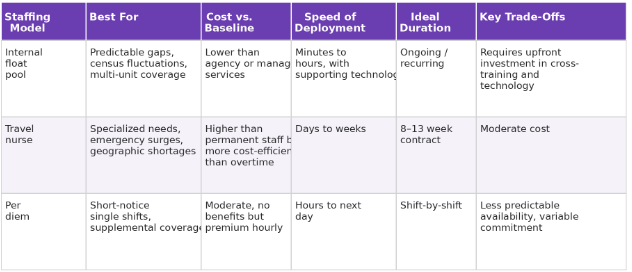
A tiered policy works best: try Tier 1 (float pool) before Tier 2 (per diem), and reserve Tier 3 (travel/agency) as the last resort.
Planning and Building an Effective Healthcare Float Pool
This section covers steps one and two of the seven-step playbook: define mission, scope, and governance, then assess demand and right-size the pool.
Start with a demand analysis focused on the service lines with the highest agency spend and most volatile census. Pilot in high-volume units, with Med-Surg, ICU, and ED as typical starting points, before scaling system-wide. This approach limits risk while generating the early wins needed to secure broader organizational buy-in.
Key Planning Decisions
· Define the float pool's mission. Is it primarily for cost reduction, quality improvement, or both? Clarity here shapes every downstream decision.
· Determine pool size based on historical vacancy data, seasonal trends, and predictive staffing analytics. Undersizing leads to continued agency reliance; oversizing creates idle labor cost.
· Establish governance. Assign clear ownership—whether that sits with nursing operations, HR, or a dedicated float pool manager—and define escalation paths.
· Set employment tiers, such as full-time float, part-time float, and hybrid per diem, to maximize scheduling flexibility while offering clinicians meaningful employment options.
· Identify integration points with existing HRIS, scheduling, and credentialing systems. Reliable data flow is essential for real-time deployment.
Building an internal contingent workforce reduces overtime and agency staffing costs, but only when the C-suite aligns on expected savings and workforce benefits from day one. A strong business case, tied to specific margin targets, secures that alignment early.
WorkWise supports this phase by integrating with existing HRIS and scheduling systems and by supporting customizable resource pool participation, approvals, and notifications at launch. That integration reduces friction and helps teams realize value faster.
Recruiting and Cross-Training for Maximum Flexibility
Step three of the playbook focuses on building the talent pipeline and cross-training program that make the float pool operationally viable.
Recruitment Strategy
Targeted recruitment campaigns for float pool roles attract nurses seeking flexibility. Float pools also strengthen retention by giving clinicians more control over work-life balance, a meaningful differentiator in a tight labor market.
Effective recruitment messaging should emphasize schedule variety and autonomy, exposure to multiple clinical environments that accelerate professional growth, competitive float pay differentials, and local assignments without the disruption of travel contracts.
Cross-Training Program Design
Cross-trained nurses are clinicians who have completed competency validation in two or more clinical specialties, enabling them to float between units such as ICU, Med-Surg, and ED while maintaining safe, protocol-compliant care.
Standardized training prepares float nurses to work across multiple units, and staff with prior experience in several units improve care quality. A structured cross-training matrix standardizes readiness:
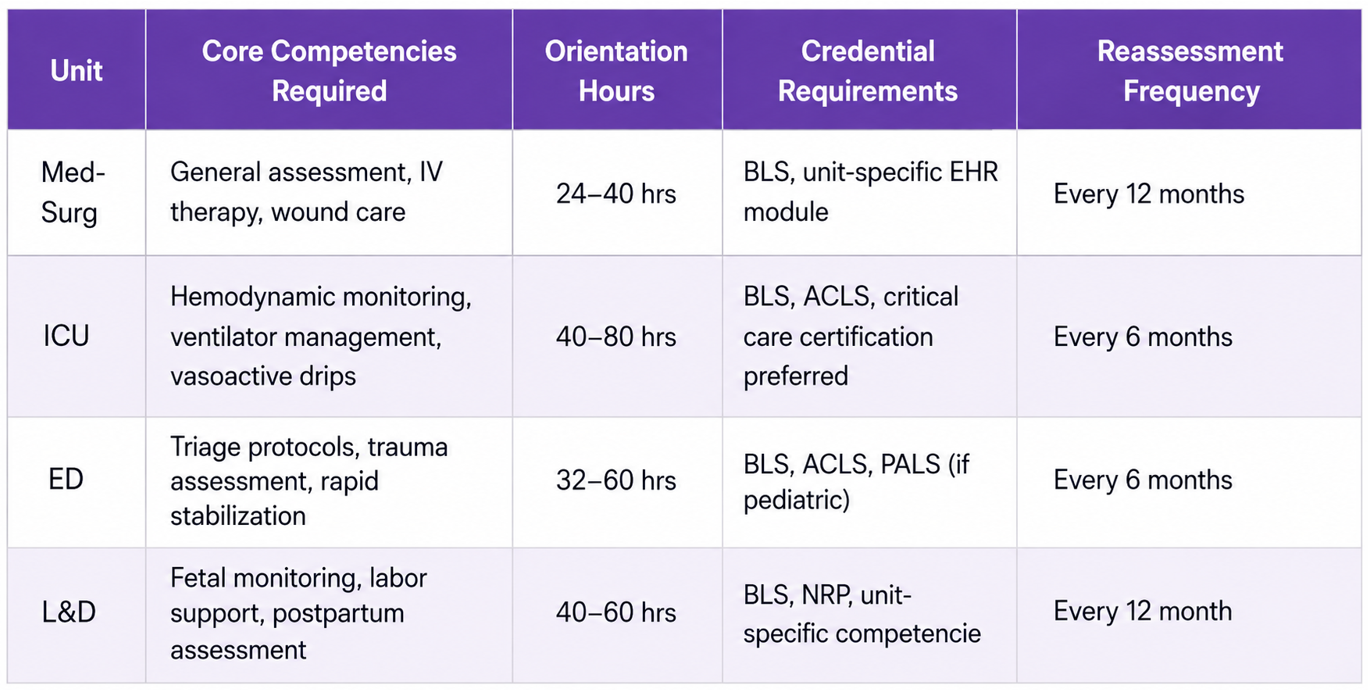
This matrix ensures every float nurse deployed to a unit meets the same readiness standard as permanent staff.
Scheduling and Deployment Best Practices for Float Pools
Steps four and five of the playbook address centralized scheduling, self-service access, deployment protocols, and escalation tiers.
Flexible, adaptive staffing models help float pools respond in real time to patient needs. Well-structured float pools support flexible scheduling without overloading permanent staff. The key is a deployment protocol that prioritizes internal resources systematically.
Tiered Deployment Protocol
· Tier 1, internal float pool: first call for all open shifts. This is the primary staffing lever.
· Tier 2, per diem / PRN clinicians: activated when float pool capacity is insufficient.
· Tier 3, external agency / travel nurses: last resort, used only when Tiers 1 and 2 cannot meet demand.
Mobile Self-Scheduling
Mobile self-scheduling is a critical enabler for float pool participation. When clinicians view, claim, and swap shifts from a mobile app, administrative overhead drops and engagement rises. WorkWise’s clinician app provides this capability natively, with mobile workflows that cut administrative steps and shorten time-to-fill.
Predictive Deployment Workflow
Predictive staffing deploys float nurses before gaps become last-minute callouts. Centralized scheduling paired with predictive demand signals—census trends, historical no-show rates, and seasonal patterns—moves staffing from reactive to proactive.
The ideal deployment sequence:
1. Demand signal detected, such as a census spike, call-out, or scheduled gap
2. Float pool notified via mobile push
3. Credential match verified automatically
4. Shift claimed via mobile self-service
5. Deployment confirmed
6. Post-shift feedback collected
This closed-loop process supports accountability and continuous improvement at every step.
Using Technology to Optimize Float Pool Management
Step six of the playbook centers on deploying integrated workforce technology that changes float pool management from manual and reactive to predictive and data-driven.
Float pool management technology is a software platform that centralizes scheduling, credentialing, compliance tracking, and real-time deployment of internal float staff. It typically integrates with existing HRIS and time management systems to enable predictive, data-driven staffing decisions.
Essential Technology Capabilities
· Predictive staffing analytics, which forecast demand and optimize shift coverage, allowing operations teams to act on data rather than intuition.
· Automated credentialing, which prevents credential expiration gaps and scope-of-practice mismatches. This is a foundational component of float pool optimization.
· Mobile self-service, so clinicians pick up shifts, manage availability, and receive notifications from any device.
· Real-time dashboards, so operations leaders see fill rates, cost-per-shift, and agency utilization in a single view without manual report compilation.
WorkWise provides these capabilities and integrates with existing HRIS, scheduling, and time management systems. Their customizable workflows manage resource pool participation, approvals, and notifications, while mobile-enabled self-service keeps clinicians engaged and responsive.
Monitoring and Improving Float Pool Performance Over Time
Step seven completes the playbook: measure, iterate, and scale. A float pool requires ongoing performance management and improvement.
A monthly or quarterly performance review cadence, led by a cross-functional team spanning nursing operations, finance, and HR, keeps the pool on track. Tracking trends over rolling 90-day windows surfaces actionable patterns:
· Is float pool utilization displacing agency spend as intended?
· Which units or shifts consistently lag in fill rates, indicating pool sizing or competency gaps?
· How is clinician satisfaction and turnover trending within the pool?
Float pooling supports more balanced workload, patient-to-nurse ratios, and shift lengths, but leaders must actively monitor and adjust based on data.
Built-in platform analytics surface these insights automatically. Smart Square® dashboards reduce the need for manual reporting, giving leaders visibility into the metrics that matter.
Scaling Beyond the Pilot
Once a pilot proves ROI in high-volume service lines, expansion to additional units and specialties follows naturally. For multi-site health systems, interorganizational float pools that share clinicians across facilities increase flexibility while further reducing agency dependence.
Avoiding Common Risks and Managing Workforce Balance
Float pools are not a cure-all. Poorly designed programs can introduce new problems: increased commuting burden, erosion of unit identity, credential gaps, or cost creep from unchecked float premiums. Proactive risk management is essential.
Key Risks and Mitigations
· Commuting burden: Some nurses prefer less commuting and more stability, especially those with children or who are older. Local-only assignments, paired with interorganizational pools and virtual care options where appropriate, address this concern.
· Loss of unit identity: Float nurses may feel disconnected from unit teams. Assigning primary and secondary unit preferences, including float staff in unit meetings, and integrating them into recognition programs restores connection.
· Credential and compliance gaps: Manual tracking invites errors. Automated credentialing through Smart Square® and ShiftWise helps ensure every deployed clinician meets current licensure, certification, and competency requirements.
· Float premium cost creep: Monitoring total compensation costs ensures float pay differentials stay offset by agency savings. When internal float costs approach external agency rates, root-cause analysis is warranted.
Family-friendly shift patterns, hybrid per diem options, and explicit retention incentives maintain pool stability. Monitoring productivity and quality metrics—including patient satisfaction scores, medication error rates, and float nurse turnover—catches unintended effects early.
Measuring Success: Key Metrics and Financial Benchmarks
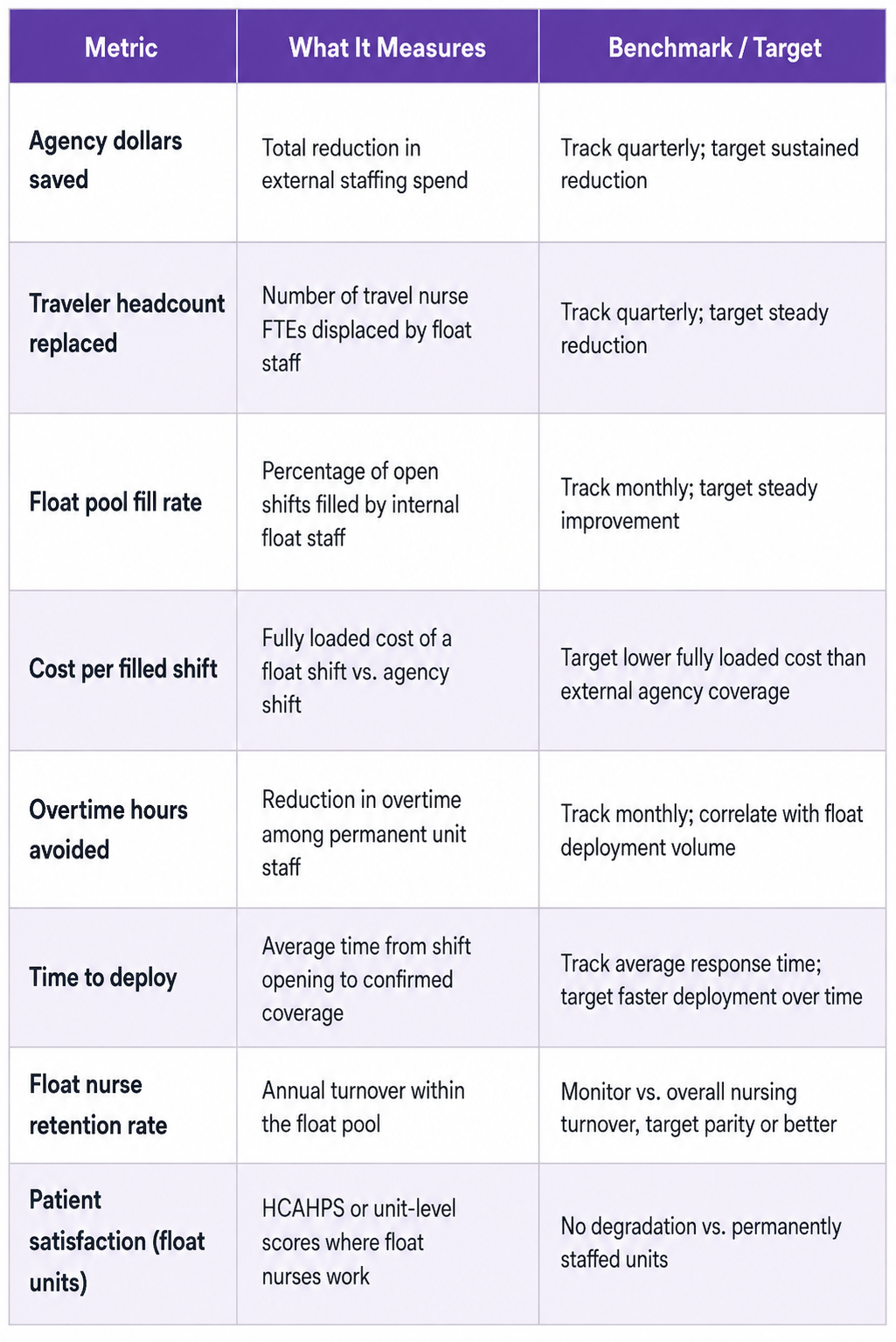
Operations leaders and CFOs need a concrete measurement framework to evaluate float pool ROI, justify continued investment, and benchmark performance against industry standards.
Sample ROI Calculation
To estimate ROI, compare the fully loaded annual cost of travel nurses against the fully loaded cost of internal float pool nurses, including pay differentials, benefits, onboarding, credentialing, and technology expenses. Real-world outcomes underscore the potential. A
large academic medical center in the Northeast partnered with WorkWise to execute a workforce strategy built on predictive analytics, patented open-shift logic, and centralized daily deployment. Over one year, the center grew its internal float pool by 140%, reduced registered nurse turnover from 28.3% to 21.7%, cut core staff utilization by 9.2%, and achieved $3.3 million in cost savings across the first two quarters of 2023.
Presenting these metrics to the C-suite in a quarterly business review format ties float pool performance directly to labor cost targets and margin improvement. The data should show that internal float pools deliver measurable financial and operational returns.
Frequently Asked Questions
What Is a Healthcare Float Pool and How Does It Differ From Travel Nursing?
A healthcare float pool is an internal team of credentialed, cross-trained nurses employed by a health system and centrally scheduled to fill staffing gaps across multiple units. Unlike travel nurses, who are contracted through external agencies for fixed assignments at premium rates, float pool nurses are already embedded in the organization's culture, protocols, and EHR systems, offering comparable flexibility at significantly lower cost.
How Much Can Hospitals Save by Using a Float Pool Instead of Travel Nurses?
Savings depend on the health system's current agency spend, float pool compensation model, utilization rate, and technology costs. A practical estimate starts by comparing fully loaded agency costs against the fully loaded cost of internal float staff, then modeling savings based on how many external shifts the float pool can realistically replace.
What Qualifications and Training Should Float Pool Nurses Have?
Float pool nurses should be experienced RNs with current licensure and credentials validated for each unit they may cover. They typically complete standardized cross-training in two or more clinical specialties, such as ICU, Med-Surg, and ED, with competency reassessments at regular intervals to ensure safe, protocol-compliant care across all assigned areas.
Can a Float Pool Fully Replace Travel Nurses in All Scenarios?
A float pool handles the majority of predictable and semi-predictable staffing gaps, but travel nurses remain valuable for highly specialized needs, emergency surges, or geographic shortages where internal capacity is insufficient. The goal is to make travel nurses the last resort, with a tiered deployment model that prioritizes internal float staff first.
How Quickly Can Float Pool Staff Be Deployed to Cover Shifts?
Deployment speed depends on staffing processes, credential readiness, and the technology used to match clinicians to open shifts. With centralized scheduling, mobile self-service, and automated credential matching, float pool teams can shorten the time between an open shift and confirmed coverage.