

Step-by-Step Guide to Building a Healthcare Float Pool Staffing Strategy
Rising agency costs, unpredictable census swings, and clinician burnout continue to pressure health systems. A healthcare float pool staffing strategy offers a practical way forward. It uses a dedicated group of cross-trained, internally employed clinicians to support coverage across multiple hospital units, reducing agency spend, cutting overtime, and strengthening workforce resilience.
An internal float pool addresses these challenges by keeping institutional knowledge in-house, giving clinicians more flexible work options, and giving operations leaders a more controllable staffing model. This guide walks healthcare leaders through the full process: how float pools differ from related staffing models; how to define goals, size the pool, tier clinicians, recruit for flexibility, govern operations, and measure ROI; and which best practices sustain clinician engagement and continuous improvement.
Understanding Healthcare Float Pools and Related Concepts
Health systems use several flexible staffing models to manage fluctuating patient volumes and workforce gaps. The definitions below draw clear boundaries between the four most common models, so every stakeholder starts from the same foundation.
Definitions: Float Pool vs. Internal Agency vs. Per Diem vs. Internal Resource Pool (IRP)
Each model serves a distinct operational need. A nurse float pool is the most common starting point for health systems seeking to reduce agency dependency, while an IRP represents a more advanced maturity level.
Why Float Pools Are a Priority in Healthcare Staffing
Internal float pools reduce agency dependency and premium labor costs while improving internal coverage and workforce resilience. For leaders balancing tight budgets against care quality, that combination makes float pools one of the most immediate levers available.
Step 1: Define Mission and Align Float Pool Objectives
With these distinctions in place, the next step turns the float pool concept into an operating model. The framework below begins with strategic alignment, then moves through demand planning, clinician tiering, recruitment, technology enablement, governance, and ongoing optimization.
Every successful float pool starts with a mission tied to organizational priorities. Its objectives should map to specific pain points, agency spend, overtime, patient safety events, and to strategic goals such as growth or service-line expansion. A one-page charter helps here, defining the program's mission, scope, target units, success metrics, and executive sponsor.
Identifying Key Goals: Reduce Agency Use, Improve Fill Rates, Stabilize Units
Most health systems launch a float pool to reduce agency use, improve internal coverage, and stabilize high-variability units. The following questions help sharpen goal-setting:
- What percentage of shifts do agency staff currently fill?
- Which units carry the highest overtime rates?
- Where do patient satisfaction scores correlate with staffing instability?
- What is the current cost-per-shift for agency versus internal labor?
- Which service lines are expanding and will need additional flexible coverage?
Mapping Coverage Gaps and Potential ROI Areas
Goals become actionable when they rest on data. Hospitals should analyze workforce patterns to identify the units, departments, and seasons with the biggest coverage shortfalls.
The table below offers an ROI benchmarking framework. Organizations populate the "Before float pool" column with baseline data, then set 12-month targets based on their priorities, current labor costs, and realistic improvement goals for their market.
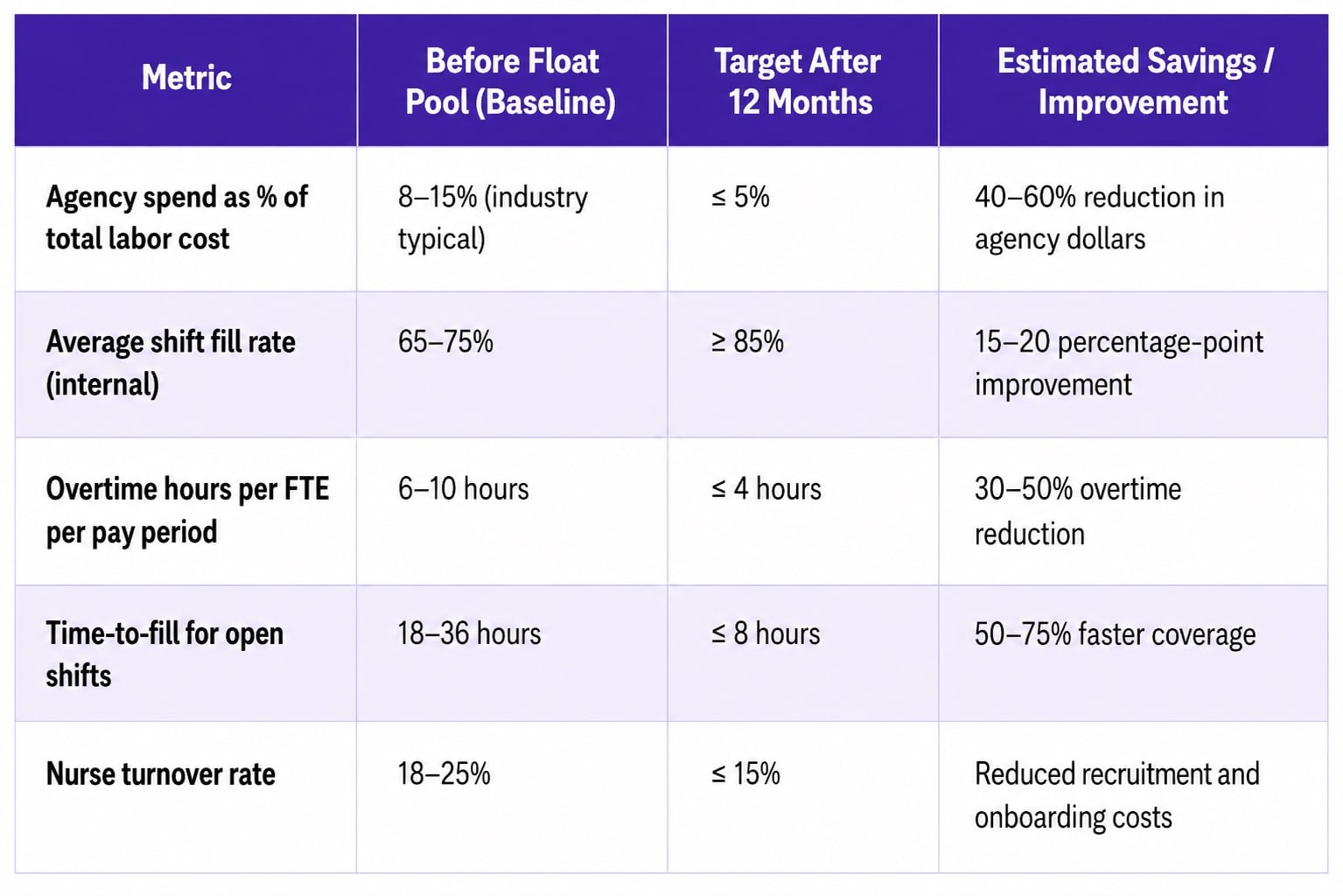
These targets are illustrative and should be calibrated to each organization's size, acuity mix, and market dynamics.
Step 2: Assess Demand and Size the Float Pool
Once the mission and ROI targets are defined, the next decision is scale. Sizing the pool correctly is the difference between an under-resourced program that still leans on agencies and an over-built one that wastes payroll. The optimal size depends on workforce patterns and demand by unit, and the pool should flex with fluctuating volumes, seasonal trends, and demand surges.
Analyzing Historical and Seasonal Staffing Patterns
Historical workforce data reveal seasonal variation and chronic shortages that instinct alone cannot detect. To surface actionable demand signals, leaders should:
- Review 12–24 months of workforce data by unit, shift type, and day of week.
- Identify recurring seasonal and weekly patterns.
- Compare patient census and acuity trends to distinguish volume-driven gaps from skill-driven gaps.
This analysis produces a demand heat map that indicates not just how many float clinicians are needed, but what kind and when.
Forecasting Specialty Needs and Optimal Headcount
Forecasting helps right-size the pool for future needs by factoring in service-line changes, known attrition, seasonal projections, and specialty demand. A practical starting point is float FTEs equal to 10–15% of total nursing FTEs across covered units, adjusted quarterly based on internal coverage, acuity, and agency dependency.
Step 3: Segment and Tier Clinicians by Competency and Cost
Not every coverage need calls for the same skill level or pay rate. Tiered float pools control labor spend by ensuring the right clinician, at the right cost, reaches the right patient.
Creating Tiers Based on Skill, Specialty, and Cost Efficiency
A three-tier model gives most health systems a practical framework to adapt:
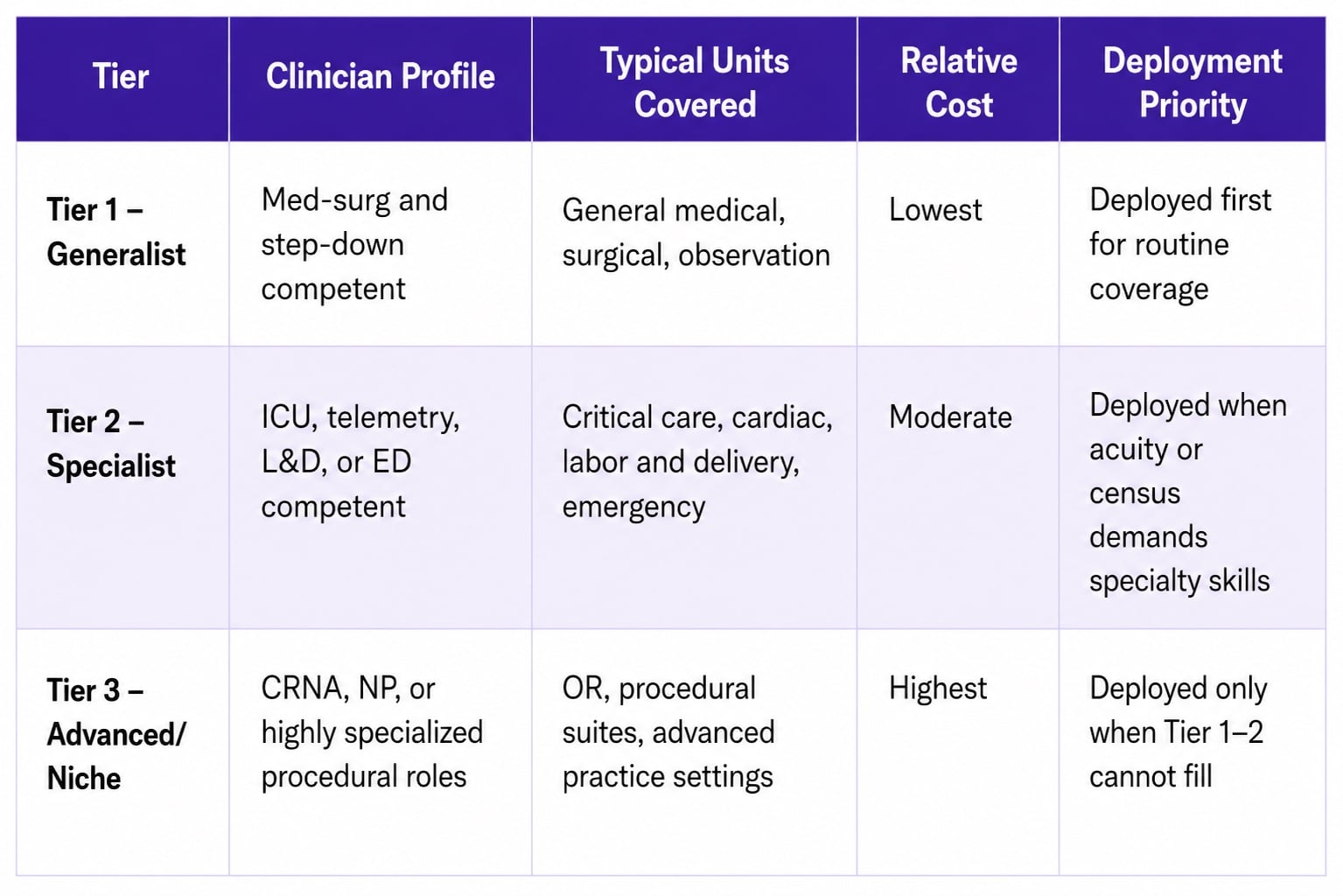
Each tier should carry clearly defined responsibilities and scope of practice, so deployment decisions stay objective and defensible.
Matching Clinicians to Appropriate Coverage Needs
Deployment protocols should prioritize float staff by acuity, census, staffing gap severity, required credentials, and cost tier. Equitable rotation matters just as much. Tracking assignment history helps prevent burnout, build trust, and reduce retention risk.
Step 4: Recruit and Onboard Clinicians for Flexibility
A float pool is only as strong as the clinicians in it. Recruiting adaptable nurses who stay independently competent across departments is essential, yet recruitment and retention remain among the toughest challenges for reliable healthcare staff pools.
Hiring Adaptable Nurses With Relevant Skill Sets
The ideal float pool candidate shows clinical versatility, comfort with ambiguity, strong communication skills, and the ability to build rapport quickly with unfamiliar teams. Effective sourcing strategies include cross-training existing staff, posting float-specific job descriptions that emphasize variety and competitive pay, and partnering with nursing schools to build early-career pipelines. Recruiting materials should highlight total compensation, work flexibility, and professional development opportunities—not just hourly rates.
Standardized Orientation and Unit-Specific Training Tools
Float pool nurses need standardized orientation and ongoing education to perform safely across multiple environments. Consistent training protects both clinicians and patients as staff move between units.
Step 5: Deploy Technology to Optimize Staffing Operations
Technology moves float pool management from a manual, reactive process to a more predictive and coordinated one. It centralizes coverage needs, clinician credentials, availability, compensation rules, and reporting in one place.
Implementing Real-Time Matching and Credential Tracking
Real-time matching compares coverage needs against clinician credentials, availability, tier, and proximity to identify the best-fit candidate while maintaining quality, compliance, and cost discipline. Credential tracking should flag missing or soon-to-expire documents before a clinician is assigned, not after. Automated credential verification reduces compliance risk and prevents last-minute issues tied to expired licenses, certifications, or mandatory training.
Automating Pay Rules and Assignment Transparency
Pay rules can vary by shift type, location, or critical coverage need, and automation removes manual calculations while reducing payroll errors. Clear assignment compensation helps clinicians understand differentials, bonuses, and mileage reimbursement before they commit.
Step 6: Govern Float Pool Operations With Clear Protocols
Without governance, even a well-designed float pool can drift into inconsistency. Someone must own the program and manage pay, credentialing, deployment, and communication as one integrated operation.
Assigning Ownership and Publishing Deployment Guidelines
Health systems should designate a float pool manager, or equivalent role, with authority over deployment decisions, credential compliance, competency tracking, and agency escalation. A published deployment protocol then defines the priority order for internal float pool, per diem, internal agency, and external agency use, along with acuity thresholds and fatigue-prevention guardrails.
Equitable Assignment Policies and Communication Best Practices
Fair assignment distribution prevents burnout and improves job satisfaction among float clinicians. Equally important, it helps float nurses feel like members of the care team rather than interchangeable labor units. Effective communication practices include pre-shift introductions, regular float pool huddles, a dedicated communication channel, and post-assignment feedback loops, so float clinicians can surface unit-level issues and contribute to improvement.
Step 7: Monitor Performance and Iterate for Continuous Improvement
A float pool is a living system. Continuous measurement helps leaders refine the program over time and prove its value to the C-suite.
Tracking Fill Rates, Overtime Reduction, and Cost Savings
A performance dashboard should track the metrics that best show whether the program is reducing agency spend, improving coverage, and maintaining care quality.
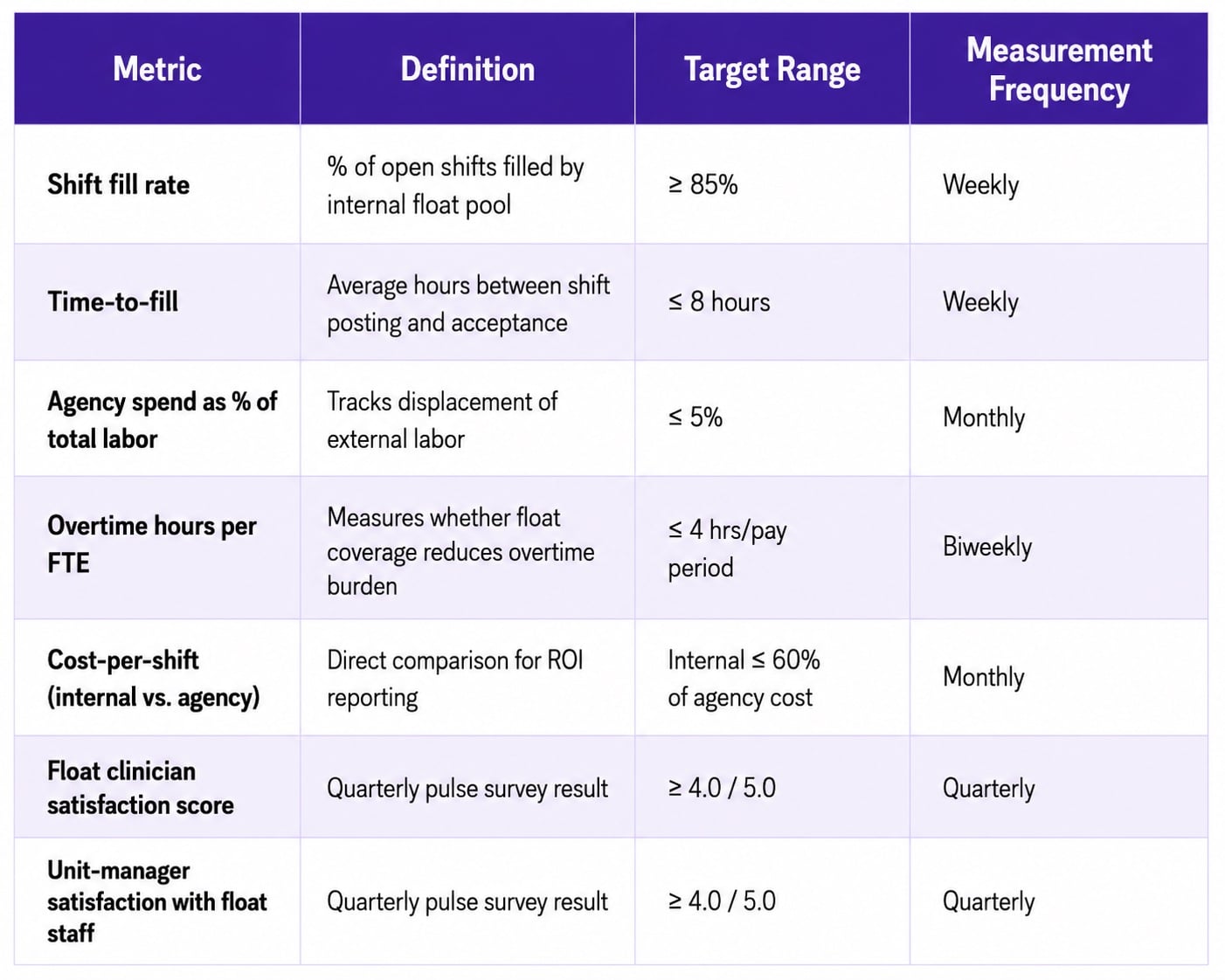
WorkWise analytics and reporting tools can automate dashboard generation and surface trends that manual tracking may miss.
Using Data to Resize, Retier, or Re-Skill the Pool
Cross-training and ongoing education keep float staff current as protocols evolve and new service lines come online. A quarterly review cadence gives leaders a regular moment to examine pool size, tier distribution, new competency needs, and external agency escalation trends. Static pools degrade over time as demand patterns shift, clinicians turn over, and organizational priorities change.
Best Practices for Sustainable Float Pool Management
Cross-Training and Standardization for Safety and Efficiency
Health systems should prioritize standard medication workflows, consistent EMR documentation templates, structured handoff communication, and emergency response protocols across covered units. Standardization keeps care safe and predictable as clinicians move.
Fair Compensation and Incentive Structures
Float pool compensation should reflect the flexibility clinicians provide. A strong package may include competitive base pay, differentials, critical-need bonuses, paid standby or on-call premiums, certification stipends, and retention incentives. When compensation is fair and transparent, recruitment becomes easier and turnover decreases, improving program ROI.
Proximity Considerations and Minimizing Travel Burdens
For multi-site health systems, organizing float pools by geographic cluster keeps travel manageable. Mileage reimbursement or travel stipends for assignments beyond a defined radius further respect clinicians' time.
Building Ownership, Culture, and Clinician Engagement
Deliberate culture-building helps float clinicians feel like part of the care team rather than interchangeable labor. Effective engagement tactics include unit champions, recognition programs, professional development opportunities, quarterly stay interviews, and input into availability preferences and preferred units.
Common Pitfalls and Metrics to Watch
Addressing Recruitment Challenges and Credentialing Gaps
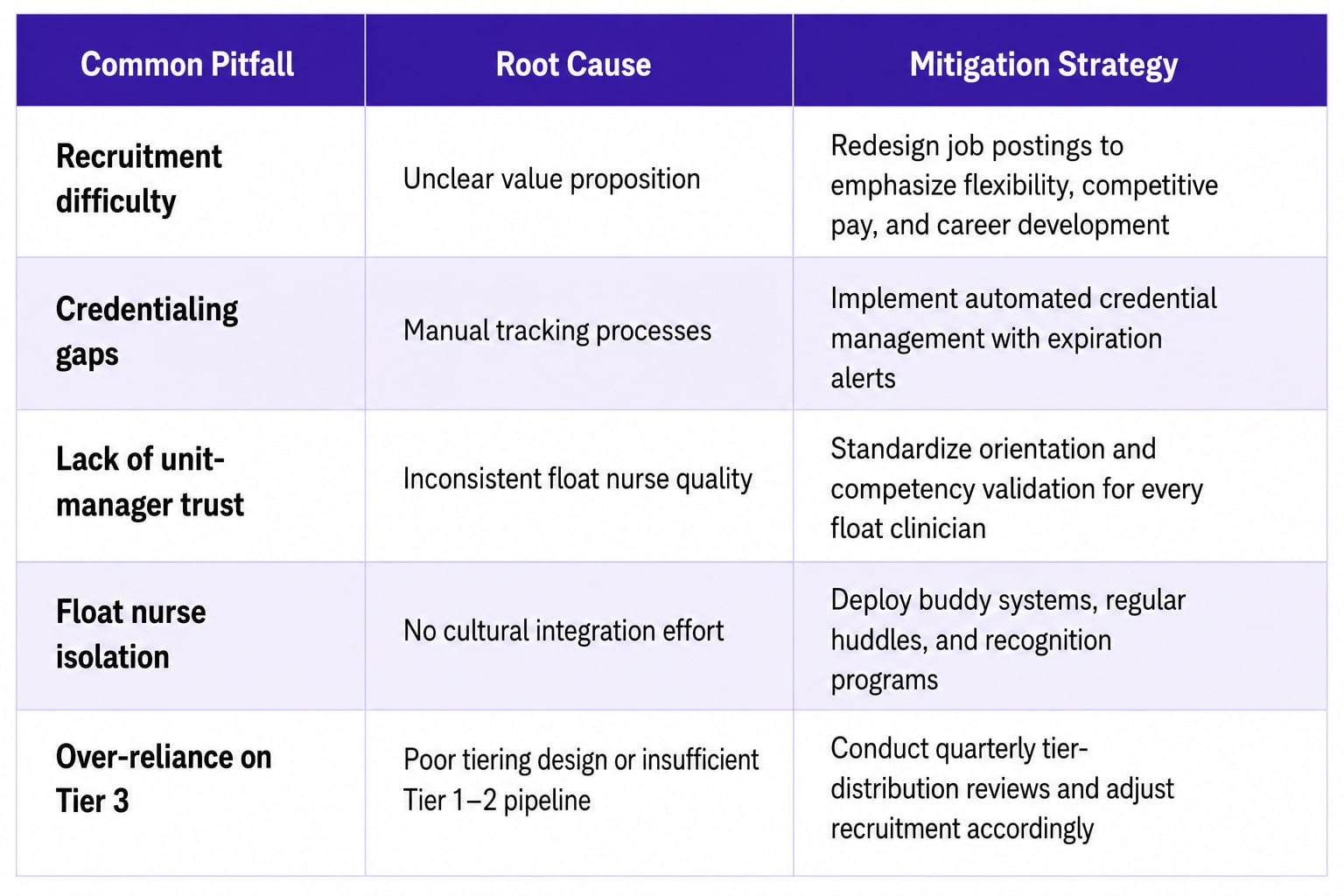
Even well-planned float pool programs meet predictable obstacles. Naming them early helps leaders build mitigation plans before launch.
Measuring ROI: Fill Rate, Time-to-Fill, Cost per Shift, and Satisfaction
A monthly ROI report should show internal coverage compared with agency use, total agency spend reduction, time-to-fill improvement, cost-per-shift differences, float clinician turnover, and patient satisfaction trends. Consistent ROI reporting helps secure executive sponsorship and budget for future expansion.
Frequently Asked Questions
What Is the Main Goal of a Healthcare Float Pool?
The primary goal of a healthcare float pool is to stabilize unit coverage, reduce overtime and agency use, and preserve care quality by deploying qualified clinicians where and when patients need them most. A well-managed float pool becomes an organization's first line of defense against staffing variability.
How Should Leaders Decide Which Roles to Include in the Float Pool?
Leaders should focus on roles that match their highest-need clinical competencies, such as ICU, telemetry, or med-surg, based on a gap analysis of departments, shifts, and seasons with the biggest coverage shortfalls. Starting with the units that generate the most agency spend or overtime lets the program prove value, then expand as it matures.
How Can Organizations Ensure Float Nurses Are Competent Across Units?
Organizations should maintain up-to-date credentialing records, provide standardized orientation with unit-specific pocket guides, and validate competency before assigning float nurses independently on any new unit. Tools like WorkWise automate credentialing and competency tracking to make validation repeatable and auditable.