
AI in Healthcare Staffing 2026: Cutting Time-to-Fill and Burnout
Healthcare systems across the country face a workforce crisis that traditional hiring methods can no longer solve. Experienced RN roles commonly take more than two months to fill, and unfilled clinical positions create financial and operational strain that compounds week over week. AI in healthcare staffing is changing this equation, moving organizations from reactive manual hiring to proactive, data-driven workforce planning. This guide explains how healthcare organizations use AI in staffing and workforce management today, what measurable outcomes they can expect, and how to implement these tools responsibly.
Healthcare staffing organizations that adopt AI should focus on measurable improvements in speed, compliance readiness, candidate engagement, and workforce visibility. The sections below map each capability to concrete results that matter to hospital leaders.
How AI Is Transforming Healthcare Staffing and Workforce Management
The numbers show the scale of the problem. Experienced RN roles commonly take 70 to 90 days to fill, while specialty roles may take even longer. These timelines strain budgets, compromise patient care, and deepen burnout among the clinicians who cover the gaps.
AI shifts healthcare staffing from reactive scrambling to proactive, data-driven workforce planning. When organizations integrate AI into workforce workflows, they improve hiring speed, reduce manual coordination, and better match candidates to role requirements.
AI in healthcare staffing means applying machine learning, natural language processing, and predictive analytics to automate and optimize recruitment, credentialing, and workforce planning across clinical and non-clinical roles. The result is faster hiring and a lighter administrative burden for teams already stretched thin.
AI touches many parts of workforce management, from candidate sourcing and screening to workforce planning and burnout prevention. Each use case that follows connects to a specific operational outcome.
Key AI Use Cases in Healthcare Staffing
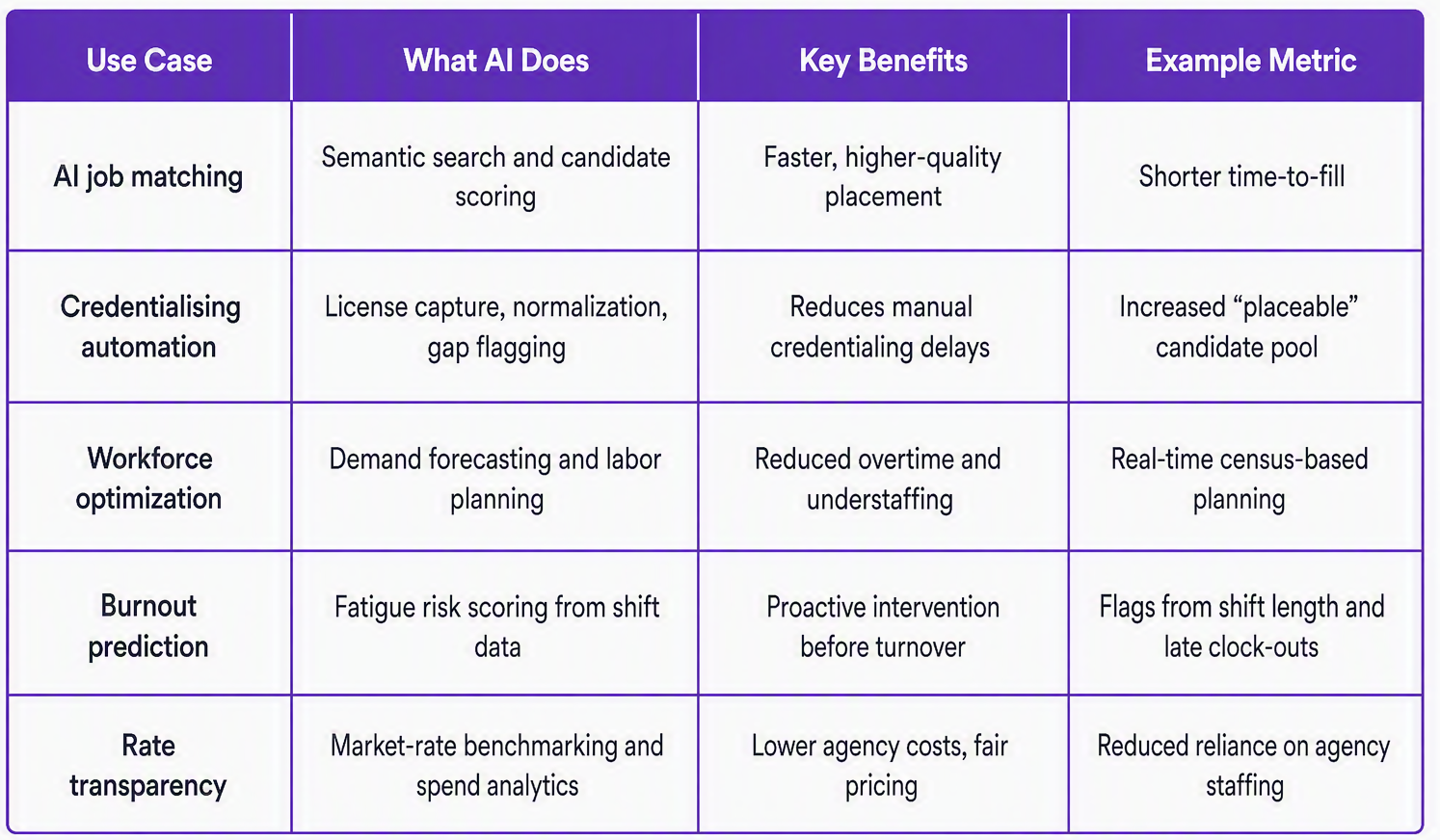
Five core applications define how AI is reshaping healthcare staffing operations today. Each addresses a distinct pain point in the hiring and workforce management lifecycle, and together they form an integrated approach to workforce optimization. The table below offers a quick-reference summary before the details.
AI Job Matching and Candidate Screening
AI matching engines and automated screening tools compress the recruitment funnel compared with manual sourcing. AI scans candidate profiles, compares qualifications against job requirements, and helps recruiters prioritize outreach faster.
The results are measurable. Through WorkWise, Trinity Health's workforce reduced contingent labor by 40% within the first six months of going live with workforce technology. By improving visibility into staffing needs, compliance status, and available talent, AI-enabled platforms help recruiters and workforce leaders focus on higher-value decisions instead of manually sorting through disconnected data.
AI also revives dormant candidate databases. It re-analyzes past applicants whose skills and certifications now match current openings, turning stale pipelines into active sourcing channels.
AI-driven matching uses machine learning to compare candidate qualifications, experience, and preferences against job requirements, producing ranked shortlists that prioritize fit, compliance readiness, and retention likelihood. This contextual, weighted analysis improves with each placement.
Credentialing Automation and Compliance
Credential verification remains one of healthcare hiring's most persistent bottlenecks. Manual verification, document chasing, and third-party checks add significant delays to the hiring process, costing organizations both candidates and revenue.
AI-powered credential automation captures, normalizes, and verifies license numbers, states, and compact status automatically. Modern staffing systems normalize BLS, ACLS, and PALS certifications and track immunization, TB, drug screen, and background-check status without manual data entry.
AI also tracks certification expiration dates and sends renewal reminders, reducing compliance lapses. The result is a continuously compliant, placement-ready candidate pool.
A robust credential automation system should track at minimum:
- State licenses and compact status
- BLS, ACLS, and PALS certifications
- Immunization and TB test records
- Drug screen and background check status
- Certification expiration dates and renewal deadlines
Workforce Optimization and Labor Planning
Predictive workforce planning uses patient census, admissions data, utilization rates, and seasonal patterns to forecast demand before shortages materialize. Instead of reacting to labor gaps after they appear, AI enables staffing teams to adjust coverage strategies in advance.
Connected workforce platforms, including WorkWise, unify compliance, staffing, and labor data into a single operational view. This replaces the fragmented spreadsheets and disconnected systems that make real-time workforce control difficult. When credentialing, staffing activity, and demand signals live in one platform, organizations see fewer overtime hours, less understaffing, and reduced reliance on expensive agency staffing.
Predictive workforce planning uses historical and real-time data—including patient census, seasonal trends, and admission patterns—to forecast staffing needs before shortages occur. It moves labor planning from a reactive administrative process to a strategic workforce function that protects both margins and morale.
Burnout Prediction and Clinician Well-Being
The burnout crisis in healthcare affects retention and patient safety alike. Excessive documentation, administrative work, and staffing pressure continue to pull clinicians away from direct patient care.
Technology can ease this burden. Deloitte estimates that currently available technologies could free up to 20% of bedside nurses' time, allowing nurses to focus more on direct patient care. AI workflow orchestration can also flag fatigue risk based on shift length, consecutive days worked, and late clock-outs, giving managers the data to intervene before burnout leads to turnover.
Ambient AI, which passively listens to and documents clinical conversations in real time, can eliminate hours of post-shift paperwork for clinicians who spend significant time charting after their shifts.
Administrative tasks such as billing, documentation, and routine communications consume hours of staff time every week. AI automates the repetitive components so clinicians can redirect that time to patient care.
Transparent Rate Management and Financial Efficiency
Agency staffing is one of the largest controllable costs for health systems, and limited rate transparency has made it hard to manage. AI-powered rate management benchmarks agency and internal staffing costs against real-time market data, giving hospitals the information to negotiate rates with confidence.
Spend analytics dashboards powered by AI surface rate variances across departments, shifts, and agencies. Finance leaders can identify where rates run above market, where specific agencies overcharge, and where internal float pools could fill gaps at lower cost.
This approach connects staffing decisions directly to financial performance, turning workforce data into a lever for margin protection.
Measurable Impact: Before and After AI Implementation
The business case for AI in healthcare staffing is clearest when stated in concrete, measurable terms. The table below contrasts traditional manual workflows with AI-augmented targets across metrics that matter to healthcare executives.
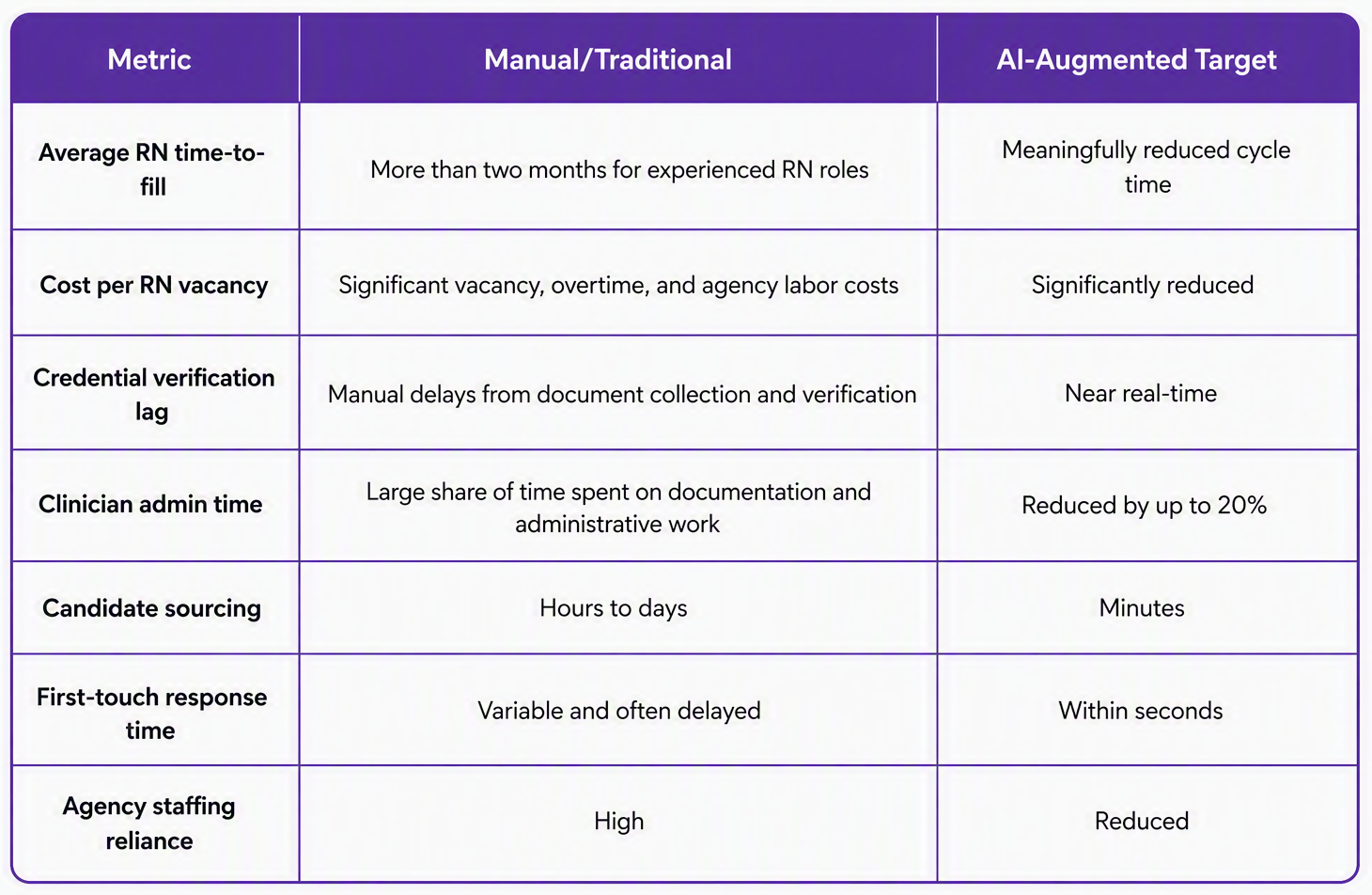
Reducing time-to-fill can generate enough savings to offset AI implementation costs quickly, especially once vacancy costs, overtime, and agency staffing premiums factor into the business case.
Organizations implementing AI should track these operational metrics before and after rollout:
- Speed-to-first-touch
- Screen completion rate
- Candidate engagement completion rate
- Submission-to-interview ratio
- Interview-to-fill ratio
- Drop-off reasons by stage
- Redeploy success rate
Quick wins often come from faster candidate responses and more consistent follow-up, while the full ROI of major AI recruiting changes typically appears over several months. Setting realistic timelines with leadership is essential.
Essential Components for Successful AI Adoption
Deploying AI in healthcare staffing is not simply a matter of purchasing software. The biggest work is often workflow redesign and data integration, not the algorithm itself. Outcomes depend on implementation quality—poor integration, opaque scoring models, and governance lapses will undermine trust and clinical validity regardless of the technology.
Integration With EHRs and HR Systems
Data integration is a foundational requirement for AI staffing success. Case studies show that faster hiring, reduced agency reliance, and better matching only materialize when AI connects to the systems where workforce data lives.
Disconnected systems make real-time workforce control difficult. The following integration points are essential:
- EHR systems (patient census, acuity data)
- ATS/HRIS (candidate pipelines, employee records)
- VMS platforms (agency management, rate data)
- Compliance databases (credentialing, licensure)
WorkWise integrates with EHR, ATS, VMS, and workforce systems to centralize labor data and support real-time staffing decisions.
Automating Conversations and Candidate Engagement
Candidate drop-off is one of healthcare recruiting's most expensive problems, and speed reduces it. NLP chatbots can initiate outreach within seconds of an application, answer common candidate questions, and keep candidates engaged throughout the process. AI-generated job postings can also improve applicant quality and search visibility.
The AI-augmented candidate journey typically follows this flow:
- An AI-optimized job posting publishes across channels.
- A candidate applies, and an NLP chatbot initiates screening within seconds.
- AI matches the candidate to role requirements and ranks fit.
- Recruiters prioritize qualified candidates for next steps.
- Credential automation verifies compliance in parallel.
- Recruiters review top-ranked, pre-verified candidates for the final decision.
This workflow compresses what traditionally takes weeks into days and ensures recruiters spend time on the highest-value decisions.
Governance, Bias Mitigation, and Clinical Validity
Workforce AI raises governance concerns around bias, data integrity, and transparency. These risks require active, ongoing management.
The industry standard is a human-in-the-loop model: AI suggests, humans decide. This distinction is critical in healthcare, where hiring decisions affect patient safety and care quality. Organizations should audit AI tools for fairness regularly, maintain strict human oversight of all AI-generated recommendations, and keep credential and compliance controls non-negotiable.
AI governance in healthcare staffing includes the policies, audits, and oversight mechanisms that ensure AI-driven hiring decisions stay transparent, fair, clinically valid, and compliant with regulatory requirements. Without governance, even advanced AI tools become a liability rather than an asset.
Economic Benefits of AI in Healthcare Staffing
The cost of inaction makes a strong argument for AI adoption. Long hiring cycles, persistent vacancy pressure, overtime, and reliance on contingent labor create major financial exposure for health systems operating on thin margins.
Savings from AI accumulate across categories. Reduced time-to-fill lowers vacancy costs. Better matching improves retention and reduces rehiring. Predictive workforce planning cuts overtime spend. Rate transparency reduces agency markups. Credential automation prevents the compliance penalties that come from placing unqualified staff.
Leadership should understand that while quick wins are achievable, the full ROI of a multi-component AI staffing strategy typically appears over several months as workflow adoption, integrations, and performance measurement mature.
Challenges and Risks in AI-Driven Staffing Solutions
No responsible guide to AI adoption ignores the risks. Healthcare leaders can address these challenges with clear safeguards.
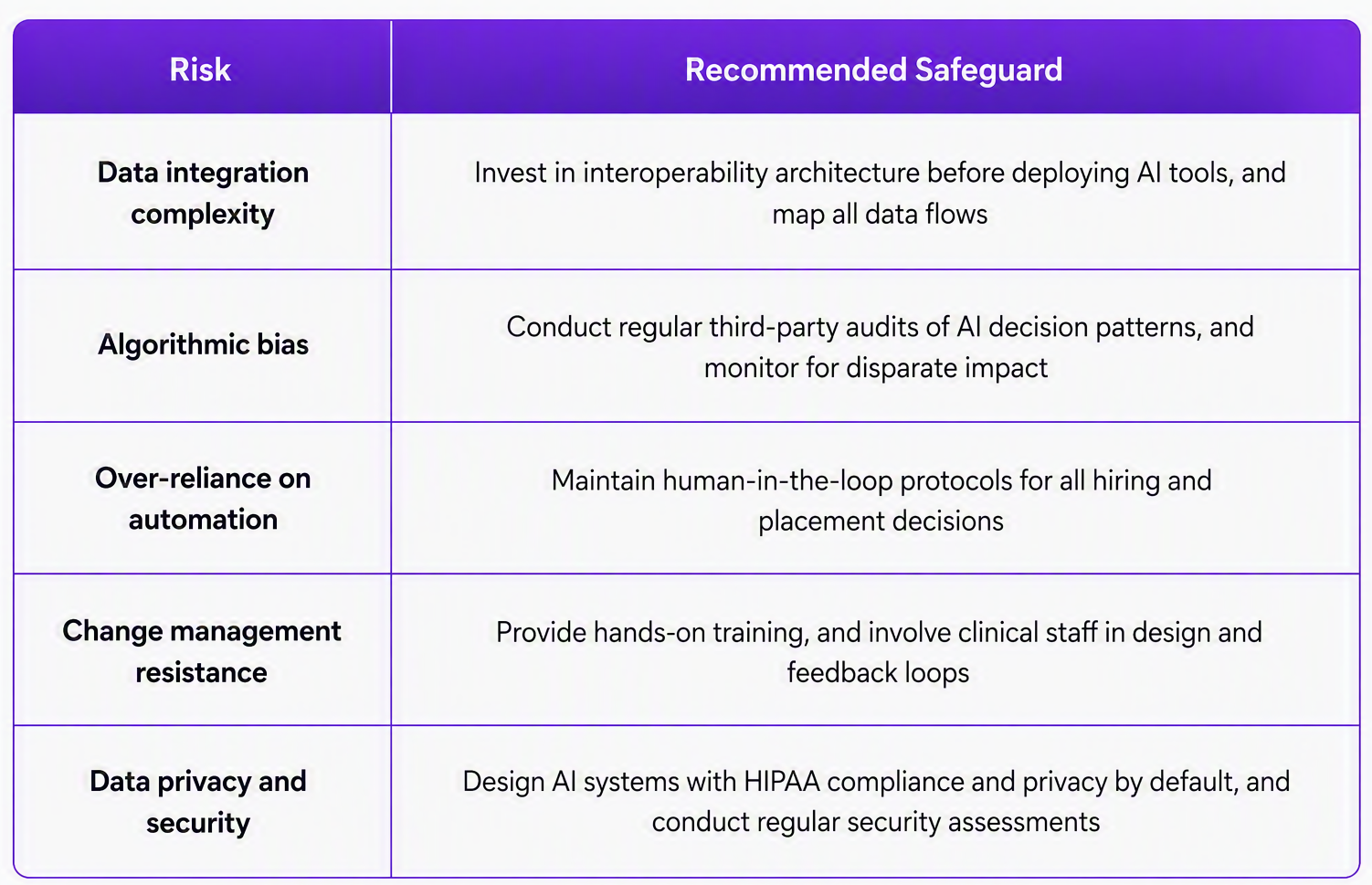
The largest effort is often workflow and data integration, not the algorithm. Organizations that underestimate change management and governance requirements often find their technology investments underperform—not because the tools are inadequate, but because the organizational infrastructure was not ready.
Future Outlook: From Reactive Hiring to Strategic Workforce Planning
AI in healthcare staffing is moving from a collection of point tools, such as screening and matching, to a strategic workforce planning layer. The next generation of AI platforms will integrate predictive analytics, real-time demand signals, and financial modeling into a unified decision-support system.
This shift is already visible. AI assistants that support executive decision-making are moving from concept to pilot. The WorkWise AI Assistant aims to support leaders' decisions rather than only automating transactions.
Predictive analytics should continue to improve candidate-role alignment and retention as models learn from placement outcomes. The future model is hybrid: AI handles efficiency, pattern recognition, and data synthesis, while people handle empathy, complex judgment, and the relational aspects of clinical care that no algorithm can replace.
Glossary of Key Terms in AI Healthcare Staffing
AI matching: An automated process that uses machine learning to compare candidate qualifications, certifications, and preferences against job requirements, producing ranked shortlists that prioritize clinical fit, compliance readiness, and retention probability for healthcare roles.
Predictive staffing: A workforce planning approach that uses historical and real-time data—including patient census, seasonal trends, admissions patterns, and acuity levels—to forecast staffing demand and proactively adjust labor coverage before shortages or overstaffing occur.
VMS (Vendor Management System): A technology platform healthcare organizations use to manage contingent labor suppliers, track agency staffing costs, ensure rate transparency, and maintain compliance across external workforce engagements.
MSP (Managed Service Provider): A third-party organization that manages a healthcare system's contingent workforce program, overseeing vendor relationships, rate negotiations, compliance monitoring, and performance reporting on behalf of the client.
NLP (Natural Language Processing): A branch of AI that enables machines to understand, interpret, and generate human language, used in healthcare staffing for resume parsing, chatbot screening, job description optimization, and clinical documentation automation.
Ambient AI: AI technology that passively listens to and documents clinical conversations in real time, reducing the need for manual documentation and freeing clinicians from hours of post-shift paperwork that contributes to burnout.
Credential automation: The use of AI to capture, normalize, verify, and monitor healthcare worker credentials—including licenses, certifications, immunizations, and background checks—eliminating manual bottlenecks that delay hiring.
Time-to-fill: A recruitment metric measuring the number of days between a job requisition opening and a candidate accepting the offer, commonly used in healthcare staffing to benchmark hiring efficiency and calculate vacancy costs.
Human-in-the-loop: An AI deployment model where automated systems generate recommendations or decisions, but a human reviewer retains final authority—essential in healthcare staffing to ensure clinical judgment, fairness, and compliance oversight.
Frequently Asked Questions
How Does AI Reduce Time-to-Fill in Healthcare Roles?
AI automates resume screening, candidate matching, and early candidate engagement, compressing early recruitment stages from days or weeks into minutes. Combined with credential automation that runs verification in parallel, this approach can cut healthcare time-to-fill significantly. The WorkWise platform combines matching, chat, and credential automation to help clients improve recruiting efficiency and reduce administrative burden.
Can AI Replace Human Recruiters in Healthcare Staffing?
AI augments recruiters by handling data-intensive tasks such as screening, matching, and candidate engagement, but human judgment remains essential for assessing cultural fit, empathy, and clinical suitability. The industry standard is a human-in-the-loop model where AI recommends and people decide, particularly for roles that affect patient care and safety.
In What Ways Does AI Help Reduce Clinician Burnout?
AI reduces burnout by automating administrative tasks such as documentation, routine communications, and workflow coordination. Predictive tools can flag fatigue risk based on shift patterns, such as consecutive long shifts and late clock-outs, enabling managers to intervene before burnout leads to turnover. Ambient AI further reduces documentation burden by automatically transcribing clinical conversations.
How Do Healthcare Organizations Ensure AI Hiring Tools Are Fair and Safe?
Organizations should deploy AI tools that undergo regular third-party audits for bias and transparency. They must maintain strict human oversight of all hiring decisions, and credential and compliance controls should stay non-negotiable. A governance framework that includes clear policies, audit trails, and accountability structures is essential for ethical, clinically valid staffing.
What Are the Cost Implications of Adopting AI for Staffing?
AI requires an initial investment in technology and integration, but it can deliver ROI by reducing vacancy costs, lowering agency spend, and cutting time-to-fill. Organizations should plan for ROI to build over time as adoption improves, workflows mature, and workforce data becomes more connected.