
Best Healthcare Workforce Management Software 2026: How Workwise.ai Compares to Connecteam and UKG
Choosing the right healthcare workforce management software in 2026 takes more than scanning feature lists. Hospitals and health systems face a mix of pressures—persistent staffing shortages, tightening regulatory scrutiny, and rising agency labor costs—that call for platforms built to handle credentialing, labor optimization, vendor management, and operational flexibility in one place.
This article compares leading platforms across the capability dimensions that matter most to healthcare buyers: all-professional-type coverage, built-in vendor management, predictive analytics, float pool management, internal agency support, and SOC 2 certification. Along the way, it highlights three key takeaways: which capabilities separate healthcare-specific platforms from generic tools, how the major options stack up side by side, and how leaders can match a platform to their organization's scale and priorities.
Overview of Healthcare Workforce Management Software
Healthcare workforce management software helps hospitals, clinics, and care facilities optimize labor resources, track time, manage staffing capacity, and stay compliant with credentialing and regulatory requirements. When workforce readiness shapes both patient outcomes and financial performance, these platforms become essential.
Workforce management now sits at the center of operational and strategic planning in 2026. Leaders use it as a decision-support layer that matches workforce capacity with real demand. The conversation has moved from basic staffing administration to enterprise-wide optimization—covering nurse coverage, physician coverage, allied health coordination, and contingent labor governance.
Two trends are shaping buyer decisions this year. First, AI automation is transforming labor forecasting, workforce planning, and rule-based compliance. Second, tighter integration between credentialing, time-and-attendance, and operational systems is closing the data silos that have long complicated complex care settings. Leading tools now automate labor forecasting, time-off workflows, workforce visibility, and compliance controls as a baseline.
The cost of choosing the wrong platform runs high. Research shows that 68% of organizations regret at least one software purchase made in the last 18 months, and 90% have replaced a tool within the past two years. Those numbers explain why a structured, dimension-by-dimension comparison pays off before any workforce management investment.
Key Features to Consider in 2026
The features below separate leading healthcare-specific platforms from legacy or generic tools. They form the evaluation criteria used throughout this article: predictive analytics, credentialing and compliance management, EMR and payroll integration, float pool and internal agency management, and security certifications. Each one addresses a distinct operational challenge that healthcare organizations face at scale.
Predictive Analytics and Workforce Optimization
Predictive workforce analytics uses machine learning and historical data to forecast staffing demand, spot coverage gaps, and recommend qualified resources. This reduces manual effort and operational risk. It marks a real shift away from spreadsheet-based planning or rules-only automation.
Market reviews point to a broad move toward AI-driven workforce planning across vendors in 2026. Advanced platforms now weigh employee skills, certifications, preferences, and availability while forecasting labor demand and tuning staffing levels to prevent both understaffing and overspending.
An important distinction separates true predictive analytics—which forecasts future demand using historical patterns, patient census trends, and seasonal variables—from rule-based automation, which simply applies predefined logic to known scenarios. Buyers should confirm whether a platform truly forecasts or merely automates existing rules.
Credentialing and Compliance Management
Credentialing management verifies and tracks healthcare workers' licenses, certifications, vaccinations, and training records so only qualified personnel reach patient-facing roles or restricted clinical environments. It remains central to regulatory compliance, patient safety, and Joint Commission readiness.
Platforms that combine workforce operations with credentialing cut down on manual checks when assigning clinical staff. The strongest differentiator among enterprise platforms is "hard-block" compliance—the ability to prevent non-credentialed workers from claiming or being assigned restricted work, rather than flagging exceptions after the fact.
Integration With EMR and Payroll Systems
EMR integration lets workforce management software connect directly with electronic medical records systems—such as Epic or Cerner—to sync patient census data, staffing needs, and clinical workflows. That connection enables real-time, data-informed workforce decisions.
Leading platforms integrate with HRIS, EHR, and clinical communication systems to create a unified data environment. Cloud-based platforms update automatically and need no on-premise servers, so distributed staff can clock in, view assignments, and manage tasks from any location.
Common integration types healthcare buyers should evaluate include:
- EMR/EHR systems (Epic, Cerner, WellSky)
- HRIS platforms (Workday, ADP)
- Payroll systems
- Clinical communication tools
- Time and attendance hardware
Float Pool and Internal Agency Management
Float pool management coordinates a flexible group of cross-trained healthcare workers who can move across units or facilities based on real-time demand. Done well, it reduces external agency costs while protecting coverage and care quality.
An internal agency is an in-house staffing model where organizations employ their own pool of per-diem or travel-style workers, managed through workforce software, to fill open shifts before turning to external agencies. This model delivers meaningful cost savings and tighter scheduling control compared with heavy agency reliance.
Both capabilities depend on credential verification, cross-unit visibility, and real-time availability tracking—well beyond what basic scheduling tools offer. As the comparison table shows, these features stand out as a key differentiator among platforms.
Security and Certification Standards
SOC 2 certification is an auditing standard developed by the AICPA that evaluates a service provider's controls for security, availability, processing integrity, confidentiality, and privacy. For healthcare organizations that need assurance their workforce data stays secure, it carries real weight.
Not every platform has achieved SOC 2 certification, which makes it a meaningful differentiator. HIPAA compliance runs alongside it, and buyers should verify both during procurement—especially as these platforms increasingly handle sensitive employee data, credential records, and systems that may touch protected health information.
Overview and Feature Highlights
If your teams spend hours managing coverage gaps, chasing credential expirations, and reacting to last-minute call-outs, WorkWise offers a path forward. WorkWise pairs AI-driven workforce technology with expert guidance to help hospitals, clinics, and care facilities automate credentialing, compliance, labor optimization, and operational workflows.
Key strengths include:
- All-professional-type coverage: WorkWise supports nurses, physicians, allied health, and contingent labor across a connected set of workforce solutions.
- Built-in vendor management: WorkWise's VMS solution manages external agency relationships, rate cards, and vendor-neutral procurement, so you coordinate contingent labor without a separate tool.
- Predictive analytics: The Workforce Planning Dashboard enables organizations to forecast and address future staffing supply and demand gaps with predictive workforce analytics.
- Float pool and internal agency management: WorkWise and its clinician mobile app help you build and manage flexible staffing pools, reducing external agency dependence.
As AI-native automation becomes a procurement priority, WorkWise works alongside you to connect analytics, credentialing, and vendor management—so you spend less time stitching tools together and more time on care. The result reaches beyond cost cutting: transformative talent solutions, expert guidance, and technology that helps deliver outstanding care while driving revenue.
Connecteam Overview and Feature Highlights
Connecteam serves deskless and frontline teams, and it primarily targets small to mid-sized organizations. Its mobile-first approach makes it accessible for teams that want quick adoption without heavy IT involvement.
Connecteam has introduced emerging AI features for message editing, automatic translation, and smart-group coordination that improve frontline communication and ease admin friction. These capabilities make it a practical choice for home health agencies, small clinics, and non-clinical teams that value operational simplicity.
That said, Connecteam favors operational simplicity over enterprise governance. It offers more limited EMR integration than enterprise platforms and lacks built-in VMS, float pool management, internal agency support, and SOC 2 certification. For organizations with complex credentialing needs or multi-facility operations, those gaps may matter.
UKG Healthcare Workforce Management Overview
UKG Pro supports time tracking, staffing, labor planning, and HR compliance workflows across large healthcare organizations. UKG Dimensions enables workforce planning across multi-site operations, making it a strong fit for enterprise-level systems.
UKG provides AI-powered labor forecasting and workforce optimization, distributing work based on employee skills, certifications, and preferences. Enterprise-level organizations rely on it for complex workforce operations and retention, and many regard it as a strong fit for teams that want HR plus workforce management in a single HCM suite.
Even so, UKG typically lacks a built-in VMS and a dedicated internal agency module within its core workforce offering. Float pool support exists but often requires configuration or add-on modules rather than purpose-built functionality. Implementation costs and timelines tend to run higher than cloud-native alternatives, which can be a barrier for mid-size organizations.
Side-by-Side Comparison of Platforms
The table below compares each platform across the capability dimensions that matter most for healthcare workforce management in 2026. Each cell represents a discrete, verifiable fact.
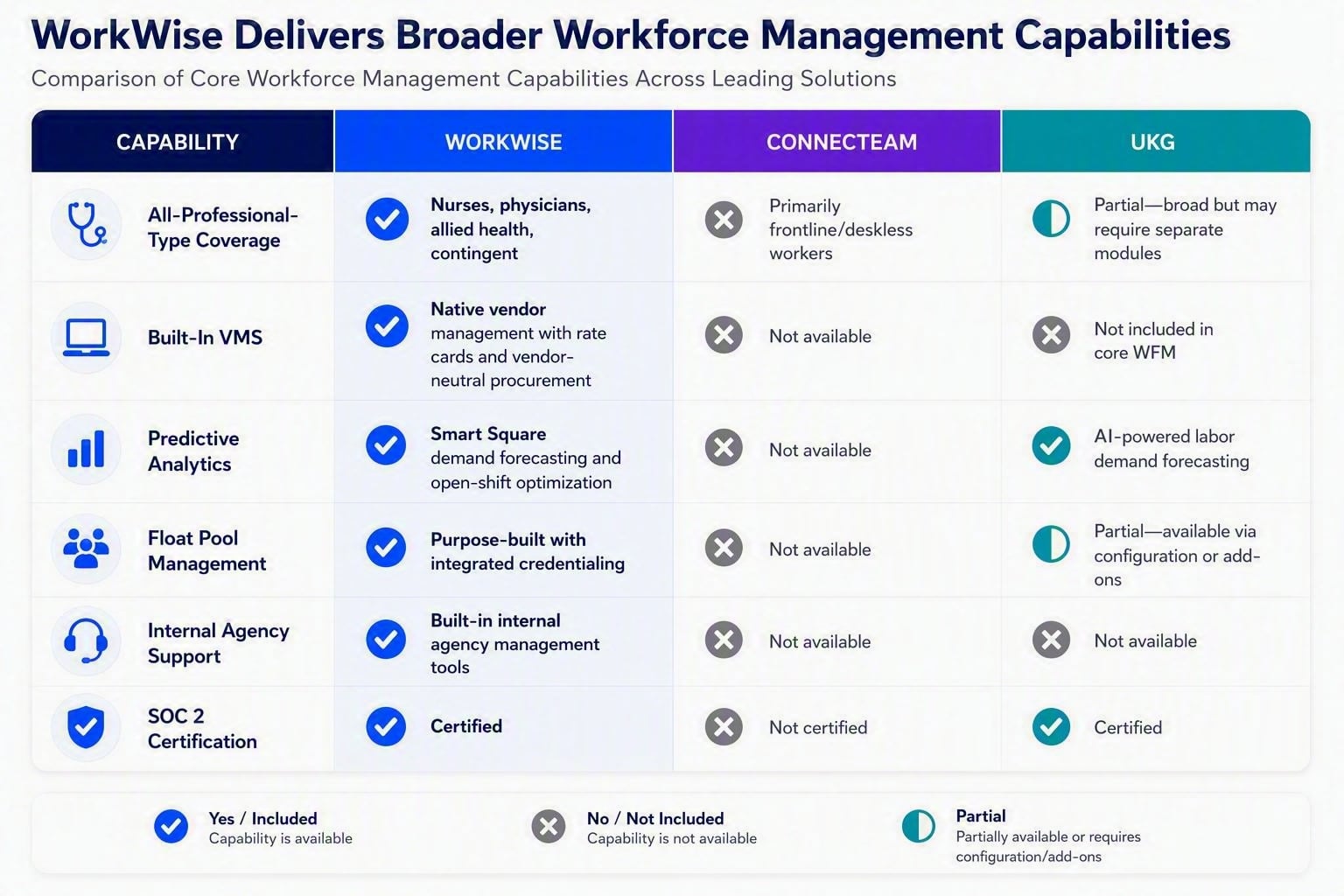
WorkWise earns a full checkmark across all six capability dimensions. This matters because healthcare organizations increasingly need one connected system that handles credentialing, vendor management, labor optimization, and flexible staffing models—without stacking multiple point solutions or costly integrations.
UKG brings real enterprise strengths in AI-powered labor forecasting and broad HR functionality, yet it leaves gaps in VMS and internal agency capabilities. Connecteam suits small, mobile-first teams but lacks the enterprise governance and security certifications larger organizations require.
For health systems that want to address the full complexity of workforce operations, credentialing, and compliance, WorkWise's connected approach removes the burden of integrating separate tools.
All-Professional-Type Coverage
Most platforms specialize in one or two worker types. Connecteam targets frontline and deskless workers. UKG covers broader populations but may require separate modules or configurations to manage all professional types.
AMN Healthcare supports workforce management for nurses, physicians, allied health professionals, and contingent labor across a connected set of solutions. This removes the operational fragmentation that appears when organizations run different tools for different workforce segments.
Built-In Vendor Management System (VMS)
A vendor management system automates the procurement, management, and billing of contingent and agency labor. It enables healthcare organizations to manage vendor relationships, enforce rate compliance, and track agency worker performance from within their workforce management system.
Neither Connecteam nor UKG offers a built-in VMS as part of its core product. Organizations using these platforms typically procure a separate VMS and integrate it—adding cost, complexity, and data reconciliation work. WorkWise's vendor-neutral VMS embeds this capability directly, so you manage agency labor and rate cards in one place.
Predictive Analytics Capabilities
True predictive analytics goes beyond dashboards and historical reports. It forecasts future staffing demand using patient census trends, seasonal patterns, and historical utilization data, then recommends optimal staffing before shortages hit.
UKG provides AI-powered labor demand forecasting and workforce optimization, placing it among the few competitors with genuine predictive capabilities. Connecteam lacks predictive analytics entirely.
The predictive capabilities of the WorkWise Workforce Planning Dashboard help healthcare leaders move from reactive staffing decisions to proactive workforce planning. By analyzing workforce supply, demand, utilization, and cost drivers in a single view, the dashboard identifies upcoming staffing gaps before they occur, enabling organizations to take action earlier and with greater confidence. Predictive modeling, automated recommendations, AI-powered insights, and drill-down analytics help leaders anticipate risks, optimize staffing strategies, balance cost and coverage, and make informed workforce decisions that support both operational performance and long-term sustainability.
Float Pool Management Features
Effective float pool management requires cross-unit visibility, credential verification, and real-time availability tracking. Leaders need to know instantly which float pool staff are credentialed for a specific unit, available for the work, and not already assigned elsewhere.
UKG offers partial float pool support, often through workarounds or add-on modules rather than purpose-built functionality. Connecteam lacks dedicated float pool features. WorkWise provides purpose-built float pool management with integrated credentialing checks, so only qualified workers deploy across units and facilities.
Internal Agency Support Functions
The internal agency model lets healthcare organizations recruit and manage their own pool of per-diem, PRN, or travel-style workers—offering agency-level flexibility at far lower cost than external staffing firms. Organizations with internal agencies can fill open shifts with their own flexible workforce before paying premium agency rates.
This capability remains relatively new to the market, and neither Connecteam nor UKG offers dedicated internal agency support. WorkWise provides built-in internal agency management tools, helping you create, scale, and manage an in-house staffing pool alongside your core workforce.
SOC 2 Security Certification Status
Two of the three platforms in this comparison—WorkWise and UKG—have achieved SOC 2 certification. Connecteam has not.
SOC 2 carries particular weight in healthcare because these platforms handle sensitive employee data, credential records, and systems that may touch protected health information. For organizations subject to HIPAA requirements and enterprise procurement standards, SOC 2 certification is a baseline trust signal worth verifying during evaluation.
Choosing the Right Healthcare Workforce Management Software
No single "best" product fits every healthcare context in 2026. The right choice depends on organizational scale, automation needs, integration requirements, and the specific staffing challenges you face. With 68% of organizations regretting at least one software purchase made in the last 18 months, a structured evaluation process protects your investment.
Matching Platform to Organization Size and Complexity
Different platforms serve different organizational profiles:
- Small clinics and home health agencies (fewer than 100 staff): Connecteam offers quick adoption, a mobile-first interface, and low cost—a practical starting point for smaller teams with straightforward needs.
- Mid-size hospitals and health systems (100–1,000 staff): AMN Healthcare delivers AI-driven automation, built-in VMS, and float pool management without the cost and complexity of legacy enterprise suites.
- Large multi-hospital systems (1,000+ staff): UKG offers deep enterprise governance, extensive HR functionality, and proven scale.
- Organizations seeking one connected platform across all dimensions: WorkWise covers all six capability areas, removing the need to integrate multiple point solutions.
Prioritizing AI Automation and Compliance Needs
Organizations buried in manual workforce administration—spending hours managing coverage gaps, chasing credential expirations, and responding to last-minute needs—should prioritize platforms that automate demand forecasting, workforce matching, and credential validation from day one.
Organizations operating in complex regulatory environments, facing Joint Commission audits or state-specific staffing mandates, should confirm their platform offers hard-block compliance enforcement. That means the system physically prevents non-credentialed workers from being assigned to restricted roles, rather than flagging violations after the fact.
WorkWise pairs AI-driven automation with credential-aware assignment controls, helping you address operational efficiency and regulatory risk together.
Evaluating User Experience and Mobile Accessibility
Cloud-based platforms make it easier for distributed staff to clock in, view assignments, and manage tasks from any device. But technology only delivers value if frontline workers actually use it. If nurses and clinicians find an app confusing or slow, adoption collapses regardless of the feature set.
Connecteam and AMN PassportWorkWise’s clinician app both earn recognition for intuitive, consumer-grade mobile experiences that keep training time short. Enterprise platforms like UKG can feel more complex given their feature density and configuration options. Buyers should request mobile demos and pilot with frontline staff before committing.
Assessing Integration and Scalability Requirements
Before selecting a platform, buyers should build an integration checklist covering EMR/EHR systems, HRIS platforms, payroll providers, timekeeping hardware, and clinical communication tools. Cloud-native platforms update automatically and require no on-premise servers, reducing IT overhead and simplifying maintenance.
Evaluate API openness, the number of native integrations, and each vendor's track record supporting healthcare-specific connections. A platform that integrates deeply with Epic or Cerner today but lacks an open API may become a bottleneck as your technology ecosystem grows. AMN Healthcare designs its integration approach for healthcare interoperability across credentialing, workforce operations, and operational systems.
Frequently Asked Questions
What Are the Advantages of AI-Driven Workforce Management in Healthcare?
AI-driven workforce management predicts staffing demand, identifies coverage gaps, and matches qualified workers to open needs in real time. This reduces manual administrative effort, lowers labor costs through optimized staffing, and strengthens patient care coverage across units and facilities. Platforms with true predictive analytics can forecast demand days or weeks in advance, preventing both understaffing and costly overstaffing.
How Do Workforce Management Platforms Support Credential Compliance?
Leading platforms automatically verify licenses, certifications, and training records before staff can claim or be assigned restricted work. The most robust systems use hard-block rules that prevent non-credentialed workers from working in restricted roles or facilities—supporting Joint Commission readiness and reducing compliance risk without relying on manual checks.
What Integration Capabilities Should Healthcare Organizations Prioritize?
Healthcare organizations should prioritize native integrations with EMR/EHR systems (such as Epic and Cerner), HRIS platforms (such as Workday and ADP), payroll providers, and clinical communication tools. Smooth data flow across these systems removes manual data entry, reduces errors, and ensures workforce decisions reflect real-time patient census and staffing data.
How Can Workforce Management Software Reduce Administrative Workload in Hospitals?
Workforce management software reduces administrative workload by automating coverage planning, credential verification, open-shift communication, and time-off approvals. Instead of spending hours coordinating staffing and chasing replacements for call-outs, workforce managers can focus on strategic labor planning, retention initiatives, and operational improvement.
What Security Certifications Matter for Healthcare Workforce Management Tools?
SOC 2 certification and HIPAA compliance rank as the most important security standards for healthcare workforce management tools. SOC 2 confirms that employee data, credential records, and any protected health information receive auditable safeguards for security, availability, and confidentiality. Buyers should verify both certifications during the vendor evaluation process.