

Calculate Hospital Workforce Software ROI Using Your Own Data
Hospital labor remains one of the largest operating expenses for health systems. As staffing shortages, overtime pressure, and reliance on contract labor continue to challenge hospital budgets, workforce management software has become an increasingly important investment. But how do you prove the investment pencils out?
Return on investment for hospital workforce software is the net financial gain an organization realizes from the platform, calculated as (Annual Savings − Annual System Cost) / Annual System Cost × 100. When that number exceeds 100%, the system pays for itself and generates net gain. This article provides a step-by-step calculation methodology and an input-driven ROI calculator so a finance team can build a defensible, CFO-ready business case using the hospital's own data. Use the embeddable input-driven WorkWise™ ROI calculator included below to model a specific hospital's case.
Understanding ROI for Hospital Workforce Software
ROI for hospital workforce software is the primary financial metric leaders should track when evaluating technology investments in 2026. It captures cost avoidance and the value of better staffing decisions, including fewer overtime hours, lower agency reliance, improved retention, and reduced administrative burden.
This urgency comes from the operational reality hospitals face every day: labor is expensive, staffing gaps are disruptive, and leaders need a clear way to connect workforce technology investments to measurable cost control and operational improvement.
Rather than relying on competitor claims or broad industry benchmark tables, hospitals should frame ROI around the cost categories they can validate internally: overtime, agency and contract labor, retention, and administrative productivity. This keeps the business case grounded in the organization's own financial reality and avoids overstating savings based on figures that may not apply to its staffing model, market, or implementation scope.
Key Cost-Savings Categories to Model
This section breaks the ROI opportunity into cost categories a team can map directly to internal budget line items.
Overtime Reduction
Centralized staffing platforms help hospitals manage overtime by improving visibility into labor needs, open shifts, scheduling patterns, and staffing gaps. To keep ROI modeling defensible, overtime assumptions should draw on the hospital's own payroll history rather than unsupported benchmark ranges.
Agency and Contract Labor
Agency and contract labor remain major cost centers for hospitals. A vendor management system supports better visibility into contingent labor usage, rate management, and vendor performance. Savings assumptions should still come from the hospital's actual agency spend, contract terms, and utilization trends.
Nurse Retention
Retention can be a meaningful financial lever because turnover creates recruiting, onboarding, vacancy, and productivity costs. Hospitals should model retention savings using their own historical turnover data and finance-approved replacement cost assumptions.
Administrative Productivity
Scheduling automation reduces manual administrative work by streamlining shift creation, approvals, credential checks, and staffing communications. Hospitals should quantify this opportunity using internal scheduling workload, admin FTE time, and process-cycle data.
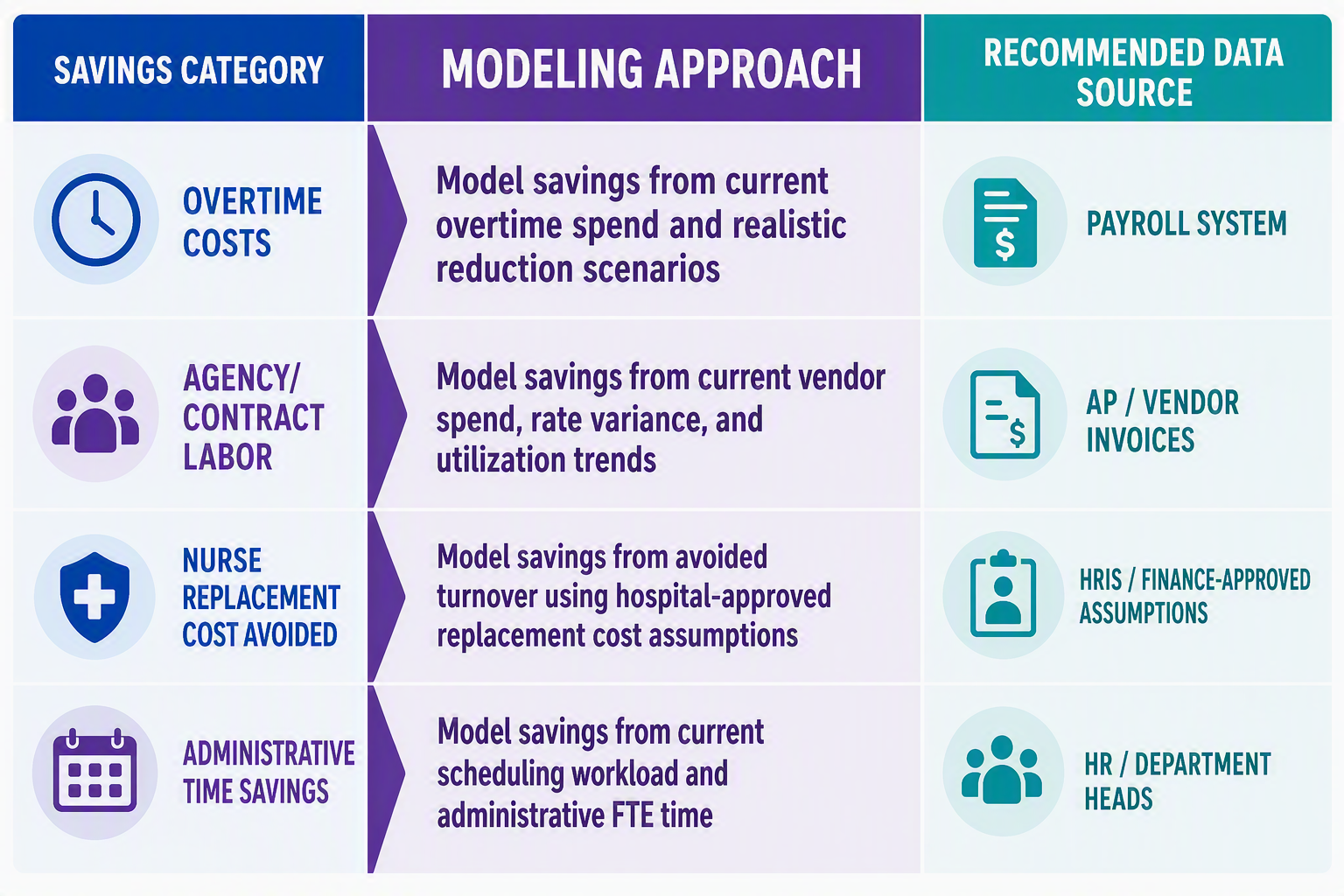
As labor demand continues to rise, the strongest ROI case comes from connecting workforce software capabilities to the hospital's own measurable cost drivers rather than citing competitor performance or unsupported market averages.
How to Calculate ROI Using Your Hospital's Data
Turning internal data into a credible financial model follows a four-step process: establish the baseline, build scenario assumptions, convert projected improvements to dollars, and subtract full system costs. Use the interactive ROI calculator below with your own inputs—nurse FTE count, average RN hourly rate, current overtime percentage, and current agency spend—to generate a personalized estimate. The embedded calculator accepts those four inputs and produces conservative, moderate, and optimistic scenarios you can export for executive review.
ROI Calculator
Input the hospital's data to estimate annual savings:
- Nurse FTE count: ___
- Average RN hourly rate ($): ___
- Current overtime (%): ___
- Current annual agency spend ($): ___
Here is the step-by-step methodology behind the calculator's logic.
Defining Baseline Inputs: Labor, Overtime, Agency Spend
Accurate ROI modeling starts with establishing the hospital's current-state cost baseline. Without this, improvement percentages carry no meaning. Baseline inputs are the current-state financial metrics, typically pulled from payroll, accounts payable, HR, and scheduling systems, against which all projected improvements are measured.
Gather these four essential data points before modeling:
- Total annual labor spend (salaries, benefits, differentials)
- Annual overtime expenditure (hours × premium rate)
- Annual agency and contract labor spend
- Administrative FTE count dedicated to scheduling, credentialing, and compliance
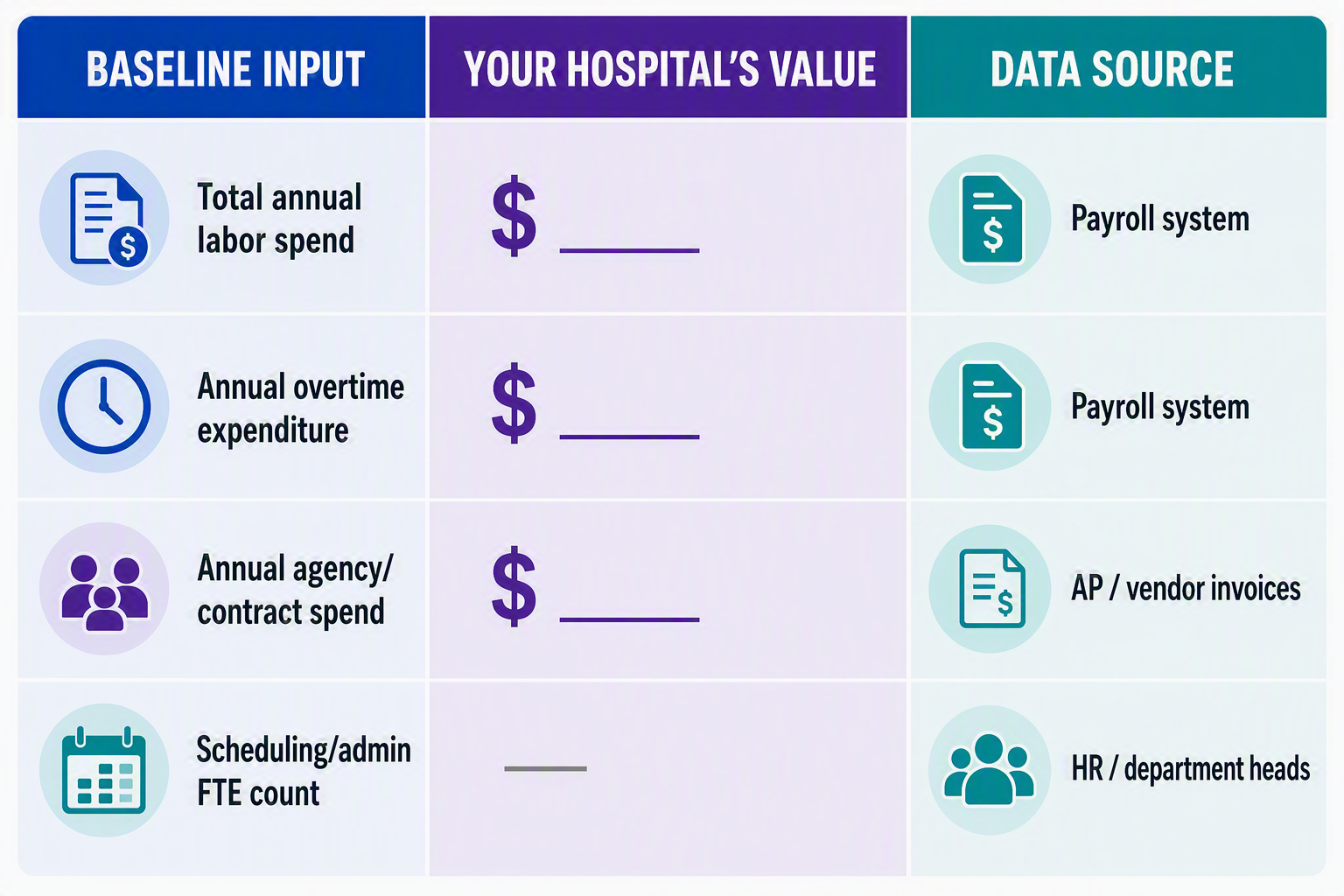
Labor pressure makes workforce strategy a major financial lever. Establishing an honest baseline is the required first step.
Building Scenario Assumptions From Internal Data
Instead of applying fixed benchmark ranges, build conservative, moderate, and optimistic scenarios from the hospital's own baseline data. Finance teams should choose assumptions they can defend based on current staffing patterns, historical overtime trends, vendor utilization, implementation scope, and adoption expectations.
Recommended areas to model with hospital-specific data:
- Overtime reduction based on current overtime spend and staffing patterns
- Direct labor cost impact based on payroll and scheduling data
- Agency spend reduction based on current vendor utilization and rate variance
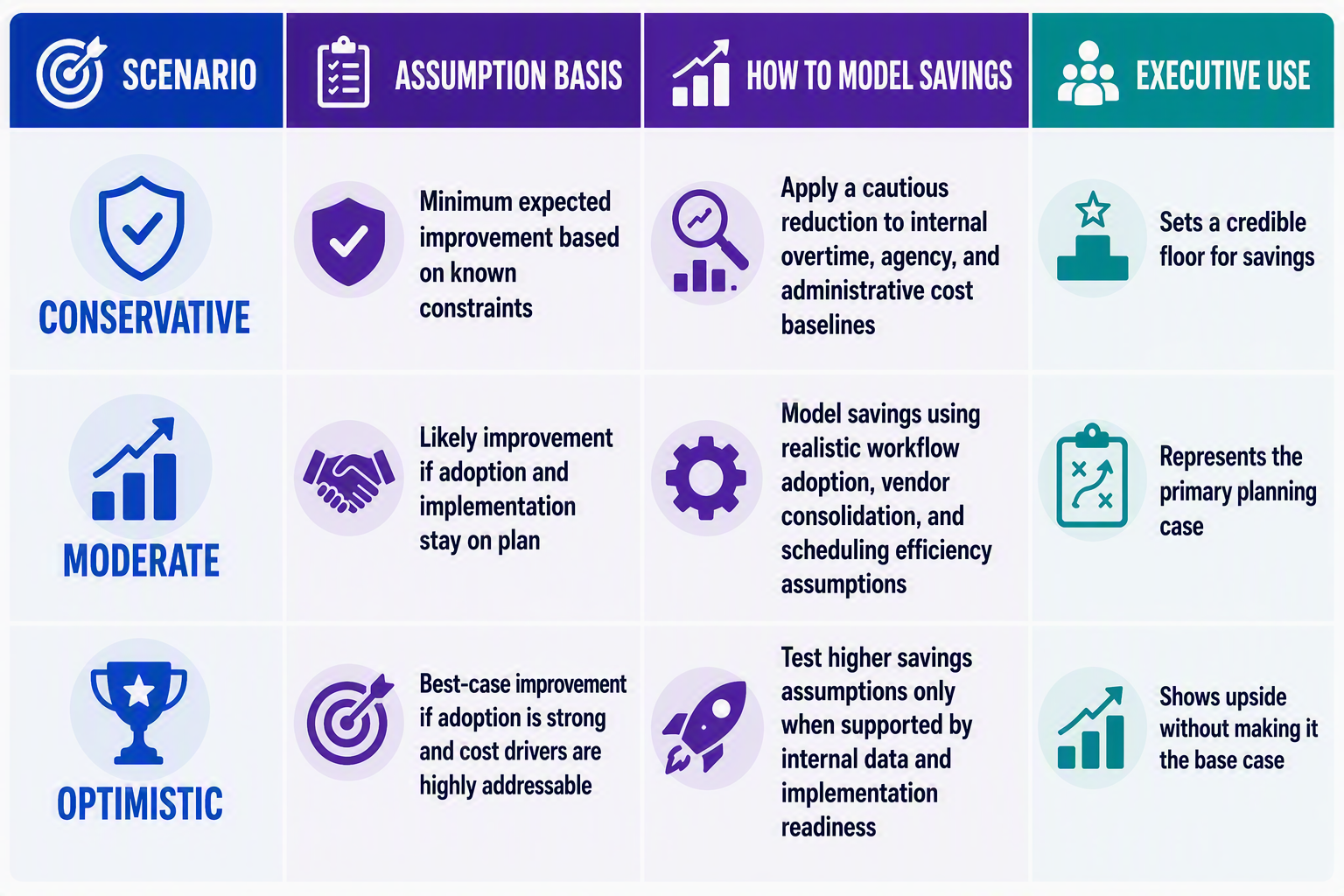
This scenario structure avoids presenting universal savings claims and keeps the model tied to the hospital's own operating profile.
Translating Improvements Into Dollar Savings
Percentages only matter when converted to dollars using the hospital's own cost baseline. For example, finance teams can estimate overtime savings by multiplying current annual overtime spend by a selected reduction assumption. Agency savings can be modeled the same way using current vendor spend, rate variance, and utilization trends. The key is to show the calculation logic clearly so executives can see how each assumption translates into projected annual savings.
When presenting to executives, include both quantitative savings and qualitative benefits, such as reduced clinician burnout, stronger retention, better staffing consistency, and improved patient experience. These outcomes can influence retention, reputation, and value-based reimbursement.
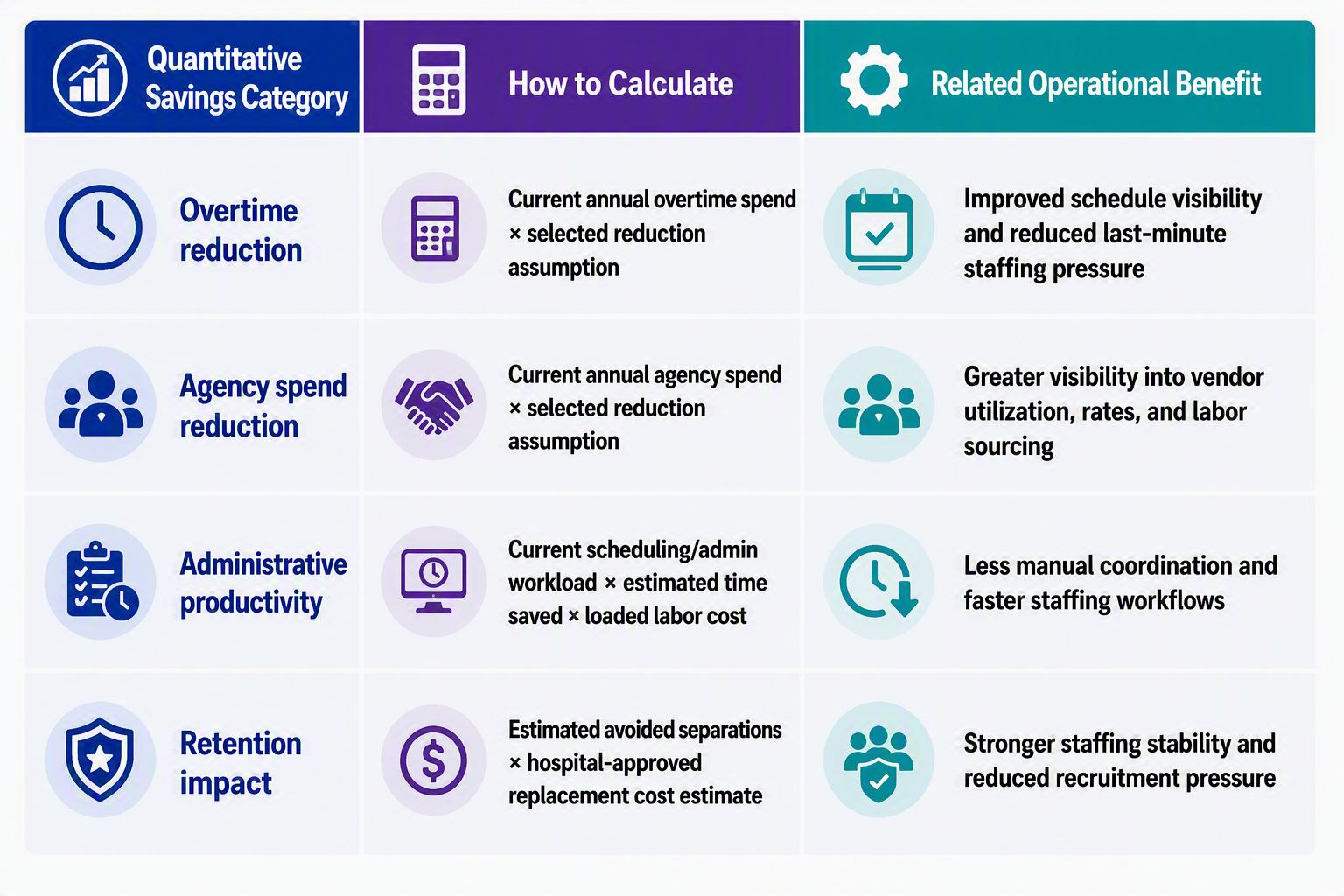
Accounting for Software and Implementation Costs
A credible ROI model must include the full lifecycle cost of the software, not just the license fee. Omitting hidden costs overstates returns and undermines credibility with a CFO.
Include all of these cost components:
- Software licensing or subscription fees
- Implementation and configuration
- Training and change management
- Data migration and integration with legacy systems
- Ongoing support and maintenance
- Internal staff time allocated to rollout
Apply the formula, ROI = (Annual Savings − Annual System Cost) / Annual System Cost × 100. "Annual System Cost" must encompass everything above, not just the SaaS fee. Third-party analyses, for example Davix.ai, note that when ROI exceeds 100%, the system pays for itself and generates net gain.
WorkWise's Approach to Maximizing Workforce ROI
WorkWise brings internal agency and float pool management, core recruitment, contingent staffing, and employee talent engagement together in a single system. This consolidation reduces the fragmented tooling that inflates costs and obscures visibility across labor categories.
The platform's AI and predictive analytics focus on the ROI levers above. Automated tiering prioritizes cost-effective labor sources, including internal staff and internal agency pools, before routing to external per diem and travel staff. Centralized contingent labor oversight and vendor management help hospitals evaluate current contract labor spend, rate variation, vendor performance, and utilization patterns using their own data. Compliance automation also reduces manual administrative burden by streamlining credentialing, approvals, and workforce documentation. WorkWise surfaces operational KPIs and supports post-implementation validation so realized savings can be measured against projections.
Each capability maps to a measurable financial outcome:
- Float pool optimization, overtime management
- VMS integration, agency spend visibility and optimization
- Systemwide visibility, data-driven decision-making that sustains savings over time
WorkWise recommends tying vendor commitments to measurable KPIs such as overtime percentage, agency utilization rate, fill rate, and administrative productivity, with post-implementation measurement required to validate claims. Accountability is the basis of a credible partnership.
Validating ROI After Implementation
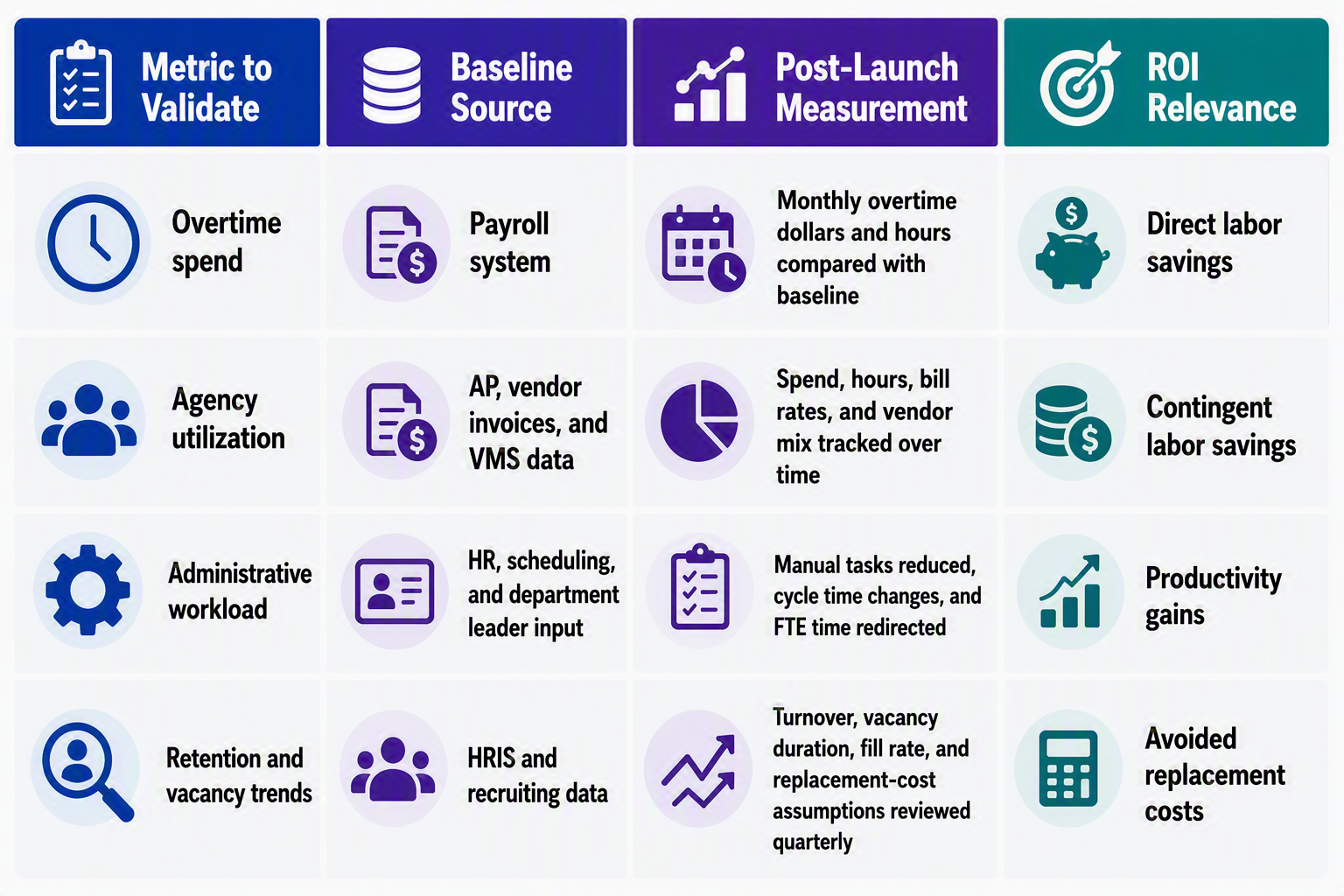
Because ROI varies by organization, the most defensible proof comes from comparing projected savings against actual post-implementation performance. Instead of relying on competitor examples or broad industry claims, hospitals should establish baseline metrics before launch, measure progress at regular intervals, and document which savings are attributable to workflow changes, technology adoption, and labor strategy improvements.
Common Challenges and Risks in Workforce Software ROI
ROI projections are only as strong as the assumptions behind them. The biggest risks are delays, low adoption, underused features, and incomplete cost accounting.
Common risks include:
- Legacy system integration and data migration delays that increase implementation cost and slow time-to-value.
- Weak change management, unclear workflow ownership, or staff resistance that limits adoption.
- Underused features that reduce the value of the software investment.
- Incomplete cost accounting that omits training, change management, integrations, or internal staff time.
- Overreliance on AI without human oversight for complex workforce or payer-related decisions.
Mitigate these risks by modeling sensitivity scenarios for adoption speed, implementation timing, and change management effectiveness.
Best Practices for Building a CFO-Ready Business Case
A strong business case packages the ROI analysis into a narrative that earns executive approval and budget allocation. Follow this checklist:
- Lead with the hospital's own labor cost context, including total labor spend, overtime exposure, agency utilization, vacancy trends, and administrative workload.
- Use hospital-specific baseline data, not industry averages alone. The payroll and AP systems hold the numbers that matter.
- Build conservative, moderate, and optimistic scenarios using assumptions that finance, operations, and HR leaders can validate.
- Include both quantitative savings, such as overtime, agency spend, administrative workload, and retention, and qualitative benefits, such as staffing consistency, provider wellness, and patient experience.
- Account for full lifecycle costs, including change management, training, and internal staff time.
- Tie vendor commitments to measurable KPIs, with post-implementation measurement requirements built into the contract.
- Present a payback timeline based on the hospital's projected savings, implementation schedule, adoption plan, and full system cost.
- Include the ROI calculator output as an appendix to the business case, personalized with the hospital's own data. This turns an abstract proposal into a concrete, defensible financial model.
Ready to build a customized ROI assessment? Contact WorkWise for a data-driven analysis tailored to your system's labor profile and strategic priorities.
Frequently Asked Questions
How Do I Calculate the ROI for Hospital Workforce Software?
Use the formula ROI = (Annual Savings − Annual System Cost) / Annual System Cost × 100. Focus on savings from overtime reduction, agency spend optimization, administrative productivity, and retention, then subtract the full lifecycle cost of the software, including implementation, training, change management, integrations, and internal staff time. The strongest ROI model uses the hospital's own baseline data and scenario assumptions that finance and operations leaders can review.
What Cost-Savings Categories Should Hospitals Model?
Hospitals should focus on cost-savings categories they can validate through internal data: overtime management, agency spend optimization, administrative productivity, and retention. Retention savings should be modeled using the hospital's own turnover history and finance-approved replacement cost assumptions.
How Soon Can Hospitals Realize a Positive ROI After Implementation?
Timing depends on implementation scope, system integration, adoption, and the baseline cost categories being targeted. Hospitals should model payback using their own projected savings and full system costs rather than relying on a fixed industry timeline.
What Hidden Costs Might Reduce the Expected ROI?
Common hidden costs include initial training time, data migration to HIPAA-compliant environments, integration with legacy systems, change management resources, and under-utilization of features. Including these in the total cost model prevents overstating projected returns and protects credibility with the C-suite.
Can Workforce Software Directly Improve Patient Outcomes and Revenue?
Yes. Optimized staffing ratios can reduce wait times, support patient safety, and improve operational consistency. These improvements may support broader quality and experience goals when staffing gains are measured against internal performance data.