

Healthcare Vendor Management System Guide: Benefits, Costs, and Choosing in 2026
Healthcare organizations carry a heavy load: quickly fill clinical roles, control labor costs, and hold the line on regulatory compliance simultaneously. With contract labor still representing a major expense for health systems, unmanaged contingent workforce programs have become a financial and operational liability. A healthcare vendor management system can ease that complexity. This guide explains what a healthcare VMS is, outlines its benefits, compares it against MSP and in-house staffing models, breaks down costs and ROI, and walks leaders through a practical six-step selection process for 2026.
What Is a Healthcare Vendor Management System (VMS)?
A healthcare vendor management system (VMS) is a centralized software platform that manages the sourcing, credentialing, compliance tracking, and billing of contingent healthcare labor. It replaces fragmented manual processes with auditable, automated workflows that give hospitals visibility and control over their temporary workforce.
Health systems face persistent staffing shortages, volatile agency costs, and stricter regulatory requirements. When teams manage contingent labor through spreadsheets, phone calls, and email chains across dozens of staffing agencies, errors multiply, costs climb, and compliance gaps appear. A VMS platform centralizes requisitions, credentialing, compliance tracking, timekeeping, and billing into a single system of record.
Here is how a healthcare VMS works at a high level:
- Requisition—A hospital posts an open shift or role into the platform.
- Vendor distribution—The system broadcasts the need to all approved staffing agencies at once.
- Candidate submission and credentialing—Agencies submit candidates, and the VMS automatically verifies credentials and compliance documents.
- Time and attendance—The platform captures and approves timesheets, then syncs them with payroll.
- Billing and analytics—Invoices consolidate into one view, and workforce performance data reports in real time.
This automation replaces the patchwork of manual coordination that still dominates many health systems. WorkWise™ is vendor-neutral, which lets approved agencies compete equally and helps hospitals keep control of their contingent workforce strategy. As a fully integrated workforce platform, WorkWise™ pairs AI, automation, and analytics to give leaders one place to forecast, plan, source, and manage talent.
Key Benefits of a Healthcare VMS
A healthcare VMS delivers value across finance, operations, compliance, and clinician experience. Below are five core benefits.
1. Real-Time Workforce Visibility and Analytics
A healthcare VMS replaces guesswork with data, giving leaders real-time visibility into who is working, for how long, and at what cost. That visibility supports stronger forecasting for future workforce needs and surfaces opportunities to consolidate redundant vendors.
Vendor performance reporting within a VMS typically includes fill rates, time-to-fill, compliance rates, and quality metrics. These dashboards help workforce leaders spot trends, compare agencies objectively, and make data-driven decisions about vendor pools. WorkWise provides real-time market rate insights and analytics so leaders can benchmark labor costs and plan with confidence.
2. Automated Credentialing and Compliance Management
Compliance requirements are strict, and the stakes are high. A VMS embeds regulatory rules directly into hiring workflows, making sure contractors meet every requirement before they arrive on a unit. The platform tracks credential and compliance documents per role and per candidate, creating a structured verification process that closes manual oversight gaps.
Healthcare-specific VMS platforms should support HIPAA, SOC 2 Type II, ISO 27001, and Joint Commission requirements. They can also flag non-compliant contract terms during creation and management. The result is stronger compliance automation, with each contingent worker verified before assignment and audit trails that document contract activity for regulatory review. Continuous monitoring can also alert hospitals to new risks, breaches, or emerging compliance issues in real time—so teams act early rather than react late.
Learn more about how proactive credentialing workflows reduce last-minute risk in contingent labor programs.
3. Significant Cost Control and Rate Transparency
For CFOs and workforce leaders, a VMS helps reduce contingent labor costs by improving rate visibility, standardizing markups, and enabling more competitive vendor management.
A VMS enforces rate and markup visibility across vendors, so hospitals negotiate more effectively with suppliers. Consolidated invoicing also reduces reconciliation errors by bringing invoices, time cards, and communications into a single billing workflow. A strong VMS should track savings from internal utilization, prioritizing internal staff before releasing shifts to external agencies. WorkWise™ supports this tiered approach, and clients have built internal agencies that saved more than $12 million while enabling 1,600 providers to self-manage schedules.
4. Operational Efficiency and Time Savings
Administrative bottlenecks consume hours of clinical and HR time every week. A VMS removes many of those tasks through automation, accelerating vendor onboarding, reducing manual review, and lowering administrative costs. In practical terms, that means less time on paperwork and more time on patient care.
A VMS coordinates timesheets, approvals, invoices, and candidate submission tracking through the same workflow. This eliminates duplicated effort across departments and lets teams focus on workforce planning rather than paperwork.
5. Enhanced Clinician Satisfaction and Vendor Performance
A healthcare VMS helps deliver vetted, ready-to-work candidates in one place, reducing frustration for hiring managers and clinical leaders. When qualified professionals fill shifts on time, patient care and team morale both improve.
Performance accountability is built into the platform. A healthcare VMS should monitor fill rates by workforce category, so hospitals can hold vendors accountable and route more requisitions to top performers. WorkWise™ includes clinician self-service and mobile tools that support smoother workforce workflows and keep clinicians engaged.
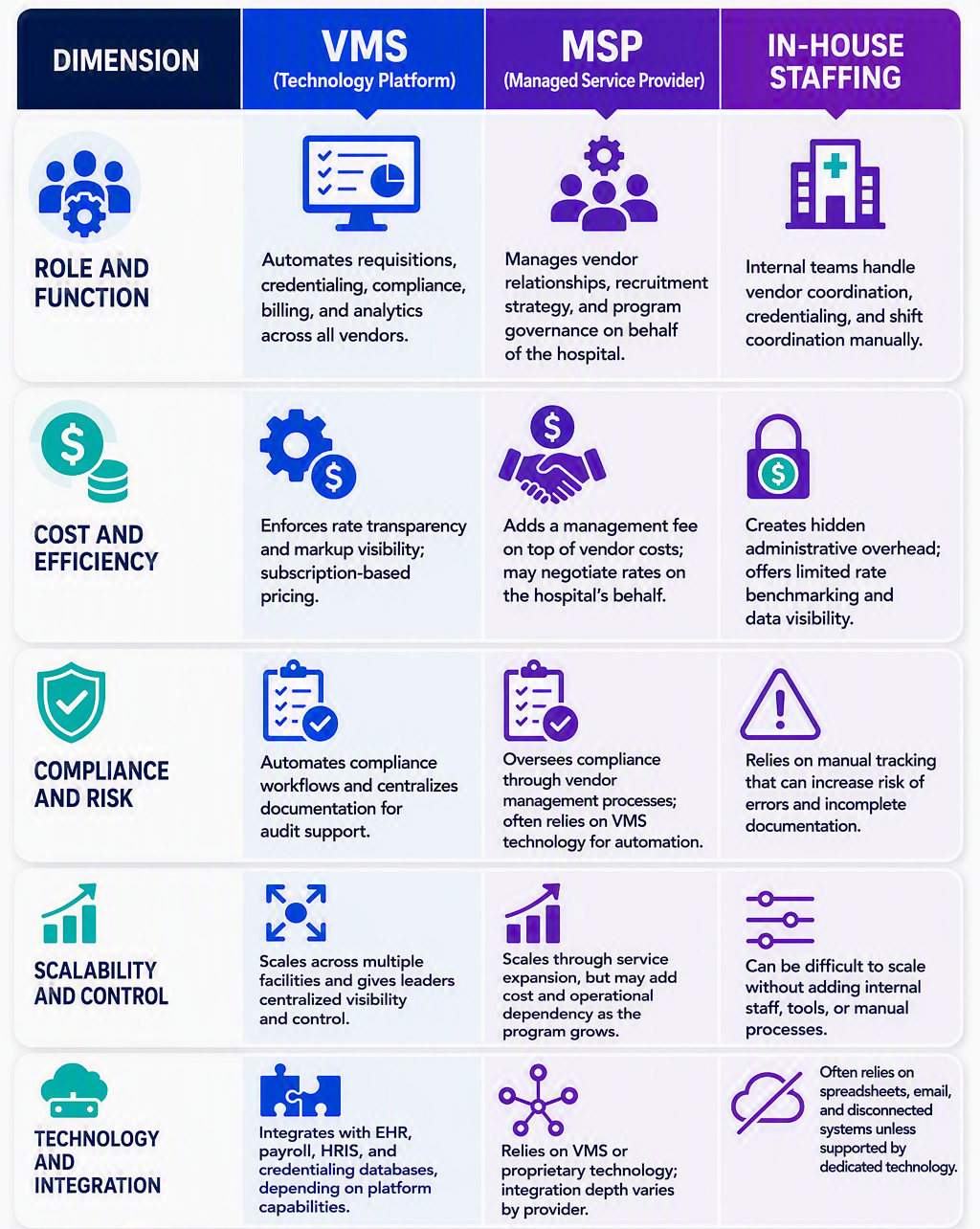
Comparing VMS, MSP, and In-House Staffing Models
Understanding these three models is essential before any investment decision. They are different, and each plays a distinct role in contingent workforce management.
- VMS (Vendor Management System): The technology platform that automates requisitions, credentialing, billing, and analytics for contingent labor.
- MSP (Managed Service Provider): A third-party service provider that manages vendor relationships and recruitment on behalf of the hospital, often using a VMS as its technology backbone.
- In-House Staffing: Internal HR and recruitment teams managing contingent labor manually or with basic tools.
A VMS works alongside MSPs and staffing agencies. It provides the technology layer that makes partnerships between the hospital, MSP, and vendors more efficient and transparent.2
WorkWise™ is vendor-neutral. Vendor-neutral platforms avoid the conflicts of interest that can arise when an MSP also operates as a staffing agency, and they help ensure the hospital's interests drive every decision.
Understanding Costs and Return on Investment for Healthcare VMS
Typical Pricing Models and Fee Structures
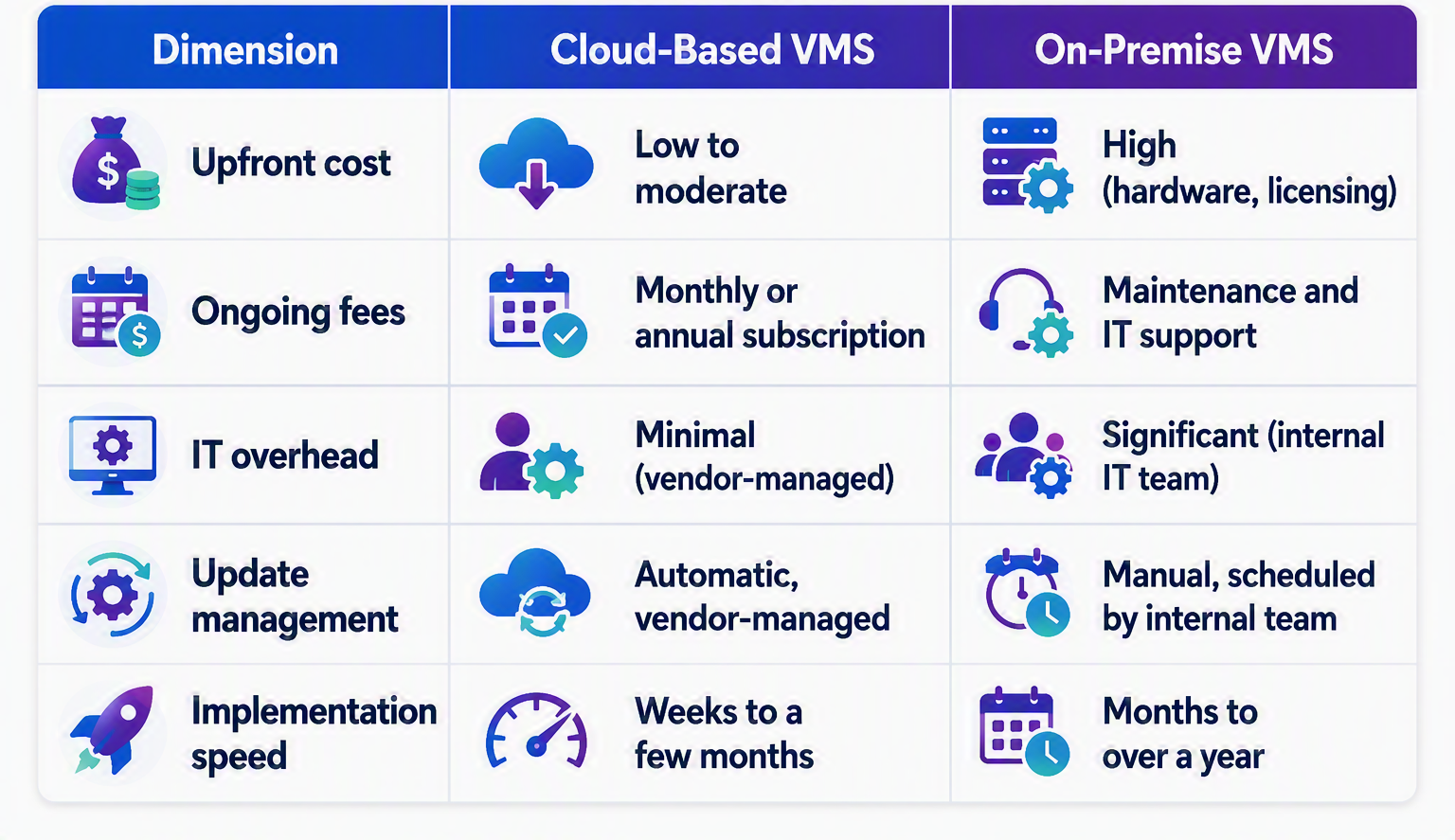
Healthcare VMS pricing typically includes three components: subscription fees (often per-user or per-transaction), one-time implementation fees, and ongoing integration and support costs. Cloud-based systems generally offer faster implementation and lower upfront cost than on-premise software.
Implementation and Integration Expenses
Beyond the license fee, real-world deployment costs include integration with EHR, payroll, HRIS, credentialing databases, and finance systems. Implementation speed is a key question for buyers, so leaders should ask vendors for realistic timelines based on comparable health system deployments.
Change management and training costs are often underestimated but critical to adoption success. Budget for dedicated training across clinical, HR, and finance teams, and confirm the vendor provides ongoing strategic support beyond initial onboarding.
Projected Cost Savings and Efficiency Gains
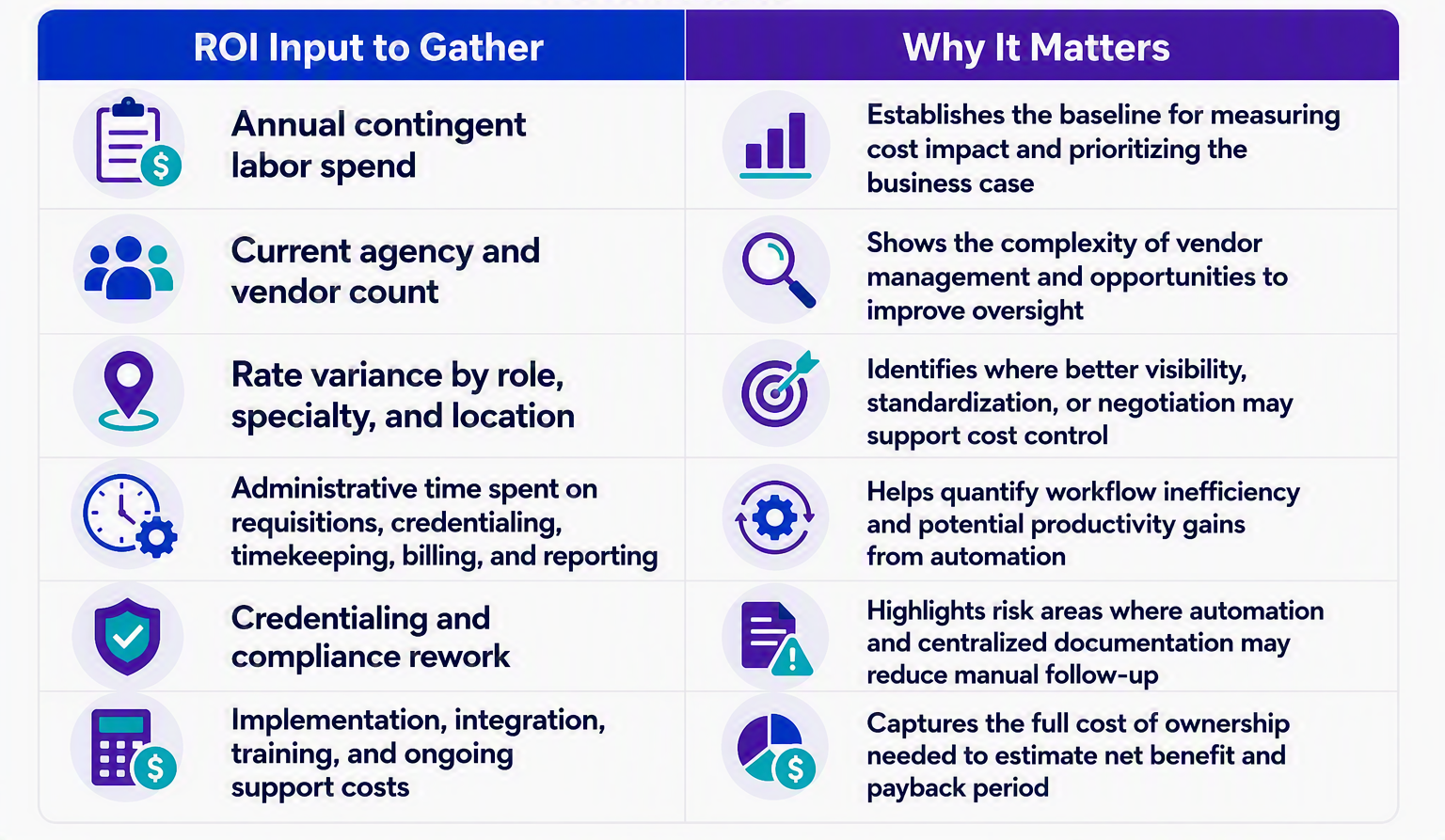
The financial upside of a well-implemented VMS can be substantial, but projected savings should reflect each health system's current contingent labor spend, vendor mix, rate variance, administrative burden, and implementation scope.
Additional savings come from:
- Lower onboarding costs through automation and reduced manual review
- Faster onboarding cycles through standardized workflows and automated credential checks
- Administrative time savings from consolidated invoicing and automated timekeeping
- Reduced compliance penalties through continuous credential verification
Calculating ROI and Payback Period
Leaders can estimate ROI by comparing total expected savings against the full cost of ownership, including subscription, implementation, integration, training, and ongoing support. Use internal baseline data rather than generic benchmarks when building the business case.
Payback period depends on scale, spend concentration, adoption, and implementation costs. For real-world examples, see how Workwise has driven measurable results for health systems in this client success story.
How to Choose the Right Healthcare VMS
Selecting a VMS is a strategic decision that will shape a contingent workforce program for years. This six-step evaluation framework helps leaders move forward with confidence.
1. Define Scope and Internal Requirements
Start by auditing the current state. Map agency usage, spend by department and role, pain points, and the existing technology stack. Identify integration needs across EHR, payroll, and finance systems.
Document which roles are hardest to fill, which vendors are most and least effective, and where compliance gaps exist. This baseline data drives every subsequent decision and provides the benchmarks leaders will use to measure VMS success.
2. Prioritize Essential Healthcare-Specific Features
Not every VMS is built for healthcare. Confirm the platform offers credentialing automation, vendor neutrality, rate control and markup transparency, mobile timekeeping, requisition distribution, analytics dashboards, and vendor performance reporting.
Ask whether the platform supports internal staff before releasing shifts externally, since this capability reduces unnecessary external spend. Also verify that the platform can manage credentialing for internal resource pools, not just external agency workers.
3. Evaluate Compliance, Security, and Credentialing Support
Verify support for HIPAA, SOC 2 Type II, ISO 27001, and Joint Commission requirements. Ask about continuous monitoring that alerts the team to emerging risks in real time.
Confirm that the platform creates full audit trails and can flag non-compliant contract terms during creation. Compliance automation is the foundation of safe contingent workforce management in healthcare.
4. Assess Vendor Neutrality and Transparency
Vendor neutrality is an important architectural decision in VMS selection. A vendor-neutral VMS gives all approved staffing agencies equal access to open requisitions, which supports competitive pricing and broader candidate pools. When a platform favors certain vendors, hospitals lose leverage and overpay.
Ask for transparent pricing on customizations, integrations, and ongoing support. Hidden fees erode ROI and create vendor lock-in.
5. Consider Implementation, Support, and Scalability
Evaluate the vendor's implementation timeline, training resources, and dedicated support model. Ask specifically about healthcare onboarding expertise, since a vendor that has only deployed in non-healthcare industries may struggle with clinical credentialing and compliance.
Confirm scalability. A healthcare VMS should scale across multiple facilities and grow with the organization instead of needing replacement in three years. Ask for references from health systems of comparable size and complexity.
6. Pilot the System Before Full Deployment
Select a high-volume service line—nursing or allied health are common choices—to test workflows, integrations, and reporting in a controlled environment. Measure fill rates, time-to-fill, compliance rates, and user satisfaction during the pilot.
Use pilot results to refine configuration, address change management gaps, and build the internal business case for full deployment. Document lessons learned for subsequent facility rollouts.
Practical Tips for Successful VMS Adoption in Healthcare
Insist on Vendor-Neutral Platforms
Vendor neutrality ensures the platform serves the hospital's interests, not a preferred staffing agency's. When all agencies compete equally, hospitals benefit from better rates, broader candidate pools, and performance accountability.
Demand Transparent Pricing and Clear Contracts
Require itemized pricing for subscription, implementation, integrations, customizations, and ongoing support. Ambiguous pricing is a red flag that often signals hidden costs. Look for platforms that help identify contract terms, obligations, and cost-reduction opportunities.
Ensure Integration with Payroll and Credentialing Systems
The VMS must connect with HRIS, payroll, EHR, and credentialing databases. EHR integration links contract terms with service delivery and billing, creating a closed-loop system that eliminates data silos. Require demonstrable, live integrations—not roadmap promises. See Workwise's technology integration capabilities for examples of integrations.
Focus on Change Management and Training
Allocate dedicated resources for training across clinical, HR, and finance teams. Resistance to change is a top reason VMS implementations underperform. Confirm the vendor provides ongoing strategic program support, not just initial onboarding—the first 90 days after go-live are critical.
Monitor Performance and Optimize
Establish KPIs from day one: fill rate, time-to-fill, cost per hire, compliance rate, and vendor scorecard metrics. Use VMS analytics to refine vendor pools, rate structures, and workforce planning strategies.
A healthcare VMS should monitor fill rates by workforce category. Build quarterly review cycles into program governance to keep the system delivering sustained value.
Request Demo
Frequently Asked Questions
What Is a Healthcare Vendor Management System and Why Do Hospitals Need One?
A healthcare vendor management system (VMS) is a centralized platform that automates the sourcing, credentialing, compliance tracking, and billing of contingent labor, such as travel nurses and allied health professionals. Hospitals need one to gain real-time visibility into workforce costs, ensure every temporary worker meets regulatory requirements before starting, and reduce administrative errors across staffing operations. WorkWise™ offers a healthcare-focused VMS that centralizes these workflows with vendor-neutral controls and common EHR and payroll integrations.
How Much Can a Hospital Save by Implementing a VMS?
Savings vary by organization and should be calculated using internal baseline data, such as current contingent labor spend, rate variance, vendor utilization, administrative workload, and implementation costs. A VMS helps reduce costs by improving rate visibility, standardizing workflows, increasing vendor accountability, and reducing manual administrative effort.
What Key Benefits Do Modern Healthcare VMS Platforms Offer in 2026?
Modern healthcare VMS platforms provide five core benefits: real-time workforce visibility and analytics, automated credentialing with compliance verification before workers start assignments, stronger rate transparency, operational efficiency through faster workflows, and improved clinician satisfaction through mobile self-service tools and better workforce coordination.
How Should a Leader Choose the Best VMS for a Hospital's Needs?
Start by auditing current agency usage, spend, and integration needs, then prioritize healthcare-specific features like credentialing automation, vendor neutrality, and rate control. Evaluate compliance support for HIPAA, SOC 2 Type II, ISO 27001, and Joint Commission standards. Assess scalability across multiple facilities and confirm the vendor's healthcare implementation expertise. Pilot the system with a high-volume service line before committing to full enterprise deployment.
Will a VMS Replace an MSP or Staffing Agencies?
No. A VMS does not replace MSPs or staffing agencies. It provides the technology layer that makes those partnerships more efficient and transparent. The MSP manages vendor relationships and recruitment strategy, while the VMS automates requisitions, candidate tracking, credentialing verification, and consolidated billing across all vendors. The three models work together, with the VMS as the shared infrastructure connecting hospitals, MSPs, and agencies. WorkWise™ is designed to integrate with MSPs and agency partners to support this model.
What Is the Difference Between a Vendor-Neutral VMS and a Non-Neutral Platform?
A vendor-neutral VMS gives all approved staffing agencies equal access to open requisitions, which supports competitive pricing and the broadest possible candidate pool. A non-neutral platform may favor certain vendors, which limits competition, inflates costs, and reduces transparency. Vendor neutrality determines whether the system serves the hospital's interests or a preferred agency's.