

Healthcare VMS Guide: Cutting Hospital Contingent Labor Costs in 2026
Many hospitals lack the tools to manage contingent clinical labor spend effectively. A healthcare vendor management system offers a practical way to regain control. By centralizing how hospitals source, credential, and pay temporary clinical workers, a VMS replaces fragmented manual processes with a single platform that unifies data. The result is lower costs, stronger compliance, and faster shift coverage. This guide explains what a healthcare VMS does, how it drives savings, and what hospital leaders need to know to evaluate, implement, and measure ROI from a VMS program in 2026.
What Is a Healthcare Vendor Management System
A healthcare VMS centralizes requisitions, credentialing, compliance, scheduling, and billing for contingent staff across all agencies in a single platform.
That definition captures the core function, and the financial context makes it urgent. Hospitals now spend over $51 billion a year on contract and agency labor, making contingent workforce management one of the largest controllable expense categories in healthcare. Without a VMS, most hospitals manage their temporary workforce through a patchwork of spreadsheets, phone calls, and email chains. A VMS replaces these fragmented legacy tools with a single integrated dashboard that gives leadership up-to-date visibility into who is working, what they cost, and whether they meet compliance requirements.
Contingent labor is no longer a temporary fix for seasonal surges. It has become a routine part of operations because of persistent staffing shortages, fluctuating patient volumes, and rising care complexity. A healthcare VMS manages non-permanent workers such as travel nurses, per diem clinicians, allied health professionals, locums, and non-clinical staff.
Contingent labor refers to non-permanent clinical and non-clinical workers—such as travel nurses, locum tenens physicians, and contract allied health staff—engaged through third-party staffing agencies on a temporary or project basis. Managing this workforce well requires purpose-built technology, not general procurement tools.
Key Features of a Healthcare VMS
Hospital decision-makers evaluating VMS platforms need a clear picture of expected capabilities and how each one translates into operational value. The following features represent the core functionality of a modern healthcare vendor management system.
- Centralized requisition management, with fast online or mobile order entry that lets hospitals broadcast open shifts to multiple agencies at once, eliminating the sequential phone calls and emails that slow fill times.
- Automated credentialing and compliance tracking, with the platform storing and managing documents, licenses, certifications, and background checks, and enforcing credential requirements before any shift is confirmed. This removes manual verification bottlenecks and reduces regulatory exposure.
- Real-time workforce dashboards, giving leadership visibility into costs, quality, and vendor performance across departments and facilities, enabling faster and more informed decisions about labor allocation.
- Configurable approval workflows, with department- or facility-level controls that enforce rate cards and staffing policies so every requisition follows organizational governance rules before it reaches a vendor.
- Consolidated invoicing and invoice validation, where automated billing review catches errors and late charges before payment. Thirty-two percent of locums invoices are rejected at least once due to errors, which shows the value of automated validation.
- Open API integrations, connecting HRIS, ATS, ERP, and payroll systems so data moves across the organization.
- Vendor bid management, with centralized bid review, interview scheduling, and online screening that simplify the process of selecting the best-fit clinician at the best rate.
Modern healthcare VMS platforms provide up-to-date workforce data across vendors and departments. This distinguishes them from general procurement or staffing tools that lack native clinical compliance support, a critical gap when managing workers who deliver direct patient care.
How a Healthcare VMS Reduces Contingent Labor Costs
Hospital CFOs often ask how much a VMS can save. The answer depends on program maturity and governance, but the data is compelling. VMS programs have delivered 5% to 15% contingent workforce savings as a baseline, with specific use cases citing up to 25% cost reductions from healthcare VMS adoption.
Those savings come from several mechanisms.
Rate transparency and vendor competition. A vendor-neutral VMS standardizes billing across agencies and creates competitive bidding for every requisition. This reduces markup variability and helps hospitals pay market-appropriate rates rather than inconsistent agency quotes.
Administrative efficiency. VMS platforms can reduce administrative time by up to 60% by automating the manual coordination that previously consumed staff hours each day.
Invoice error recovery. With 32% of locums invoices rejected at least once due to errors, automated invoice validation prevents overpayments that erode margins.
Internal float pool prioritization. A float pool helps health systems cover gaps without turning to locum agencies, and VMS technology can automate float-pool management and let providers accept shifts on mobile devices, routing work to lower-cost internal resources first.
ROI Snapshot: A Hospital Spending $10M/Year on Contract Labor
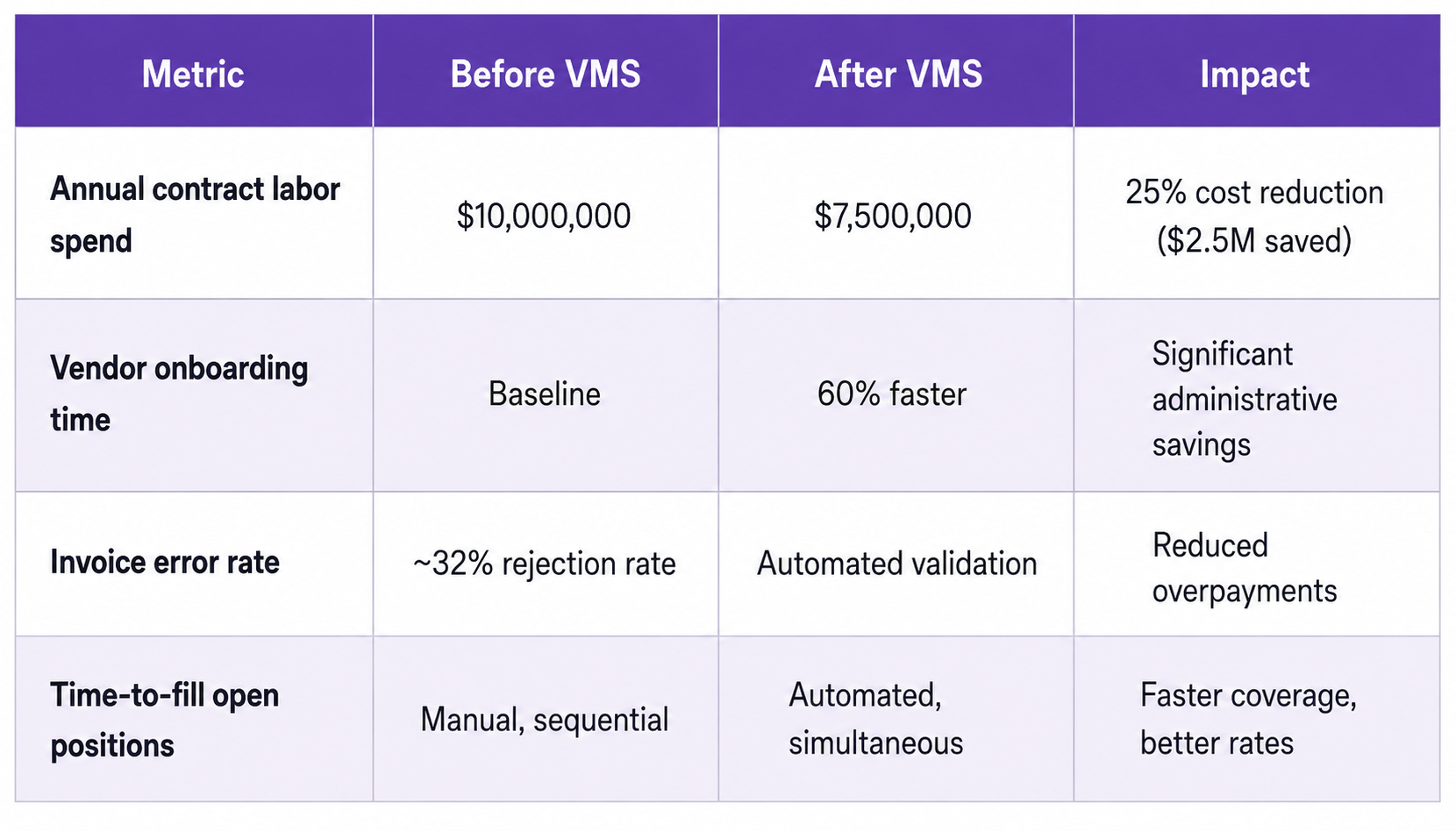
Results vary by program maturity, model selection, and governance discipline. These figures represent achievable outcomes for hospitals that commit to a structured VMS program with active management, not a plug-and-play technology deployment alone.
Centralizing Compliance and Credentialing With a VMS
Credentialing is the process of verifying a clinician's licenses, certifications, education, training, and background checks to confirm they meet regulatory and organizational standards before providing patient care. It is one of the most labor-intensive and risk-sensitive functions in healthcare operations.
Hospitals face staffing shortages and compliance demands at the same time. A VMS addresses both by automating credential verification before any shift is confirmed, ensuring no clinician begins work without meeting requirements.
Healthcare VMS platforms automate compliance tracking across regulatory frameworks, including HIPAA, Joint Commission standards, state licensing, and background checks. Automated enforcement prevents costly rework and regulatory exposure by flagging gaps before they become violations.
That improves patient care continuity. When only credentialed, qualified clinicians are placed, hospitals reduce the risk of care disruptions caused by last-minute compliance failures. A VMS provides this assurance systematically instead of relying on manual checks that are prone to human error.
At WorkWise, credential checks are enforced before any shift is confirmed as a core platform function, built into the vendor-neutral program architecture to ensure compliance is never treated as an afterthought.
Improving Operational Efficiency with VMS Automation
Before a VMS, managing contingent labor typically means juggling spreadsheets, phone calls, and emails across dozens of staffing agencies. Each requisition triggers outreach, negotiation, credential collection, and invoicing, which consume large amounts of administrative time.
A VMS automates these workflows end to end.
Requisition broadcasting. When a position opens, the VMS pushes it to all qualified vendors at once. This eliminates sequential outreach and shortens time-to-fill, giving hospitals access to a broader candidate pool faster.
Centralized scheduling. A centralized scheduling system helps hospitals avoid inefficiencies and reduce costs. Confirming shifts earlier also helps hospitals secure better rates, since last-minute placements usually carry premium pricing.
Administrative time savings. The up to 60% administrative time savings that VMS platforms provide frees capacity for clinical coordinators, HR teams, and department managers who can redirect their time toward patient care priorities.
Consolidated invoicing. Consolidated invoicing cuts review time and reduces billing errors by standardizing how agencies submit charges and how hospitals validate them.
Modern VMS platforms also provide fast online or mobile order entry, enabling clinician self-service and reducing friction for frontline staff who need coverage quickly. WorkWise clinician self-service tools and 24/7 data access improve operational speed and clinician satisfaction, which affects retention and fill rates.
Vendor Neutrality and its Impact on Cost Control
A vendor-neutral VMS is a workforce management platform that ensures unbiased vendor selection based on rate competitiveness, credential quality, and fill-rate performance rather than proprietary inventory preferences.
This distinction affects cost control. A healthcare VMS gives leaders visibility and control over contingent labor. Vendor neutrality ensures hospitals exercise that control without bias, so every agency competes on a level playing field.
Vendor-neutral bidding creates competition among agencies, standardizing billing and reducing markup variability. A VMS can also strengthen vendor relationships through centralized management, clear expectations, and consistent communication.
A diverse vendor network with negotiated pricing improves fill rates. When hospitals are not locked into a single agency's inventory, they can draw from a broader talent pool and fill shifts faster.
Vendor-Neutral VMS vs. MSP-Owned VMS
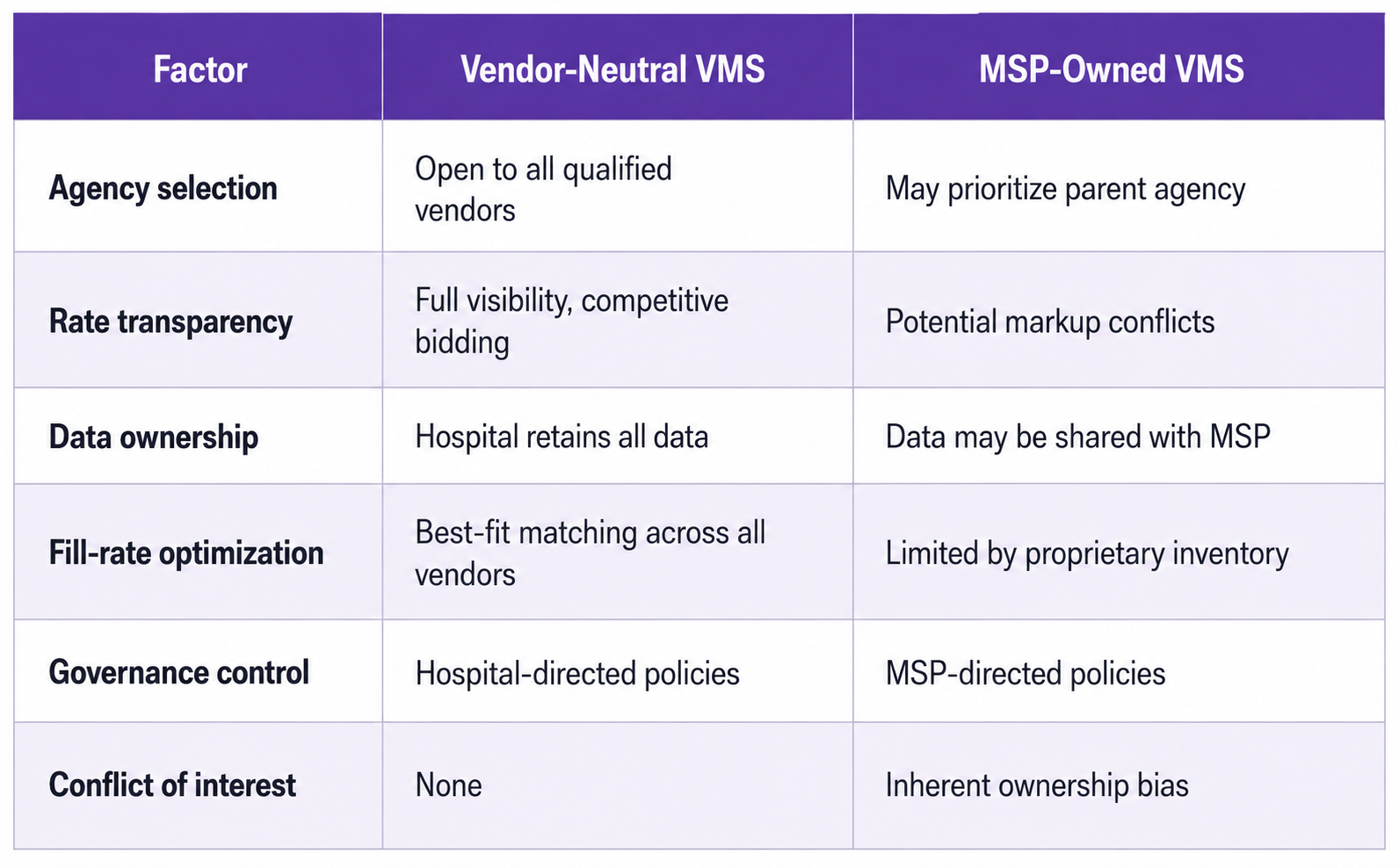
Both models can provide value, but the structural incentives differ. Hospitals that prioritize transparency, data ownership, and unbiased vendor selection will find a vendor-neutral model better aligned with their goals. The WorkWise.ai vendor-neutral program is designed around this principle.
Integrating VMS With Existing Hospital Systems
A common concern among IT leaders is whether a new VMS will create another data silo. Modern healthcare VMS platforms address this through open APIs for HRIS, ATS, ERP, and payroll integration, ensuring data moves across the organization.
Key integration points include:
- HRIS/HCM, syncing employee records, internal float pool availability, and scheduling data so the VMS reflects the current state of the workforce.
- Payroll and accounts payable, with automated invoice validation and consolidated billing that reduce manual reconciliation and accelerate payment cycles.
- EHR/EMR, supporting patient care continuity by aligning staffing data with clinical scheduling so the right clinicians are in the right units at the right times.
- ERP and procurement, centralizing vendor contracts, rate cards, and purchase orders for full spend visibility.
Cloud-based VMS platforms with open APIs deploy faster than legacy systems. Most organizations can be fully operational within weeks rather than months, minimizing disruption during the transition.
Real-time dashboards for leadership visibility are most useful when fed by integrated data from across the organization. When a VMS connects to HRIS, payroll, and EHR systems at once, it becomes the single source of truth for contingent labor management. For guidance on evaluating technology flexibility, the WorkWise resource on choosing a flexible workforce technology provides a framework.
Steps to Implement a Healthcare VMS Program
A successful VMS implementation follows a structured process. Here is a seven-step roadmap that hospital leaders can adapt to their organization's scale and complexity.
- Conduct cross-functional discovery. Map current spend, pain points, and desired outcomes across Finance, Clinical, HR, Procurement, and IT stakeholders. This ensures the program is designed around real operational needs rather than assumptions.
- Define the program model. Choose between a vendor-neutral VMS, an MSP hybrid, or an MSP-run model based on scale and governance needs. An MSP (Managed Service Provider) in healthcare staffing is a third-party organization that manages the contingent workforce program on behalf of the hospital, handling vendor relationships, compliance, and day-to-day operations. Understanding the tradeoffs between these models is essential before selecting technology.
- Select a healthcare-specific VMS. Prioritize platforms with native credentialing, scheduling, compliance automation, and open APIs for systems integration. General-purpose procurement tools lack the clinical compliance functionality that healthcare demands. Consider vendors like WorkWise that are built specifically for healthcare workflows and vendor-neutral deployment.
- Centralize requisitions and rate governance. Establish vendor rules, rate cards, and credential checks that must be satisfied before any shift is confirmed. This is where cost control begins.
- Implement consolidated invoicing and automated validation. Capture billing errors and late charges systematically. With 32% of locums invoices rejected at least once due to errors, this step alone can deliver meaningful savings.
- Build or expand internal float pools. A float pool helps health systems cover gaps without using locum agencies. Technology can automate float-pool management and let providers accept shifts on mobile devices, making internal resources the first line of coverage.
- Track KPIs and iterate governance. Monitor contingent spend, fill rates, agency mix, invoice exceptions, and time-to-fill. Use quarterly business reviews to refine the program continuously.
A VMS works best when deployed as part of a managed, healthcare-specific contingent labor program, combining technology, process design, supplier strategy, and analytics into a cohesive system.
Measuring ROI and Cost Savings From a VMS
Building an internal business case for VMS adoption requires specific metrics and realistic benchmarks. The common savings range is 5–15%, with mature programs achieving up to 25% cost reductions through disciplined governance and continuous optimization.
The KPIs hospitals should track to measure VMS ROI include:
- Total contingent labor spend, both absolute dollars and as a percentage of total labor budget
- Cost-per-fill by role type and vendor
- Fill rate, the percentage of requisitions filled within the target timeframe
- Time-to-fill, days from requisition to confirmed shift
- Invoice exception rate, the percentage of invoices requiring correction
- Agency mix, internal float pool versus external agency utilization
- Compliance audit pass rate, the percentage of workers fully credentialed before their first shift
Healthcare staffing software helps hospitals control labor costs without sacrificing care quality. The ROI extends beyond cost savings to include risk reduction, care continuity, and clinician satisfaction, factors that are harder to quantify but important to long-term program success.
WorkWise.ai supports this measurement through 24/7 access to operational and market rate data, backed by quarterly business reviews. Real-world results are documented in case studies with SIH and University Regional Health System, where structured VMS programs delivered measurable cost reductions and operational improvements.
The system typically pays for itself through the elimination of hidden costs, including invoice errors, overpayments, compliance rework, and administrative overhead that accumulate in organizations without centralized contingent labor management.
Frequently Asked Questions
What Exactly Is a Healthcare VMS?
A healthcare VMS is a specialized software platform that centralizes the sourcing, scheduling, credentialing, and billing of contingent clinical labor, such as travel nurses and contract clinicians, into a single dashboard, replacing fragmented manual processes with automated, transparent workflows. Platforms like WorkWise provide these capabilities with healthcare-specific compliance and vendor-neutral controls.
How Does a VMS Cut Labor Costs for Hospitals?
A VMS cuts labor costs by creating rate transparency through competitive vendor bidding, automating invoice validation to catch billing errors, and prioritizing lower-cost internal float pools before engaging external agencies. Hospitals typically see 10–25% savings on contingent labor spend depending on program maturity and governance.
How Does a VMS Handle Healthcare-Specific Compliance?
A healthcare VMS automates the tracking and verification of licenses, certifications, background checks, and regulatory requirements like HIPAA and Joint Commission standards. Every clinician is verified as fully credentialed before being assigned to a shift, preventing compliance gaps that could result in regulatory penalties or patient safety risks.
How Long Does It Take to Implement a Healthcare VMS?
Modern cloud-based VMS platforms with open APIs can be deployed within weeks rather than months. Integration with existing HRIS, payroll, and EHR systems is designed to minimize disruption to hospital operations during the transition.
What Is the Typical ROI of Deploying a Healthcare VMS?
Hospitals typically see 5–25% reductions in contingent labor costs, up to 60% administrative time savings, and measurable decreases in invoice errors and compliance risk. Many organizations achieve full payback within the first year of deployment through the elimination of hidden costs like overpayments, billing errors, and manual administrative overhead. WorkWise analytics and 24/7 data access help hospitals track these KPIs and demonstrate program value.