
Healthcare Workforce Strategy 2026: Complete Guide with Step-by-Step Plan
Healthcare organizations can no longer afford to treat staffing as a series of urgent, reactive decisions. In 2026, the convergence of an aging patient population, persistent clinician burnout, emerging AI tools, and a multigenerational labor force demands a different approach. This guide gives healthcare leaders and clinical managers a clear definition of healthcare workforce strategy, a structured six-step planning framework, and practical guidance for building resilient, high-performing care teams. Whether a leader runs a community hospital or a multi-state health system, these principles help shift the organization from firefighting staffing crises to architecting a sustainable workforce, one aligned with clinical mission, financial targets, and the well-being of the people who deliver care every day.
What Is Healthcare Workforce Strategy
Healthcare workforce strategy is a data-driven, technology-enabled approach to planning, developing, and sustaining healthcare teams that deliver high-quality patient care while optimizing operational stability and costs.
A healthcare workforce strategy goes beyond reactive hiring or filling open requisitions. It is a continuous, integrated system that connects every talent decision, from recruitment and credentialing to career development, to clinical outcomes and financial goals. Healthcare leaders across the industry are shifting from short-term fixes to longer-term workforce systems that create organizational resilience.
Effective workforce planning is a cycle, not a one-off event. The core rhythm follows four phases: assess → forecast → act → monitor. Organizations that adopt this continuous loop revisit priorities regularly and adjust plans as conditions change, rather than waiting for annual budget cycles to force a reckoning.
It helps to draw a clear distinction between two related but different concepts. Workforce planning is tactical and near-term, focusing on scheduling, headcount management, and filling today's gaps. Workforce strategy is the long-range alignment of talent capabilities with organizational mission and market evolution. The strongest organizations do both, but strategy sets the direction that planning follows.
Why Healthcare Workforce Strategy Matters in 2026
Healthcare workforce strategy in 2026 centers on three non-negotiable imperatives: stability, flexibility, and sustainability. As the Baby Boomer generation ages into their 80s, patient acuity is rising across nearly every service line. Changing care models, persistent clinician burnout, and the emergence of AI-enabled tools make a strategic approach to workforce management essential. It is not aspirational.
The AHA's 2026 Health Care Workforce Scan highlights that four generations now work side by side in healthcare settings, and this multigenerational workforce can be a strategic strength when managed intentionally. Generations differ in communication style, technology maturity, and motivation. Organizations that recognize these differences and design flexible support structures will outperform those that apply one-size-fits-all approaches.
The shift is already underway. Large health systems are moving from annual workforce planning to multi-year strategic frameworks, with workforce redesign becoming a defining transformation of this era.
Four strategic pillars are driving 2026 workforce strategy:
- Stabilizing day-to-day coverage, reducing overtime, agency dependency, and emergency staffing
- Investing in workforce development, training, upskilling, and internal mobility pathways
- Expanding talent pipelines, new markets, international professionals, and role redesign
- Optimizing with data and technology, scheduling automation, analytics, and AI-enabled forecasting
The 6-Step Healthcare Workforce Planning Framework
The following framework provides a structured, repeatable process for building and executing a healthcare workforce strategy. Each step builds on the previous one, and the cycle repeats as organizational conditions evolve.
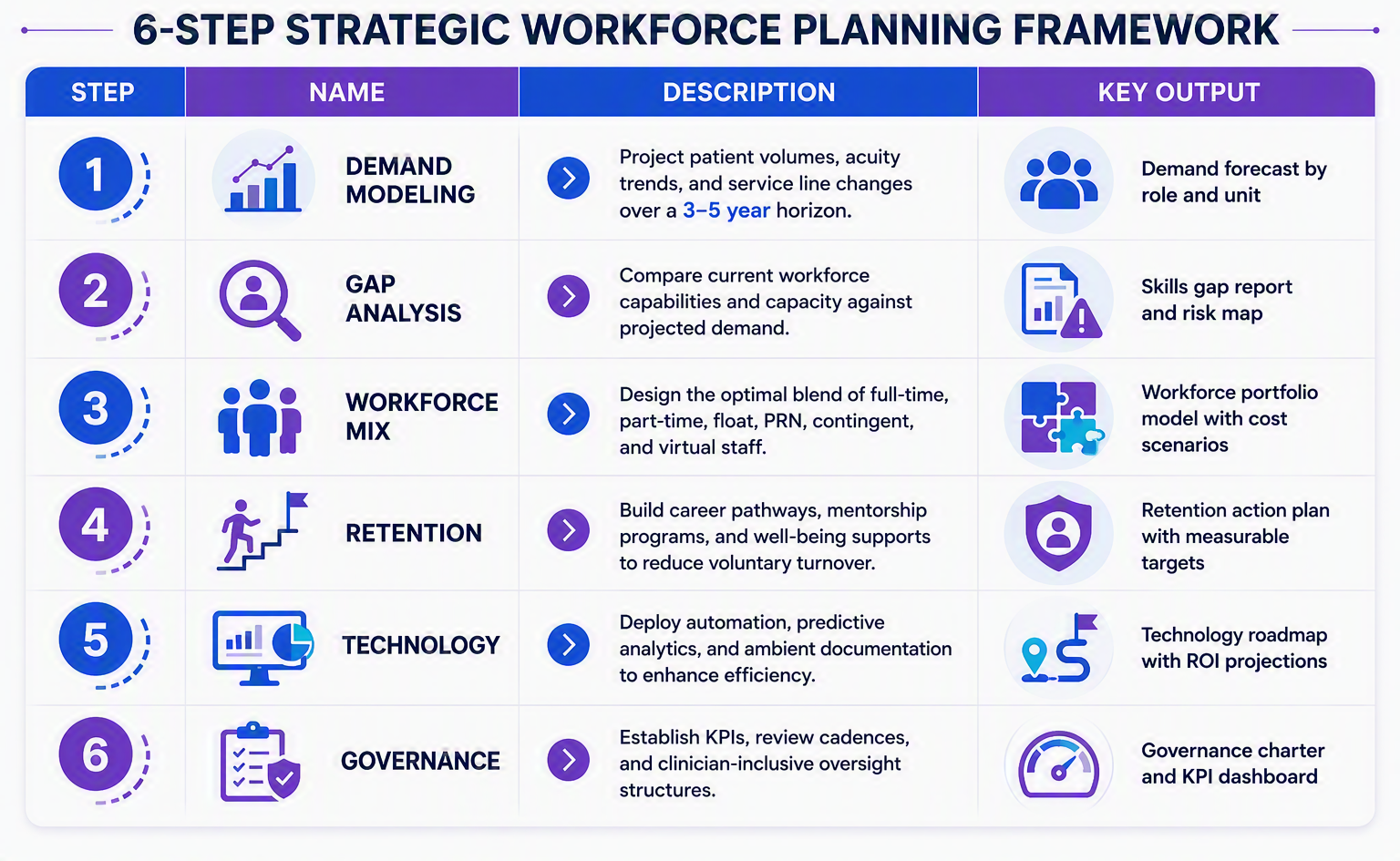
This framework is the navigational anchor for the rest of this guide. For organizations seeking an integrated platform that supports every step, the WorkWise solutions overview is a practical starting point.
Assessing Your Current Workforce
Every credible workforce strategy begins with an honest, data-driven assessment of what the organization has today. Without a clear baseline of workforce composition, skills inventory, and cost structure, any forward-looking plan rests on assumptions. Current-state analysis is the foundational first step in strategic workforce planning.
Analyzing Workforce Composition and Skills
The first task is to catalog the workforce with precision. Leaders should map every team member by role type (RN, LPN, APP, allied health, support staff), employment status (full-time, part-time, PRN, contingent), tenure, certifications, and competency levels. Planning around skills rather than static job titles increases organizational agility and reveals capabilities that traditional headcount reports miss.
A structured format helps organize this data. The sample below is illustrative and should be replaced with organization-specific workforce data before use in planning or reporting.
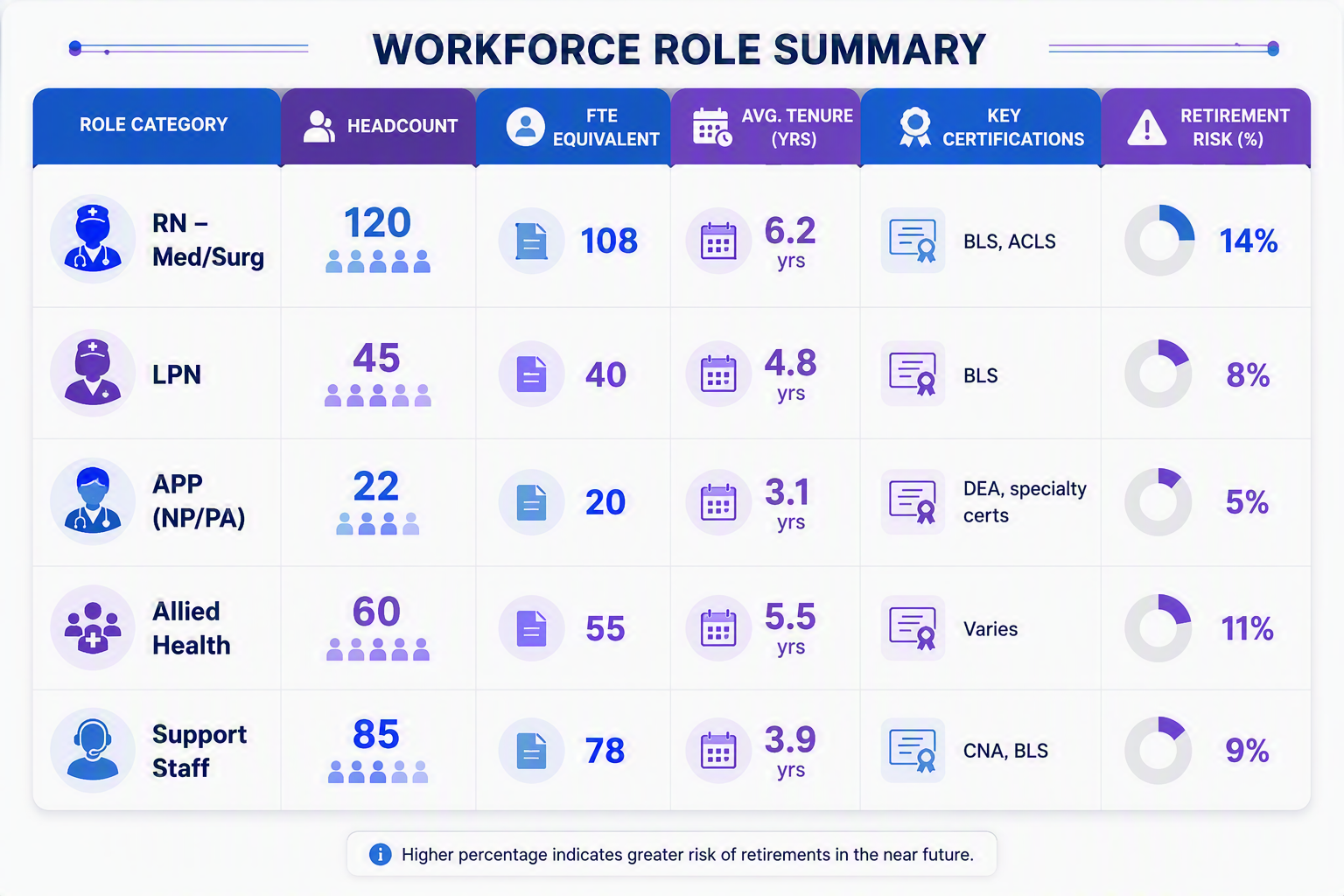
This template should be adapted to the organization's structure and populated with real data. Leaders should align this skills inventory with the strategic plan and service-line priorities, because workforce planning should always follow business objectives.
Identifying Coverage Gaps and Cost Drivers
Workforce stabilization means achieving consistent coverage and fewer last-minute scheduling gaps. Before stabilizing, leaders need to know exactly where coverage is breaking down and where money is being spent reactively.
The following metrics deserve analysis across every unit:
- Overtime hours by department and role
- Agency and traveler spend as a percentage of total labor cost
- Unfilled shift rates by day of week and shift type
- Call-off patterns and their root causes
Presenting this data in a cost-driver dashboard format gives leadership something to review monthly. Understanding coverage gaps is not just about headcount, it is about matching the right skills to the right shifts at the right cost. For guidance on tracking these metrics effectively, the WorkWise KPI optimization resource offers a practical framework.
Forecasting Future Workforce Demand
With a clear picture of the current state, the next step is to look forward. Demand forecasting estimates the skills and capacity the organization will need over the next three to five years. A strong workforce strategy starts with clarity on where the business is going, not just where it is today.
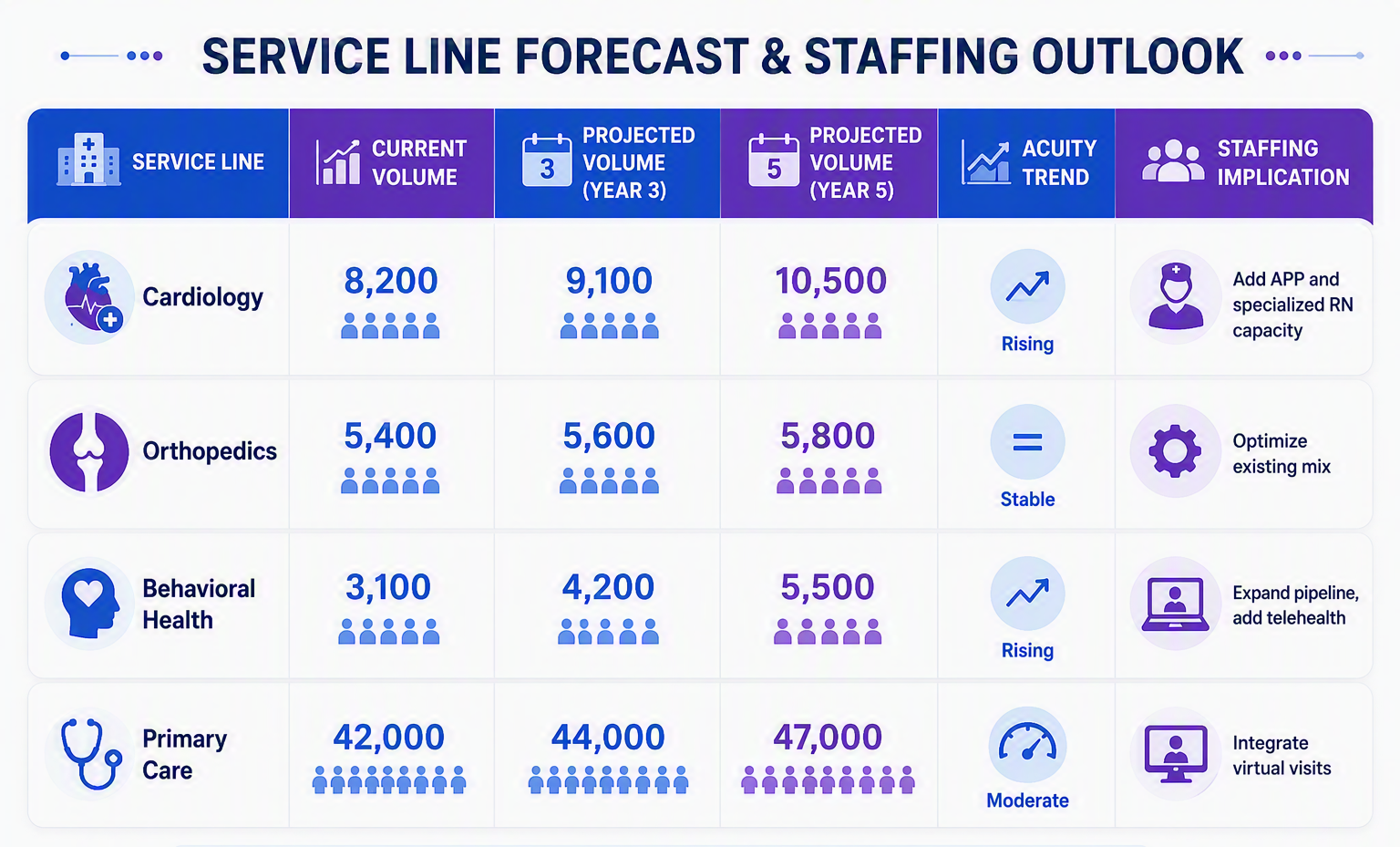
Projecting Volume, Patient Acuity, and Service Line Changes
Leaders should build demand models that account for the clinical and operational variables most likely to shift staffing needs. That means projecting patient volumes by service line, factoring in demographic trends (aging populations, chronic disease prevalence), payer mix shifts, and planned facility expansions or contractions.
Rising patient acuity means more specialized staff per patient. The workforce mix must reflect this reality, and projections should align with revenue targets and growth priorities.
Accounting for Technology and Care Model Evolution
Geographic, operational, and technology expansion all affect talent needs. Technology-enabled care models require deliberate workforce design; they do not simply replace roles, they reshape them.
Leaders should model how telehealth adoption, virtual nursing, ambient documentation, and AI-assisted triage will reduce certain role demands while creating new ones. Virtual nursing, for example, can extend experienced nurses' reach across multiple units without adding bedside FTEs.
AI is an enabler, not a replacement, in workforce planning. The goal is to free clinician time and sharpen decisions, not to eliminate human judgment. For a deeper exploration of this dynamic, see the WorkWise guide to AI in healthcare workforce management.
Conducting Skills Gap Analysis
Skills gap analysis is the systematic process of identifying what capabilities are missing in the current workforce relative to projected demand. It is the bridge between assessment and action, the step that determines whether an organization builds, buys, or borrows talent.
Mapping Critical Capabilities and Adjacent Talent Pools
A skills matrix maps critical capabilities, such as ICU competency, telehealth proficiency, chronic care management, and AI tool fluency, against current staff certifications and experience. This reveals not only what an organization lacks but also where internal candidates with adjacent capabilities could be developed.
Adjacent talent pools are employees whose existing skills are close enough to a needed capability that targeted upskilling is more cost-effective than external recruitment. Internal development helps organizations grow capability without relying solely on scarce external talent markets.
Leaders should also identify "stretch candidates," staff members who are one credential or training program away from filling a critical gap. These individuals represent the highest-return development investments.
Prioritizing Upskilling and Internal Mobility Opportunities
The build, buy, borrow model offers a clear decision framework:
- Build: Develop existing employees through training, credentialing, and career pathways
- Buy: Recruit externally for specialized or scarce roles that cannot be developed internally in time
- Borrow: Use contingent labor, per diem, or agency staff for variable or temporary demand
Strategic action planning can include building skills, redesigning roles, or recruiting, often all three at once. Workforce development that includes training, upskilling, and internal mobility creates clear progression pathways that also improve clinician retention.
A prioritization matrix with two axes helps focus effort: impact on patient care (high/low) and feasibility of internal development (high/low). High-impact, high-feasibility gaps should be addressed through upskilling first. Low-feasibility, high-impact gaps require external recruitment. Low-impact gaps can be deprioritized or addressed through workflow redesign.
Designing an Optimal Workforce Mix
The workforce mix decision, how an organization combines full-time, part-time, float pool, PRN, and contingent staff, is one of the most consequential choices in healthcare workforce strategy. The goal is a deliberate workforce portfolio that balances cost, coverage reliability, flexibility, and clinician satisfaction. The AHA Workforce Scan confirms that leaders are actively redesigning staffing models with team-based approaches.
Balancing Full-Time, Part-Time, Float, and Contingent Staff
Understanding the role each staff category plays is essential:
- Float pool: Cross-trained staff deployed across multiple units based on real-time demand, providing flexibility without agency costs
- PRN (pro re nata): Staff who work on an as-needed basis without guaranteed hours, offering surge capacity for unpredictable demand
- Contingent labor: Temporary or contract workers sourced through agencies or internal staffing programs to fill short-term coverage gaps
Scenario analysis helps model the workforce mix:
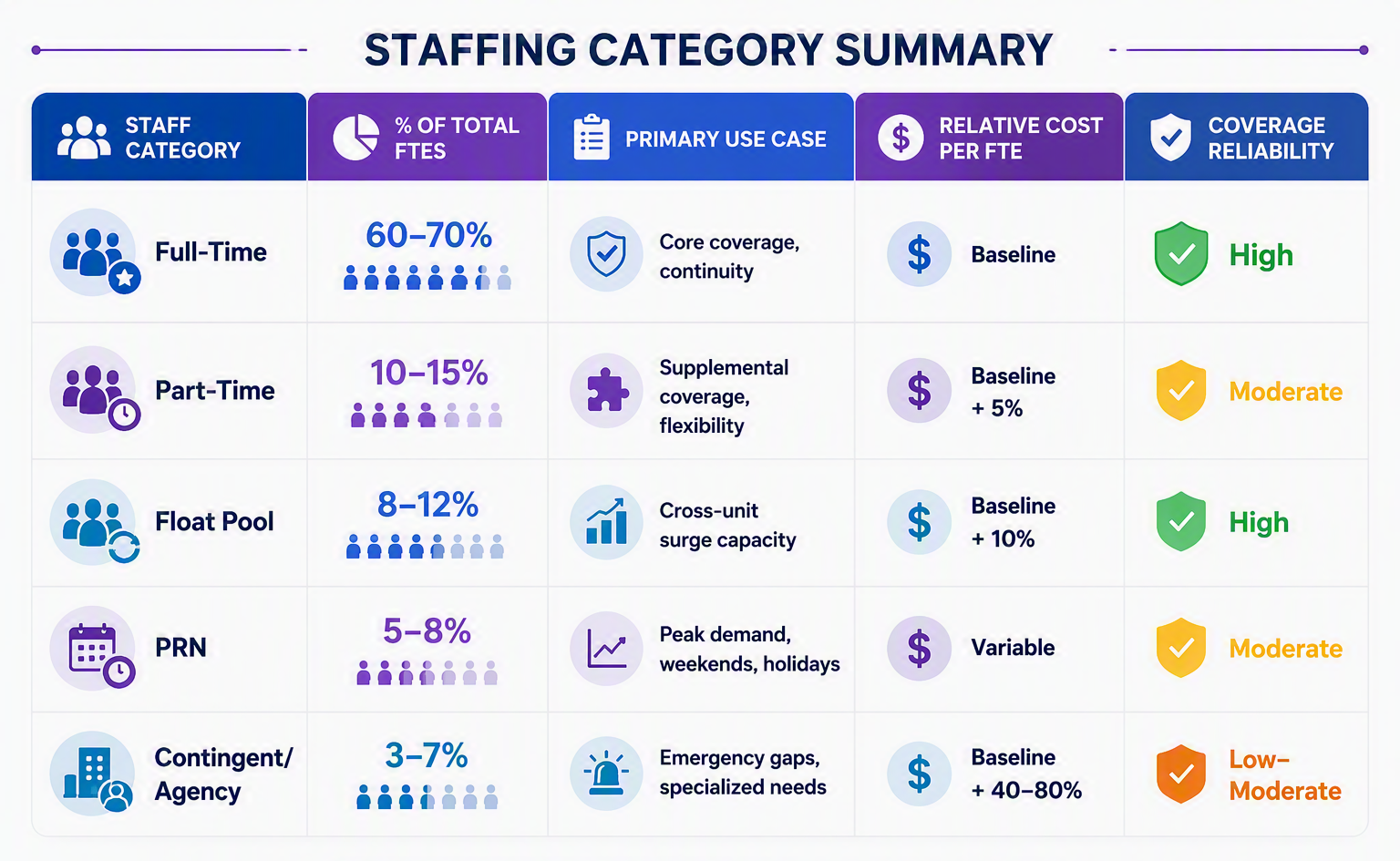
A well-designed mix reduces last-minute volatility. Reducing overtime and emergency staffing is a key part of workforce stabilization, and it starts with getting the ratios right.
Integrating Advanced Practice Providers and Virtual Roles
Advanced Practice Providers (APPs)—nurse practitioners, physician assistants, certified nurse midwives, and clinical nurse specialists—can diagnose, treat, and prescribe independently or collaboratively, extending physician capacity into areas that would otherwise face access constraints.
Virtual nursing is a care delivery model in which experienced nurses provide assessment support, patient education, and documentation remotely via video. It reduces bedside workload while maintaining clinical oversight, and it creates meaningful roles for clinicians who may no longer be able to work at the bedside due to physical limitations.
Role redesign can broaden access to qualified healthcare talent. Leaders should evaluate which tasks currently performed by bedside nurses or physicians could be redistributed to APPs, virtual nurses, or support staff. This is the concept of care-team layering, the deliberate distribution of clinical tasks across team members based on licensure, competency, and cost-efficiency to maximize each provider's scope of practice.
Building Talent Development Pathways
Sustainable care teams are built, not just hired. Workforce development, encompassing training, upskilling, and internal mobility, is both a retention lever and a capacity-building tool that reduces dependency on external labor markets.
Implementing Stackable Credentials and Apprenticeships
Stackable credentials are short-term, industry-recognized certifications that can be earned incrementally and combined to qualify for progressively advanced roles. This modular approach allows employees to advance without leaving the organization.
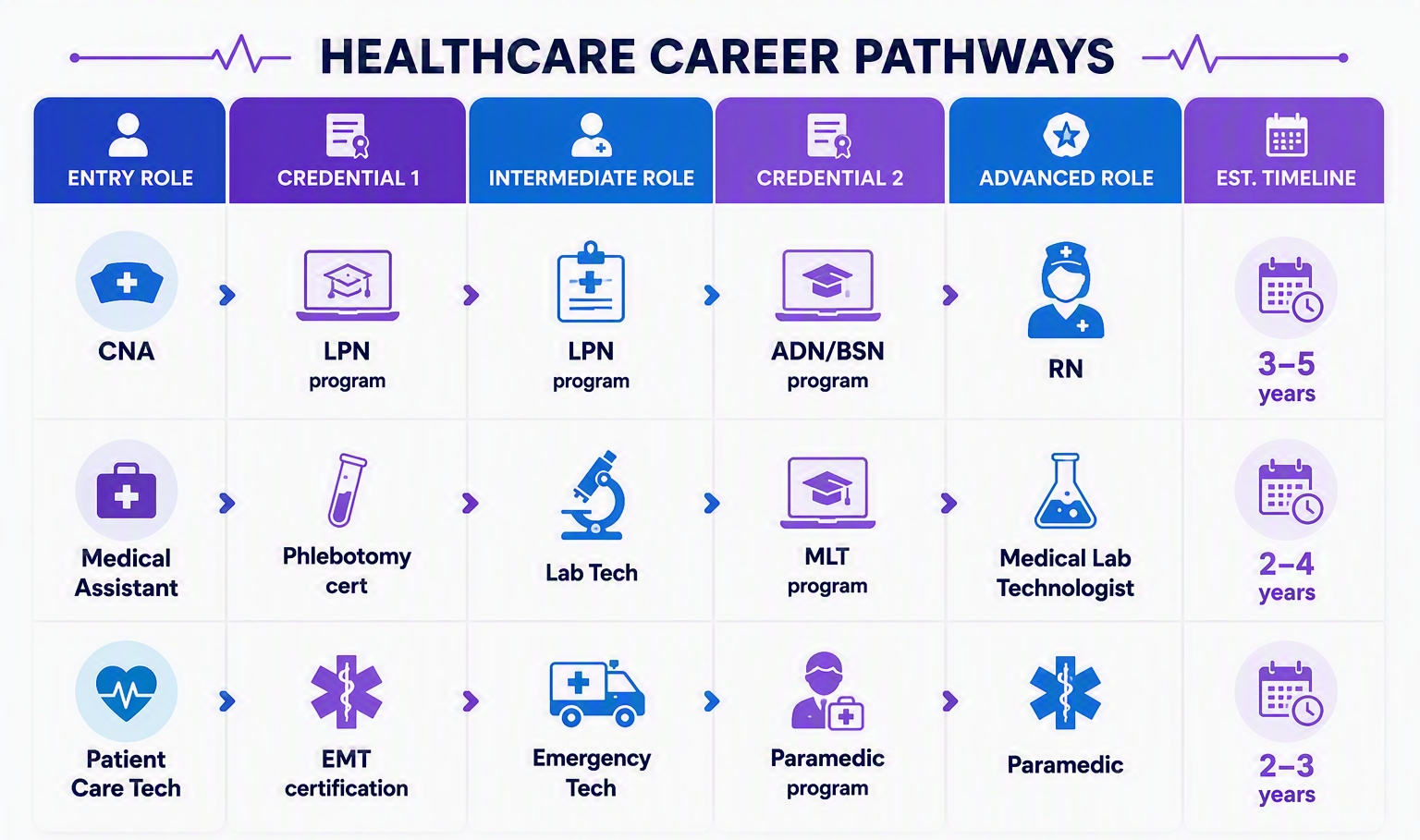
Partnering with local training programs and community colleges can create apprenticeship pipelines. Workforce expansion may also include supporting international professionals through sponsorship and credentialing assistance.
Establishing Mentorship and Targeted Training Programs
Cross-generational mentorships strengthen both retention and attraction. Leaders can pair experienced clinicians with newer staff in structured programs that include defined goals, regular check-ins, and skill-transfer milestones.
Mentorship programs should be explicitly linked to well-being, because they reduce isolation, accelerate competency, and create a sense of belonging. The AHA's workforce scan emphasizes that improving employee engagement and well-being is a strategic priority.
Offering training in multiple formats—in-person, virtual, self-paced, and simulation-based—accommodates different learning preferences across a multigenerational workforce. Flexible support and varied training modalities consistently outperform one-size-fits-all approaches.
Leveraging Technology to Optimize Workforce Management
Technology is the operational backbone of a modern healthcare workforce strategy. It gives organizations the speed, accuracy, and predictive visibility needed to move beyond manual processes. Automation can support documentation, reporting, workforce insights, and talent analytics at scale. The AHA notes that building the foundation for AI to deliver value is a critical priority for healthcare organizations. But technology adoption alone does not solve workforce challenges; it must be paired with the right workflows, governance, and clinician-centered safeguards. For an overview, see the WorkWise healthcare workforce technology guide. Workforce technology should connect predictive analytics, workforce insights, and clinician workflows so organizations can turn forecasts into more informed staffing decisions and measurable outcomes.
Using AI-Powered Analytics for Predictive Planning
Predictive workforce analytics applies machine learning and statistical models to historical and real-time workforce data to forecast staffing needs, identify turnover risks, and optimize labor allocation before problems occur.
Strategic workforce planning connects talent data to business strategy. Predictive analytics is the mechanism that makes this connection actionable. Key use cases include
- Forecasting seasonal or event-driven demand surges weeks in advance
- Identifying units with elevated turnover risk based on engagement surveys and workload patterns
- Modeling the cost impact of different workforce mix scenarios before committing resources
For organizations ready to put these capabilities to work, the WorkWise predictive analytics solution provides an integrated approach, forecasting staffing needs as far as 120 days out from the shift.
Ensuring Governance and Clinician Well-Being Safeguards
Every technology implementation should be evaluated against its impact on clinician workload, autonomy, and well-being. AI should support clinicians, not add burden.
A workforce technology governance framework should include:
- Clinician representation on technology selection committees
- Mandatory well-being impact assessments before deploying new tools
- Transparent data usage policies: what data is collected, how it is used, and who has access
- Regular feedback loops to identify and resolve technology-induced friction quickly
Technology governance is a well-being strategy, not just a compliance exercise. Organizations that get this right build trust with their clinical workforce, which accelerates adoption and maximizes return on technology investments. WorkWise offers governance templates and clinician-facing workflows that help operationalize these safeguards.
Piloting and Scaling New Staffing Models
Innovation in staffing models is no longer optional; it is a strategic imperative driven by workforce constraints and changing patient needs. The key is to test new models in controlled environments before committing to system-wide rollouts.
A pilot-to-scale framework keeps this disciplined: define success criteria, select a pilot unit, implement for 60–90 days, measure outcomes, refine, and expand.
Team-Based Care and Float Pool Approaches
Team-based care is a staffing model in which a multidisciplinary group—physician, APP, RN, and support staff—shares responsibility for a patient panel. Tasks are distributed by competency level to maximize each team member's scope of practice.
Float pools reduce reliance on agency staffing by creating an internal reserve of cross-trained clinicians who can be deployed where demand is highest. This directly supports workforce stabilization and gives float pool members exposure to diverse clinical environments, which can improve engagement and skill breadth.
Pilot outcomes deserve measurement across three dimensions:
- Coverage reliability: unfilled shift rate before and after
- Cost: total labor cost per patient day
- Clinician well-being: engagement scores, overtime hours, voluntary turnover
Virtual Nursing and Telehealth Integration
Telehealth is a valuable tool for expanding access without expanding headcount. It allows providers to conduct routine appointments more efficiently and manage remote monitoring, effectively extending the existing workforce.
Virtual nursing programs typically station experienced nurses at a central hub where they provide admission assessments, discharge education, medication reconciliation, and documentation support via in-room video. Bedside nurses are freed to focus on hands-on care, and experienced virtual nurses can extend their impact across far more patients than a single unit assignment would allow.
Leaders should evaluate which patient interactions can be safely and effectively delivered virtually, and pilot these models with clear outcome metrics before scaling. For additional guidance on technology-driven workforce transformation, see the WorkWise resource on tech-driven workforce transformation.
Establishing Continuous Monitoring and Improvement
Healthcare workforce strategy is not a plan written once and filed away. It is an adaptive system that requires ongoing measurement, review, and refinement. Implementation and monitoring keep workforce plans aligned as the business evolves, closing the loop on the assess → forecast → act → monitor cycle.
Defining Key Performance Indicators
A focused set of KPIs that tie directly to strategic objectives keeps the program on track:
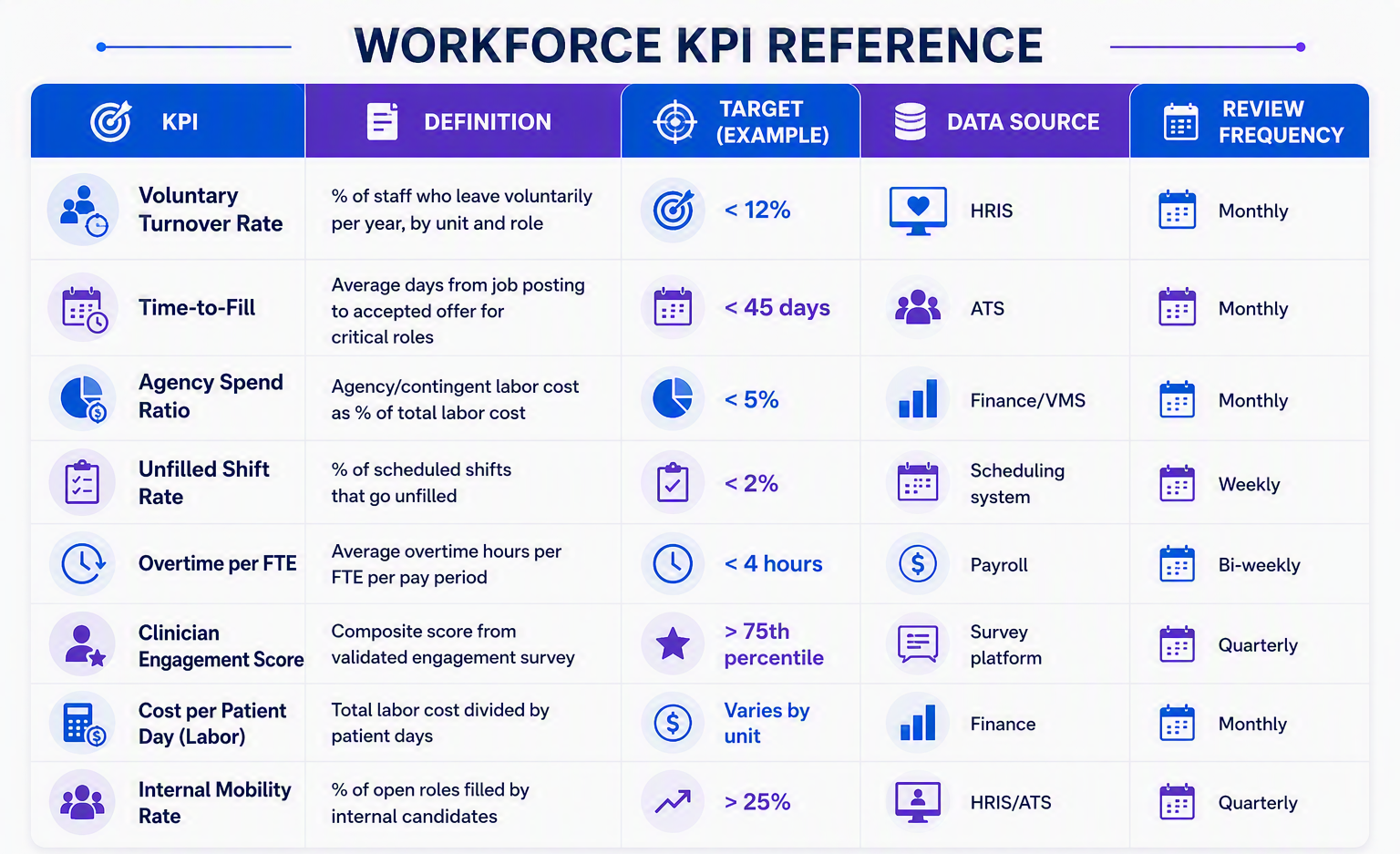
Each KPI should tie to a specific strategic objective. Workforce decisions should map directly to clinical and financial goals. If a metric does not inform a decision, it does not belong on the dashboard.
Setting a Review Cadence for Forecasts and Action Plans
A structured review cadence keeps the strategy responsive:
- Monthly: Operational metrics review—unfilled shifts, overtime trends, agency spend, call-off patterns
- Quarterly: Strategic KPI review, demand forecast updates, talent pipeline assessment, progress against retention targets
- Annually: Full workforce strategy refresh, multi-year scenario modeling, budget alignment, and executive strategic review
The goal is to make workforce planning a continuous organizational capability. This separates organizations that react to crises from those that anticipate and prevent them. A simple but disciplined planning rhythm—assess, revisit priorities, adjust plans—transforms workforce strategy from a document into a living system.
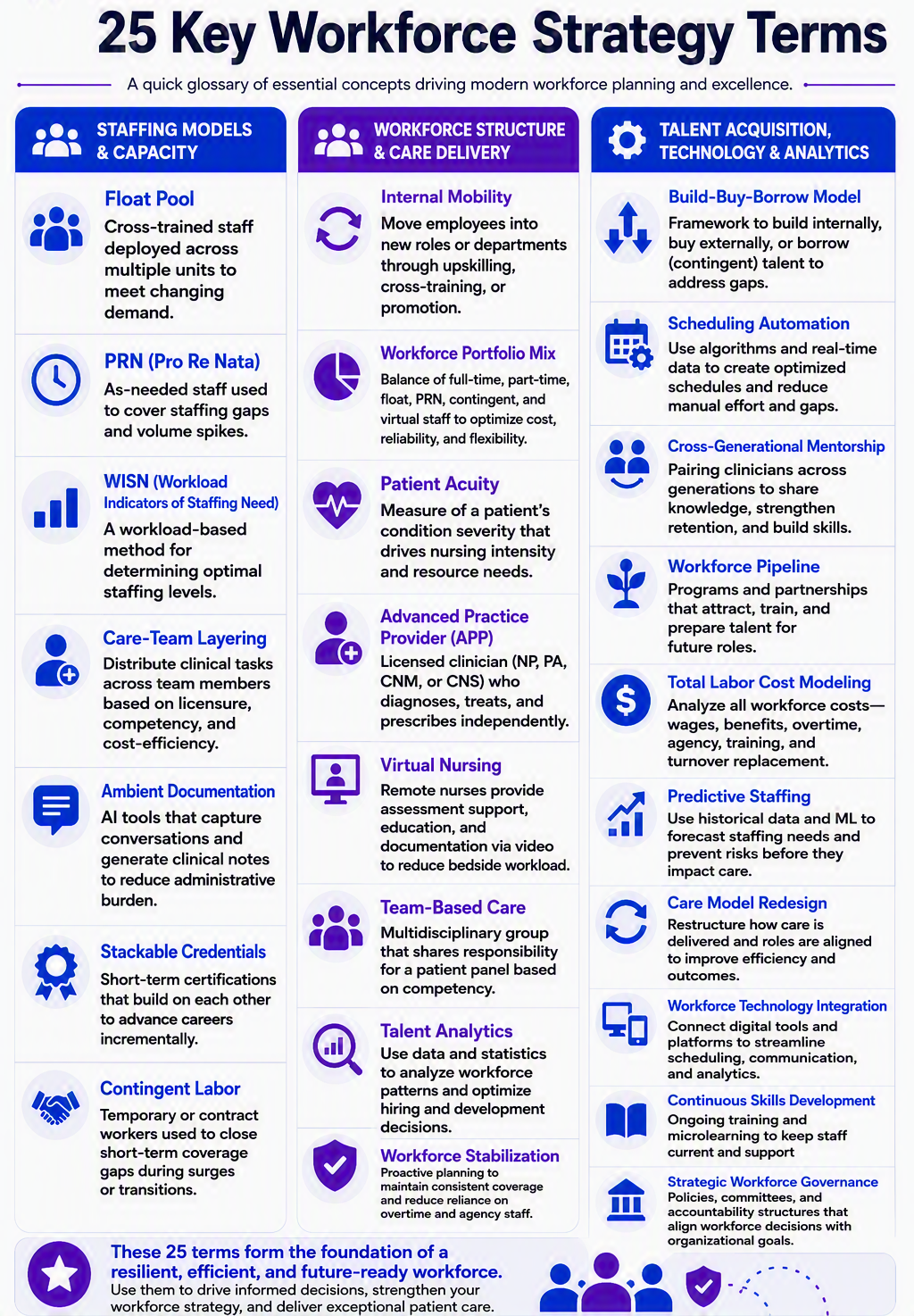
Glossary of Healthcare Workforce Strategy Terms
Request Demo
Frequently Asked Questions
What Is the Most Important Skill Healthcare Workers Need in 2026?
Tech fluency—comfort with EMRs, digital dashboards, and AI-assisted tools—is essential. Organizations should pair digital literacy training with clinical skill development. WorkWise supports integrating digital literacy into workforce development programs.
How Does AI Support Healthcare Workforce Planning and Delivery?
AI-powered predictive analytics can help healthcare organizations forecast staffing needs, identify turnover risks, and model workforce scenarios before gaps affect care delivery. These tools should complement clinical judgment and pair with governance and well-being safeguards.
Why Is Retention Considered the New Shortage in Healthcare Staffing?
Turnover undermines capacity even when headcount looks sufficient, so investing in predictable schedules, career pathways, and well-being is more effective than continuous external recruitment. WorkWise helps leaders measure and prioritize retention actions.