
WorkWise: A Guide to AI-Powered Healthcare Staffing Management
Healthcare organizations face rising labor costs, ongoing shortages, fragmented technology, and clinician burnout. Traditional tools—standalone vendor management systems, disconnected scheduling software, and manual spreadsheets—were never built to solve these problems across the whole system. WorkWise™ takes a unified, system-level approach. As an enterprise AI-powered healthcare staffing platform, it brings recruitment, internal pools, contingent labor, compliance, and predictive analytics together in a single system built for health systems. This guide explains what WorkWise does, how its AI capabilities translate into measurable outcomes, and what healthcare leaders should weigh when evaluating modern workforce management technology.
What Is WorkWise and How Does It Serve Healthcare Staffing?
WorkWise is an enterprise healthcare workforce platform covering all professional types—physicians, nurses, allied, and non-clinical—and all job types—permanent, shift, contract, and locums—from a single AI-powered system.
That distinction matters because most health systems rely on narrower tools. Rather than managing contingent nurses through one vendor management system, scheduling shifts through another, and running recruitment through a third, WorkWise combines internal agency, float pool, recruitment, and contingent staffing into one healthcare workforce management platform. The system uses AI, workflow automation, deep integrations, and real-time data to optimize workforce management, from predicting tomorrow's staffing gaps to tracking credential expirations across thousands of clinicians.
To understand why this matters, consider how WorkWise compares to the legacy tools it replaces:
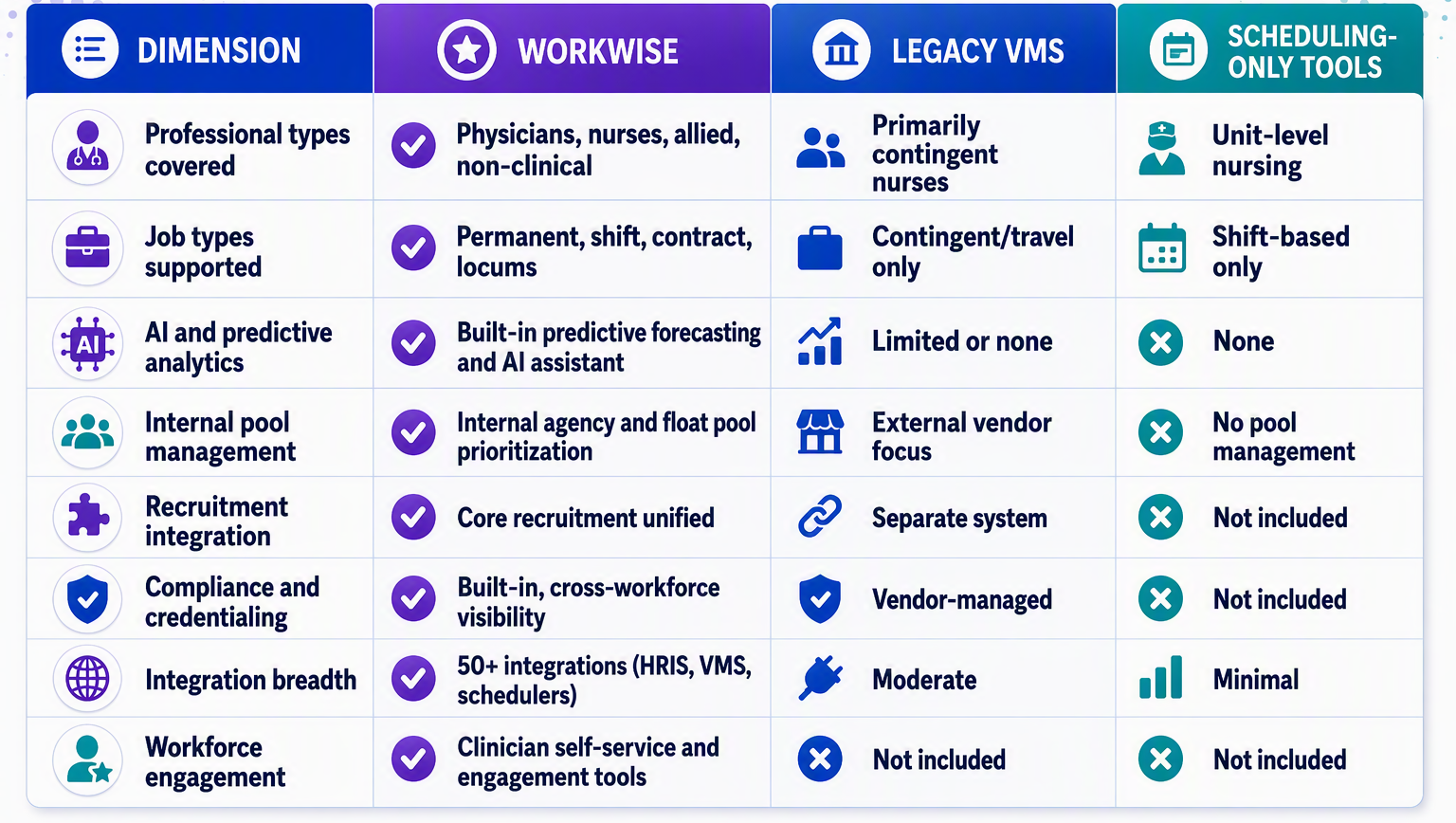
Legacy VMS platforms were designed to manage external vendor relationships, not to act as a comprehensive healthcare staffing technology layer. Scheduling-only tools solve a single operational problem without connecting to the broader workforce ecosystem. WorkWise bridges these gaps by organizing its capabilities into three pillars—workforce optimization, workforce management, and workforce engagement—and delivering them through a unified, interoperable platform. This consolidation helps health systems gain operational control and clearer cost visibility.
Core Features of WorkWise for Healthcare Workforce Management
WorkWise structures its feature set around three capability pillars, each addressing a distinct dimension of the staffing lifecycle.
Workforce Optimization
Workforce optimization is where the AI capabilities in WorkWise have the most immediate impact. The predictive analytics engine gives healthcare leaders early visibility into staffing gaps and supports smarter schedule optimization by analyzing historical patterns, real-time census data, and external variables.
Predictive analytics in healthcare staffing uses historical data, real-time inputs, and machine learning models to forecast future staffing demand, identify emerging gaps, and recommend proactive scheduling adjustments. This allows health systems to move from reactive crisis-filling to strategic workforce planning.
Alongside predictive analytics, WorkWise features an Open Talent Marketplace, a bid-driven platform that connects healthcare organizations with a network of talent and vendors to fill positions at transparent, competitive rates. This marketplace replaces opaque pricing with clear market visibility, giving health systems greater control over labor spend.
Workforce Management
The management pillar covers the operational backbone of staffing: compliance, credentialing, internal pool management, and contingent labor coordination. WorkWise provides built-in tools for compliance and credential visibility across both internal and contingent staff, so credentialing status, license expirations, and regulatory requirements are tracked in a single system rather than scattered across vendor portals and spreadsheets.
Float pool management is another core capability. Rather than treating internal float pools as an afterthought, WorkWise makes them a primary fill source, surfacing available internal clinicians before routing needs to more expensive external channels.
Workforce Engagement
The engagement pillar addresses clinician experience. WorkWise includes self-service tools that let clinicians manage their schedules, preferences, and availability directly. Fair, predictable schedules improve job satisfaction, and satisfied clinicians are more likely to stay, reducing turnover costs and preserving institutional knowledge.
The platform's AI Assistant operates 24/7. It helps recruiters and managers by retrieving orders, answering complex staffing questions, and reducing the manual administrative work that pulls talent acquisition teams away from relationship building.
How WorkWise Uses AI to Optimize Staffing and Labor Costs
The business case for AI in healthcare staffing is simple: every hour a position goes unfilled, or gets filled with the most expensive labor source, erodes an organization's financial and operational health. The AI capabilities in WorkWise are designed to reduce administrative overhead while improving hiring outcomes, turning complex staffing challenges into more manageable, data-driven operations.
At the core of this approach is an internal-first prioritization logic. WorkWise helps organizations prioritize core staff and internal pools before turning to external per diem or travel labor. This matters financially because external travel nurse rates can run two to three times higher than internal labor costs. Every shift filled internally represents direct savings.
AI matching algorithms connect the right clinician to the right role at the right time, improving both quality of care and recruitment efficiency.
The AI optimization cycle within WorkWise follows a clear workflow:
- Data ingestion. The platform pulls real-time data from connected HRIS, VMS, and scheduling systems.
- Predictive demand forecasting. Machine learning models surface upcoming gaps based on historical patterns and current census trends.
- Internal-first fill recommendations. AI recommends sourcing from core staff, float pools, and internal agency clinicians first.
- Automated external escalation. Remaining unfilled needs post automatically to external vendor networks and the Open Talent Marketplace.
- Real-time performance tracking. Dashboards monitor fill rates, bill rates, labor mix, and cost-per-fill in real time.
This cycle changes staffing from a reactive scramble into a predictive, cost-controlled operation, reducing both overtime spend and reliance on premium-rate external labor.
Integrating Workforce Functions: Recruitment, Internal Pools, and Contingent Staffing
One of the most persistent problems in healthcare staffing is fragmentation. Recruitment lives in one system, scheduling lives in another, contingent labor management runs through a separate VMS, and credentialing data sits in yet another database. The result is data silos, duplicated work, delayed decisions, and inflated costs.
WorkWise removes this fragmentation by combining internal agency, float pool, recruitment, and contingent staffing into a single operational workflow. Here is how the internal-first prioritization model works in practice:
- Core staff availability surfaces first, matching open needs against existing employees' schedules and preferences.
- Internal float pool and agency clinicians are offered shifts next, keeping labor spend within the organization's control.
- Unfilled needs escalate to external contingent vendors only after internal sources are exhausted.
- The Open Talent Marketplace enables competitive, transparent bidding from external vendors, ensuring market-rate pricing.
This layered approach only works if data flows across systems. WorkWise supports more than 50 integrations and interoperabilities, connecting to the HRIS, VMS, and scheduling platforms that health systems already use. This means candidate data, credential records, shift assignments, and billing information move through a single pipeline rather than requiring manual reconciliation.
The difference between integrated and fragmented staffing is stark:
- Integrated (WorkWise): single dashboard, unified candidate pipeline, real-time fill tracking, automated compliance checks, and one source of truth for all workforce data.
- Fragmented (legacy approach): multiple logins, manual data reconciliation across systems, delayed visibility into fill progress, duplicated credentialing efforts, and inconsistent reporting.
- For health systems managing thousands of clinicians across multiple facilities, this integration is a prerequisite for operational control.
Ensuring Compliance, Credentialing, and Data Security in Healthcare Staffing
In healthcare, compliance failures create patient safety risks, regulatory penalties, and legal liability. WorkWise treats compliance and credentialing as core platform capabilities rather than bolt-on features, providing built-in credential visibility across both internal and contingent staff.
Credentialing in healthcare staffing is the process of verifying a clinician's qualifications, licenses, certifications, and work history before they can provide patient care. Effective credentialing management ensures regulatory compliance, reduces liability, and prevents last-minute staffing disruptions from expired or missing credentials.
The analytics capabilities in WorkWise strengthen compliance and staffing efficiency by using predictive models to flag upcoming credential expirations and compliance gaps before they cause disruptions. Rather than discovering an expired license on the day a clinician is scheduled to work, staffing leaders receive automated alerts weeks in advance.
On the data security front, WorkWise holds SOC 2 Type 2 certification. An independent auditor has verified that the platform meets ongoing standards for security, availability, processing integrity, confidentiality, and privacy. Unlike a SOC 2 Type 1 report, which evaluates controls at a single point in time, Type 2 certification confirms that these controls operate effectively over a period, providing stronger assurance for healthcare organizations handling sensitive workforce and patient-adjacent data.
Key compliance capabilities within the platform include:
- Real-time credential tracking across all worker types—internal, float pool, and contingent
- Automated expiration alerts and renewal workflows
- Audit-ready documentation and reporting
- SOC 2 Type 2 certified data protection
- Visibility into contingent vendor compliance status
- Cross-workforce compliance dashboards for organizational oversight
For healthcare leaders evaluating staffing technology, the question is whether those features are embedded across the entire workforce lifecycle or siloed in a separate module that staff may not consistently use.
Managing Large-Scale Workforce Events and Disruptions With WorkWise
Health systems do not operate in steady state. Flu seasons spike census counts, natural disasters displace staff, pandemics create unprecedented demand surges, and planned facility expansions require rapid onboarding of hundreds of clinicians. These scenarios demand a staffing response that traditional tools cannot deliver at speed.
WorkWise includes an Event Management Module designed to support staffing during events of any scale, from predictable seasonal surges to unplanned crises. The module works through four phases:
- Rapid need creation. Staffing leaders can quickly build and post bulk staffing requirements across multiple specialties and facilities at once.
- Network-powered sourcing. The platform uses its talent and vendor network for fast sourcing, tapping internal pools first and escalating to external channels as needed.
- Real-time fill tracking. As candidates are submitted, reviewed, and confirmed, leadership has live visibility into fill progress across every open position.
- Post-event analytics. Reporting tools capture what worked, what did not, and where the organization can improve its response for next time.
The Event Management Module connects directly to the predictive analytics capabilities in WorkWise, which can identify surge patterns before they become crises. For example, a health system might use historical data to predict that census will spike 15–20% in the three weeks following a major holiday. Rather than scrambling to find staff when the surge arrives, the system can pre-activate internal float pools, alert preferred vendors, and begin sourcing weeks in advance.
Consider a practical scenario: a multi-hospital system sees an unexpected 25% census increase driven by a regional respiratory illness outbreak. Using the Event Management Module, the staffing team creates bulk orders across nursing, respiratory therapy, and support staff within hours. The AI engine prioritizes available internal clinicians, routes remaining needs to the vendor network, and provides real-time dashboards so leadership can track fill progress by facility, unit, and shift. Post-event, analytics reveal which sourcing channels responded fastest and at what cost, informing the playbook for the next surge.
This crisis workforce management capability matters for health systems that have learned, often painfully, that reactive staffing during disruptions leads to premium-rate spending and care quality risks.
Real-World Outcomes: Staffing Efficiency, Cost Reduction, and Clinician Satisfaction
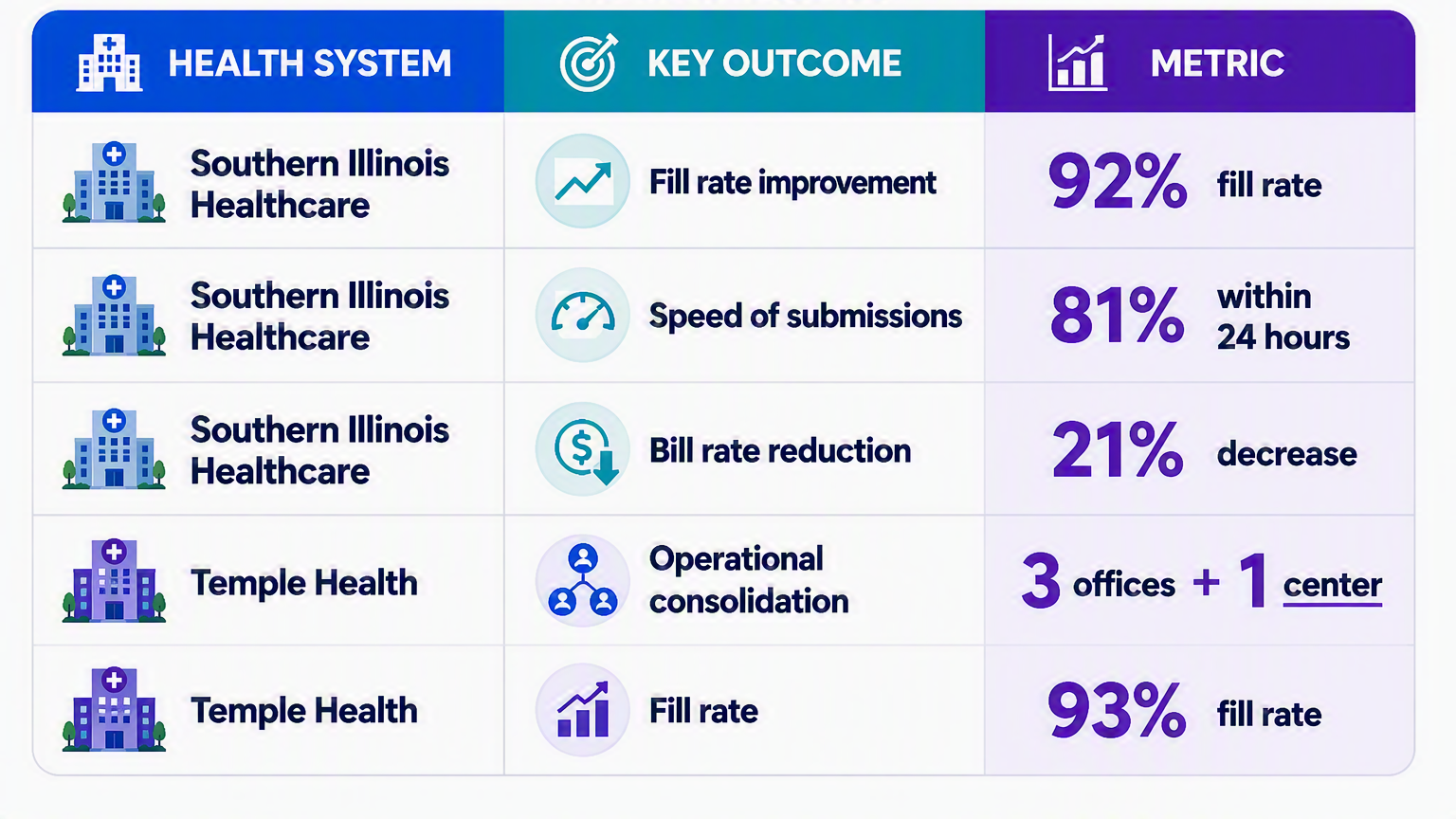
Platform capabilities only matter if they produce measurable results. Two published case studies illustrate the impact WorkWise delivers in practice.
Southern Illinois Healthcare achieved significant gains after implementing WorkWise:
- 92% fill rate across open positions
- 81% of posted jobs received submissions within 24 hours
- 21% reduction in bill rates, translating directly to labor cost savings
These metrics, documented in the WorkWise case study, demonstrate the combined effect of predictive analytics, internal-first prioritization, and marketplace-driven pricing transparency.
Temple Health used WorkWise insights to restructure its staffing operations, consolidating three separate staffing offices into a single centralized resource management center. The results included an expanded flexible staffing pool, reduced reliance on external staffing agencies, and a 93% fill rate.
Beyond these specific implementations, fair, predictable schedules can support clinician job satisfaction and retention. These outcomes align with the engagement and scheduling capabilities in WorkWise and suggest the platform's impact extends beyond cost metrics to workforce stability and satisfaction, which carry their own financial implications.
Implementation Considerations: Integration, Data Quality, and Change Management
Adopting an AI-powered workforce management platform is not a plug-and-play exercise. Success depends on planning across three critical dimensions.
Integration Scope
To realize end-to-end automation, organizations need connectivity between their HRIS, VMS, scheduling systems, and WorkWise. The platform supports more than 50 integrations, but each health system's existing technology landscape will determine the complexity and timeline of implementation. Legacy systems with limited API support may require middleware or custom configuration. Organizations should audit their current technology stack early and identify integration points, potential gaps, and data mapping requirements before deployment begins.
Data Quality and Governance
Predictive models are only as good as the data they consume. If census data is delayed, schedule information is incomplete, or credential records are outdated, AI forecasts will underperform and staffing leaders will lose trust in the system's recommendations. Establishing data governance protocols before or during implementation is essential. This means defining data ownership, setting quality standards for key inputs, and creating processes for ongoing data hygiene across HRIS, scheduling, and credentialing systems.
Change Management
The human side of AI adoption is often the most challenging. Staffing coordinators accustomed to manual processes need retraining to trust AI recommendations and adopt new workflows. Clinicians need to embrace self-service tools for schedule management. Leadership needs to commit to using platform insights for strategic decision-making rather than defaulting to legacy habits.
Effective change management includes:
- Executive sponsorship and communication. Visible leadership support signals organizational commitment.
- Phased rollout strategies. Starting with a pilot facility or department reduces risk and builds proof points.
- Role-specific training programs. Recruiters, managers, and clinicians each interact with the platform differently and need tailored training.
- Quarterly business reviews. Regular reviews translate platform insights into policy and operational changes, sustaining momentum beyond the initial launch.
Implementation Readiness Checklist
- Audit current technology stack and identify integration points
- Assess data quality across HRIS, scheduling, and credentialing systems
- Define governance roles and data ownership
- Secure executive sponsorship and stakeholder alignment
- Plan phased rollout with clear milestones
- Design training curriculum for all user roles
- Establish KPIs and quarterly review cadence
Organizations that invest in these foundational steps consistently achieve faster time-to-value and stronger adoption rates than those that treat implementation as a purely technical exercise.
Future Trends: The Role of AI in Healthcare Workforce Management
The healthcare staffing industry is at an inflection point. AI is moving from pilot programs to operational infrastructure, and upcoming capabilities will extend current functionality.
Several trends are shaping the next phase of AI-driven workforce management:
- Deeper predictive modeling. Current systems identify gaps. Next-generation models will deliver prescriptive recommendations, suggesting optimal shift structures, recommending market-rate benchmarks for specific roles and geographies, and modeling the financial impact of different staffing scenarios before decisions are made.
- Clinician-centric self-service. The workforce engagement dimension will continue to expand, giving clinicians greater control over their schedules, preferences, and career development through AI-powered tools. Platforms that treat clinicians as people, not just resources to be deployed, will hold a retention advantage.
- Real-time labor market intelligence. AI will increasingly monitor external labor market conditions—supply and demand dynamics, rate trends, and competitor activity—and adjust sourcing strategies dynamically. This turns workforce planning from an internal exercise into a market-aware strategic function.
- Unified workforce ecosystems. The convergence of recruitment, scheduling, credentialing, engagement, and analytics into single platforms is already underway. WorkWise embodies this unified approach today, with an AI-led data platform that connects information across channels and applications. As the industry matures, fragmented point solutions will become increasingly difficult to justify.
Health systems that invest in AI workforce technology now will be better positioned to navigate ongoing labor shortages, changing regulatory requirements, and the broader shift toward value-based care models that require efficient, high-quality staffing.
Request Demo
Frequently Asked Questions About WorkWise and AI-Powered Healthcare Staffing
What Benefits Can AI Bring to Healthcare Staffing Management?
AI brings predictive demand forecasting, automated schedule optimization, reduced administrative overhead, and data-driven decision-making to healthcare staffing. These capabilities help organizations fill positions faster, lower labor costs, and improve clinician satisfaction through balanced workloads and proactive planning instead of reactive crisis management.
How Does WorkWise Prioritize Internal Talent Before External Staffing?
WorkWise uses prioritization logic that surfaces core staff availability first, then routes unfilled needs to internal float pools and agency clinicians before escalating to external per diem or travel labor. This layered approach helps health systems control costs while maintaining high fill rates, ensuring that the most cost-effective labor sources are used before premium-rate external channels.
What Role Does Predictive Analytics Play in Reducing Staffing Gaps?
Predictive analytics uses historical and real-time data to forecast future staffing demand, giving healthcare leaders early visibility into emerging gaps. This enables proactive adjustments—activating internal pools, adjusting schedules, and beginning external sourcing days or weeks before shortages would otherwise become crises.
How Does WorkWise Support Healthcare Compliance and Data Security?
WorkWise provides built-in credential tracking and compliance visibility across both internal and contingent staff, with automated expiration alerts and audit-ready reporting. The platform is SOC 2 Type 2 certified, meaning an independent auditor has verified that it meets ongoing standards for security, availability, confidentiality, and privacy, which is essential for organizations handling sensitive healthcare workforce data.
What Should Organizations Consider When Adopting AI Workforce Management?
Key considerations include integration scope with existing HRIS, VMS, and scheduling systems; data quality and governance to ensure accurate AI predictions; change management strategies to build staff trust in AI recommendations; and clear KPIs with regular review cadences to sustain gains and continuously improve workforce operations.